

 Newsletter

Almost every Indian knows the story of Abhimanyu.
During the Mahabharata, the Kauravas formed the Chakravyuha, one of the most complex battle formations described in the epic. As the story goes, Abhimanyu overheard his father, Arjuna, explaining how to enter the Chakravyuha while he was still in Subhadra's womb. Before Arjuna could explain how to break out of it, the conversation ended.
Years later, on the battlefield of Kurukshetra, Abhimanyu entered the formation knowing only half the strategy. He fought with extraordinary courage, but without understanding the exit, he was eventually surrounded and killed.
Whether one interprets the story literally or symbolically is almost beside the point. The analogy to investing is difficult to ignore. Most investors devote years to learning how to enter a position, but comparatively spend very little time thinking about the circumstances under which they should leave it.
To be fair, you can't really blame them.

Financial literature has historically been biased towards buying. Books, courses and research are overwhelmingly devoted to identifying attractive businesses, estimating intrinsic value, understanding competitive advantages and constructing portfolios.
Comparatively little attention has been paid to developing structured frameworks around selling. The thinking has often been: if you buy well, selling will take care of itself.
Experience suggests otherwise.
Buying and selling may appear to be opposite sides of the same decision, but they demand very different forms of judgement. When an investor initiates a position, the analysis is relatively clean. The investment thesis has just been formed, capital has not yet been committed and the decision is based almost entirely on expectations about the future.
Selling rarely enjoys that luxury.

By the time an exit is being considered, the investor has accumulated months or years of information, multiple earnings seasons, management commentary, price movements and, inevitably, an emotional relationship with the investment.
The original thesis is no longer evaluated in isolation; it is filtered through gains, losses, conviction and hindsight. The question shifts from 'Is this still the best use of my capital?' to 'Am I making a mistake by selling?'
Behavioural finance has spent decades explaining why selling is consistently more difficult than buying. Investors anchor themselves to their purchase price, hesitate to realise losses, hold on to losing positions in the hope of getting back to even and often sell winners simply to crystallise the satisfaction of being right.
Hersh Shefrin and Meir Statman described this tendency in 1985, calling it the disposition effect. Terrance Odean's later work, drawing on actual brokerage account data, showed just how expensive these habits can become in practice.
That part is relatively well understood.
The more interesting question is whether improving the quality of selling decisions actually translates into better investment outcomes.
A 2022 paper titled Fund Manager Skills: Selling Matters More attempted to answer precisely that. Studying 5,661 actively managed U.S. equity funds over a sixteen-year period, Tosun and his co-authors found that superior managers were distinguished less by their ability to identify attractive investments and more by the quality of their selling decisions.
Managers who consistently exited positions more effectively generated higher long-term performance than those whose primary strength lay in stock selection.
The finding challenges one of investing's most deeply held assumptions. Alpha is often associated with discovering an overlooked business before everyone else does. The evidence suggests that a meaningful portion of excess returns may instead come from recognising when an existing investment no longer deserves capital.
Identifying opportunities is important. Knowing when to redeploy capital appears to matter just as much.
That imbalance is reflected across the broader investment ecosystem. Brokerage research is overwhelmingly structured around finding opportunities through earnings forecasts, valuation models and target prices. Comparatively little attention is devoted to building systematic frameworks around selling. This is not a criticism of the research process; it is simply a reflection of what the industry has historically prioritised.
Used correctly, research reports are inputs into decision-making. They were never meant to replace it.
The same limitation applies to external opinions more broadly. The 2008 global financial crisis remains the clearest reminder. Complex structured credit products carrying investment-grade ratings collapsed once the assumptions underpinning those ratings proved incorrect.
More recently, Silicon Valley Bank retained favourable ratings until shortly before its failure. These episodes are not arguments against research or credit ratings. They simply illustrate that every analytical framework is constrained by the information available at a particular point in time. No external assessment can substitute for continuous independent judgement.
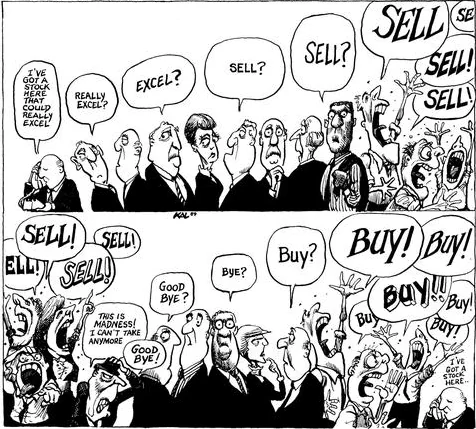
For individual investors, the practical implication is straightforward. Every investment deserves an exit framework before capital is committed. Investors routinely define entry prices, expected returns and downside risks, yet very few articulate the conditions under which the original thesis would be considered invalid. An exit framework does not require predicting future prices.
Perhaps the most important distinction is that selling should be driven by the evolution of the investment thesis rather than the movement of the share price. Markets fluctuate continuously, often for reasons that have little to do with underlying business fundamentals.
The relevant question is not whether the stock has gone up or down, but whether the reasons for owning it remain valid. If the thesis has strengthened, a higher price may still represent an attractive investment. Conversely, if the thesis has broken, a lower price alone is rarely sufficient justification for continuing to hold the position.
Most investing conversations revolve around what to buy next—the next secular trend, the next great business or the next undervalued company. Those questions matter, but they represent only one half of the investment process. Every position that is opened will eventually have to be closed, whether because the thesis has played out, the underlying facts have changed or capital can be deployed more productively elsewhere.
That is perhaps why Abhimanyu's story has endured for centuries. It is not merely a story about courage, but about the consequences of mastering only half a strategy. Markets demand the same completeness. Learning how to enter a position is essential. Learning when and why to leave it is what ultimately transforms good analysis into good investing.
Disclaimer: This article is intended solely for educational and informational purposes. It does not constitute investment advice, a recommendation, or an offer to buy or sell any security. The examples and research discussed are illustrative and may not apply to every investor or market situation. Readers should conduct their own research and consult a SEBI-registered investment adviser before making investment decisions.