

 Newsletter
Not all states contribute equally to India's tax kitty. Some generate several times more direct tax than others. But that's not because their residents pay higher tax rates.
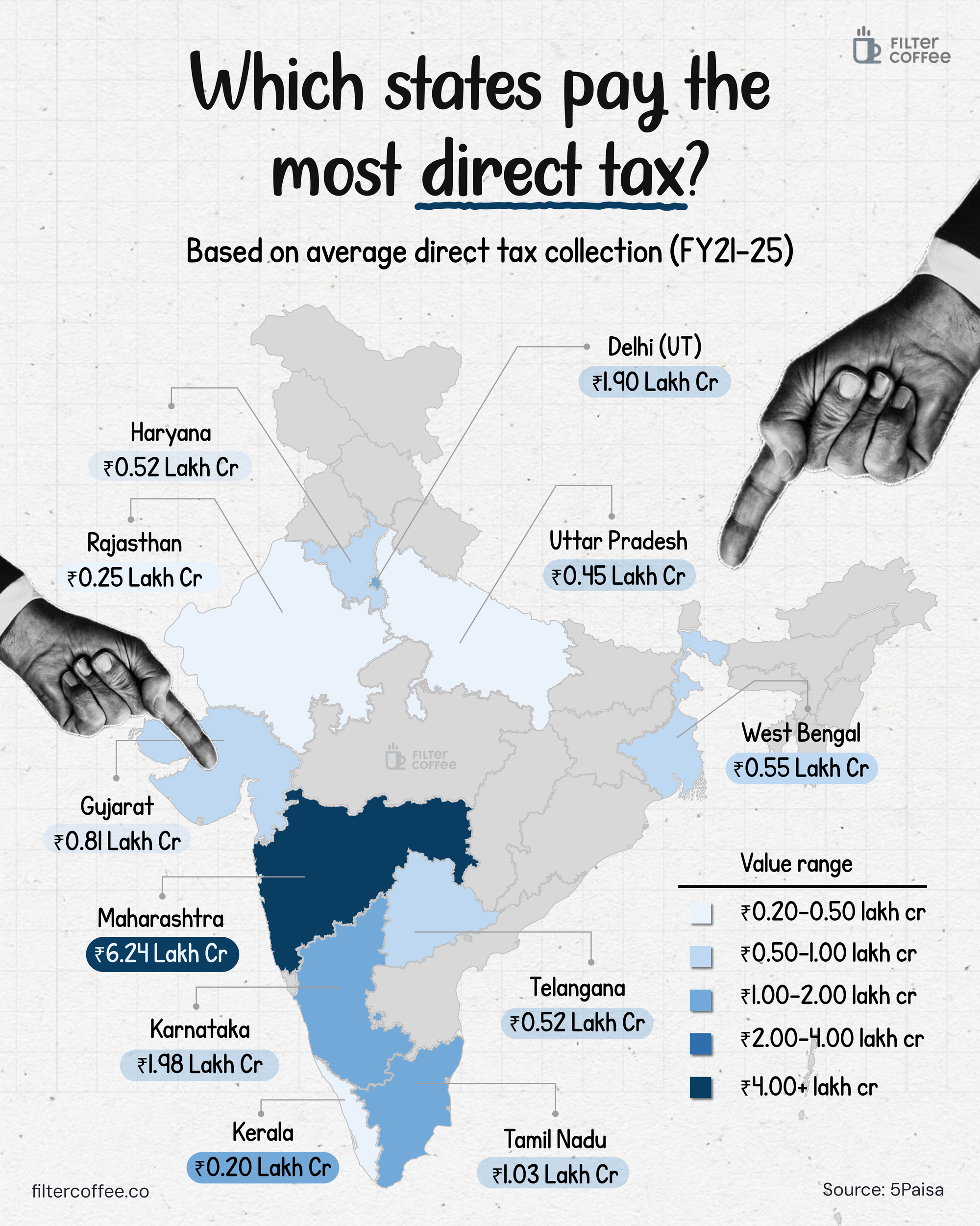
It's because of where India's biggest companies, financial institutions and high-paying jobs are based. Between FY21 and FY25, Maharashtra collected an average ₹6.24 lakh crore in direct taxes, comfortably ahead of Karnataka (₹1.98 lakh crore), Delhi (₹1.90 lakh crore) and Tamil Nadu (₹1.03 lakh crore). The gap is enormous, but it isn't accidental.
Mumbai is India's financial capital. It's home to the headquarters of several of the country's largest listed companies, banks, insurers, financial institutions and multinational corporations.
So when these companies report profits or employees earn high salaries, a significant portion of those taxes gets recorded in Maharashtra.
The states that follow tell a similar story.
Karnataka benefits from Bengaluru's thriving technology ecosystem. Delhi houses the headquarters of several large businesses, government-linked entities and professional services firms. Tamil Nadu's strong manufacturing and industrial base also contributes significantly to the country's tax collections.
But this isn't just a snapshot of where India's economy stands today. It also hints at where it's headed.
By mid-July 2026, India's net direct tax collections had already crossed ₹6.5 lakh crore, growing over 16% compared to the same period last year. Advance tax collections, often considered an early indicator of corporate profitability and high-income earnings, also rose by more than 15%, signalling continued growth in both businesses and individual incomes.
There's another interesting trend unfolding beneath the surface.
A few years ago, corporate taxes accounted for the largest share of India's direct tax collections. Today, personal income tax and other non-corporate taxes contribute even more. That usually reflects an economy that's becoming increasingly formal, with more salaried employees, professionals and small businesses entering the tax net.
Of course, higher tax collections don't necessarily mean all the economic activity happens within those states. A company may operate factories, offices and warehouses across India but pay taxes from its registered headquarters in Mumbai or Bengaluru. And once these taxes are collected, they don't stay with the state.
They flow to the Centre, which redistributes a share to states through the Finance Commission's formula. So this isn't really a leaderboard. It's a map of where India's organised economy is concentrated today.
As more companies expand beyond traditional business hubs, more Indians move into formal employment and incomes continue to rise, this map will gradually evolve.
And every additional taxpayer represents more than just higher government revenue, it reflects an economy that's creating better jobs, stronger businesses and a broader foundation for long-term growth.