

 Newsletter

At first glance, corporate tax looks like just another percentage on a government website. But in reality, it's one of the most powerful economic tools a country has.
Every percentage point can influence where companies invest, where factories are built, where jobs are created and how much capital flows into an economy.
That's why governments don't simply decide tax rates based on how much revenue they want, they also think about how competitive they want to be. A comparison of corporate tax rates across major economies tells an interesting story.
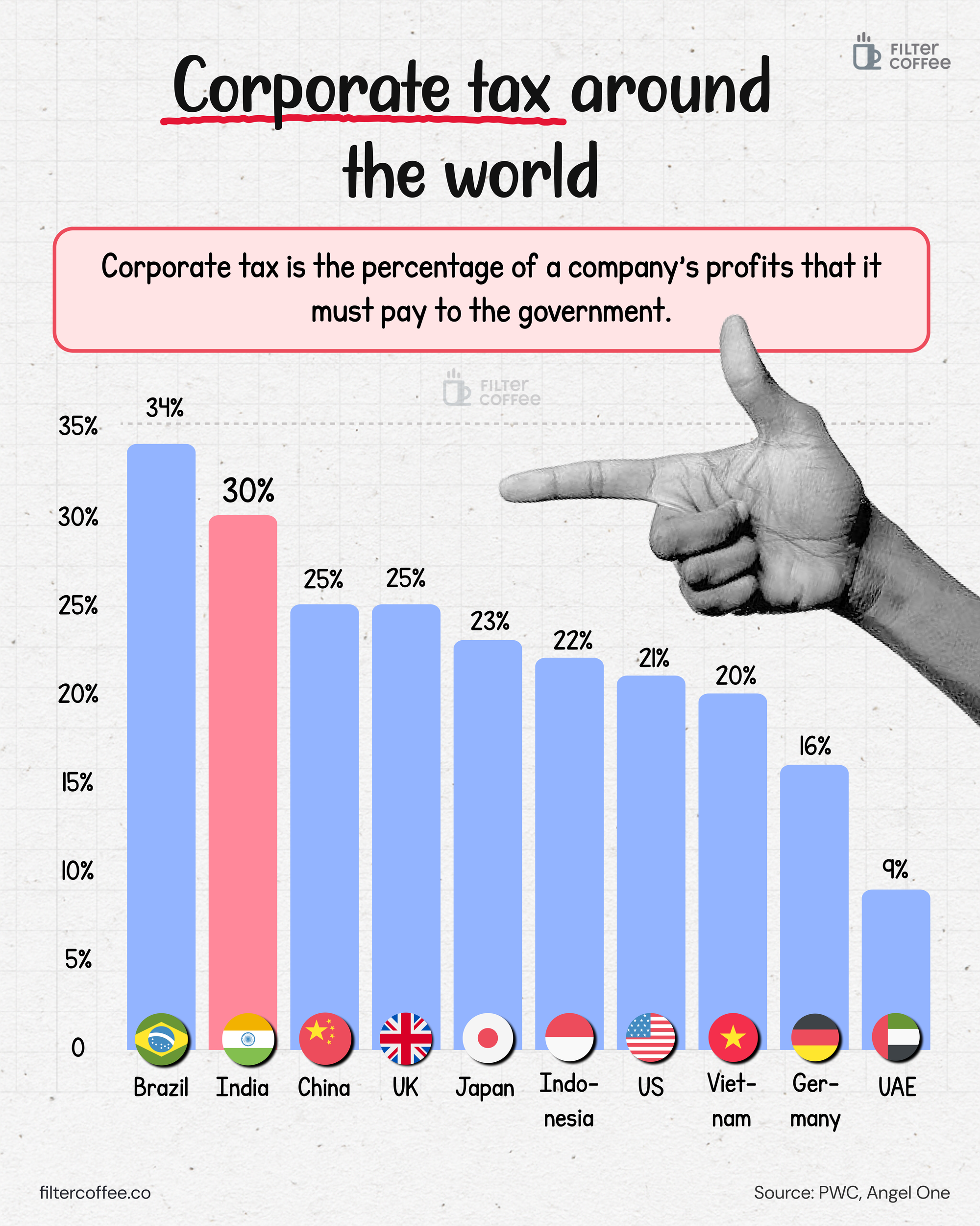
The UAE taxes corporate profits at 9%, Vietnam at 20%, the US at 21%, while Germany, Japan, India and Brazil are closer to the 30-34% range. At first glance, you might assume that countries with lower taxes automatically attract more businesses.
But if that were true, every multinational would simply move to the country with the lowest tax rate. That doesn't happen. When companies decide where to invest billions of dollars, tax is only one part of the equation.
They also look at infrastructure, logistics, political stability, skilled labour, regulations, access to suppliers and the size of the consumer market. A lower tax bill may improve returns, but it cannot replace reliable roads, efficient ports or a stable policy environment.
This is where governments face a constant balancing act. Lower taxes can encourage investment and improve business confidence. But they also reduce government revenue, money that's needed to build highways, airports, railways, power networks and digital infrastructure. Ironically, these are the very things companies look for before making long-term investments.
In other words, countries aren't just competing on tax rates. They're competing on the overall business environment. India offers a good example of this shift.
Although the country's headline corporate tax rate appears relatively high in global comparisons, the government cut the base rate to 22% for domestic companies opting into the new regime in 2019 and 15% for eligible new manufacturing companies.
Since then, tax reforms have been complemented by Production Linked Incentive (PLI) schemes, record infrastructure spending and policies aimed at positioning India as a global manufacturing hub. The strategy reflects a broader global trend.
Governments today are trying to attract not just companies, but long-term capital. A new factory doesn't just create jobs. It builds supplier networks, increases exports, drives consumption and generates tax revenue for years to come.
For investors, this matters just as much as it does for policymakers. A lower corporate tax rate can improve company earnings, but a strong economy depends on far more than one number.