
 Newsletter

A passport is more than just a travel document. It quietly determines how easily you can cross borders, how much paperwork you'll need and, in many ways, how the world views your country.
That's why the latest passport mobility rankings are worth paying attention to.
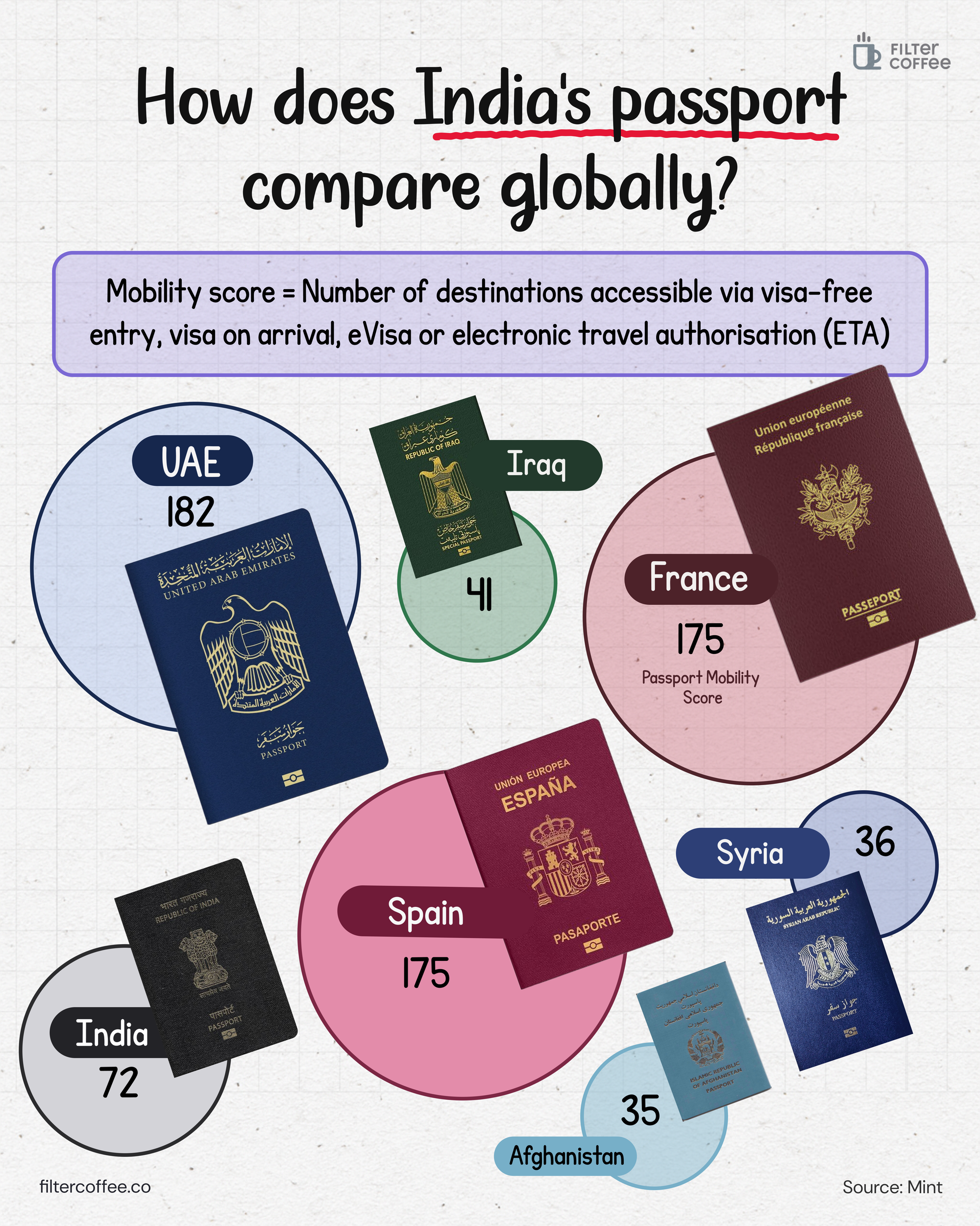
India's passport currently has a mobility score of 72, meaning Indians can travel to 72 destinations through visa-free entry, visa-on-arrival, eVisas or electronic travel authorisations (ETA).
That's well behind the UAE (182) and France and Spain (175), but ahead of countries like Iraq (41), Syria (36) and Afghanistan (35).
At first glance, it may seem like a simple travel ranking. But it actually reflects something much bigger than tourism.
Every visa waiver is the outcome of years of diplomacy, security cooperation and reciprocal agreements between governments. Countries with stronger diplomatic relationships, lower immigration risks and greater international trust typically enjoy better passport access.
The UAE is a good example. Over the past two decades, it has aggressively signed bilateral agreements across the world, transforming one of the region's weakest passports into one of the strongest.
India's position is a little more complicated.
The infographic uses a mobility score, which counts visa-free travel, visa-on-arrival, eVisas and electronic travel authorisations. Other rankings, such as the Henley Passport Index, use a different methodology and therefore rank India differently. That's why passport rankings often vary depending on who's measuring them.
The encouraging part is that India's global mobility has gradually improved over the years as more countries have introduced eVisas and simplified entry rules for Indian travellers.
But the gap with the world's strongest passports remains significant.
Closing that gap won't simply depend on economic growth. It will require stronger diplomatic ties, more reciprocal visa agreements and greater trust between governments. In other words, a stronger passport isn't something a country can buy overnight. It's built through years of foreign policy, international cooperation and credibility.
So the next time you tuck your passport into your bag before a holiday, remember that little navy-blue booklet represents far more than your identity.
It also reflects your country's place in the world.