
 Newsletter


India's state-owned National Aluminium Company (NALCO) has signed an agreement with Russian aluminium producer RUSAL to explore extracting scandium, a valuable metal used in aerospace and defence equipment, from industrial waste.
The agreement, signed on 17 November 2026, is still at the technology evaluation stage. But it raises an interesting possibility. India produces millions of tonnes of waste while making aluminium, and some of that waste contains minerals that industries are willing to pay for.
In fact, an earlier Ministry of Mines estimate put India's annual production of this waste at around 90 lakh tonnes.
So, what exactly is sitting inside all that waste, and why haven't we recovered it already?
First, a little about how aluminium is made.
Aluminium begins as bauxite, a reddish-brown ore extracted from the ground. Refineries process bauxite using a chemical solution to separate alumina, a white powder that is eventually converted into aluminium metal.
But the process leaves behind a thick, reddish, highly alkaline residue called red mud.
For every tonne of alumina produced, refineries typically generate around one to two tonnes of red mud. And because it can contain leftover caustic chemicals, companies cannot simply dump it anywhere. They need designated storage areas, treatment systems and long-term monitoring to prevent contamination.
For aluminium producers, that means spending money to manage something they cannot easily sell.
However, red mud also contains useful materials such as iron, titanium, aluminium compounds and small quantities of rare earth elements.
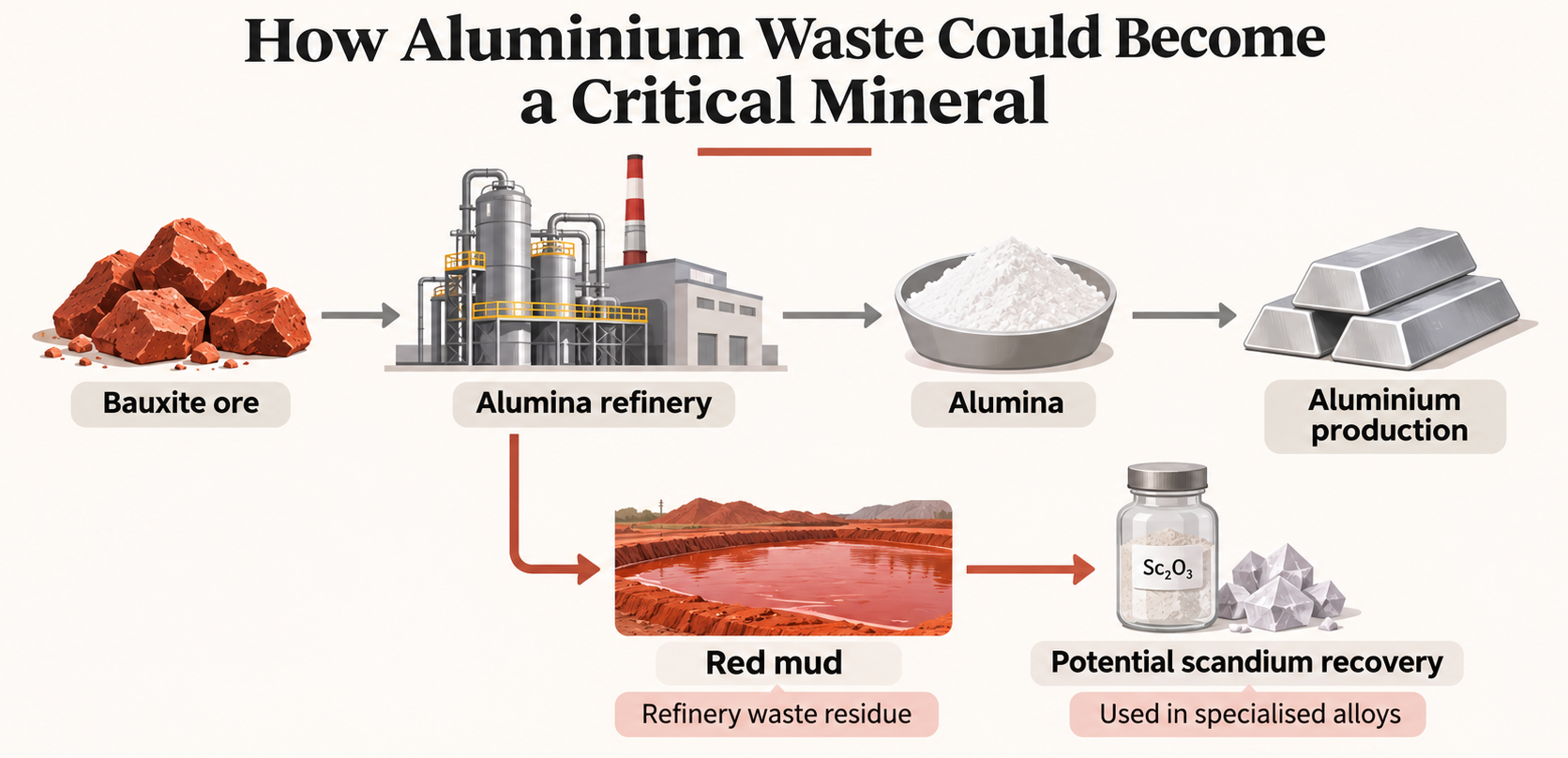
One of them is scandium.
Scandium is a rare earth metal that can make aluminium alloys stronger while keeping them lightweight. That makes it useful in specialised aircraft components, military equipment and other high-performance applications. Scandium compounds are also used in certain fuel cells that generate electricity.
And it is expensive.
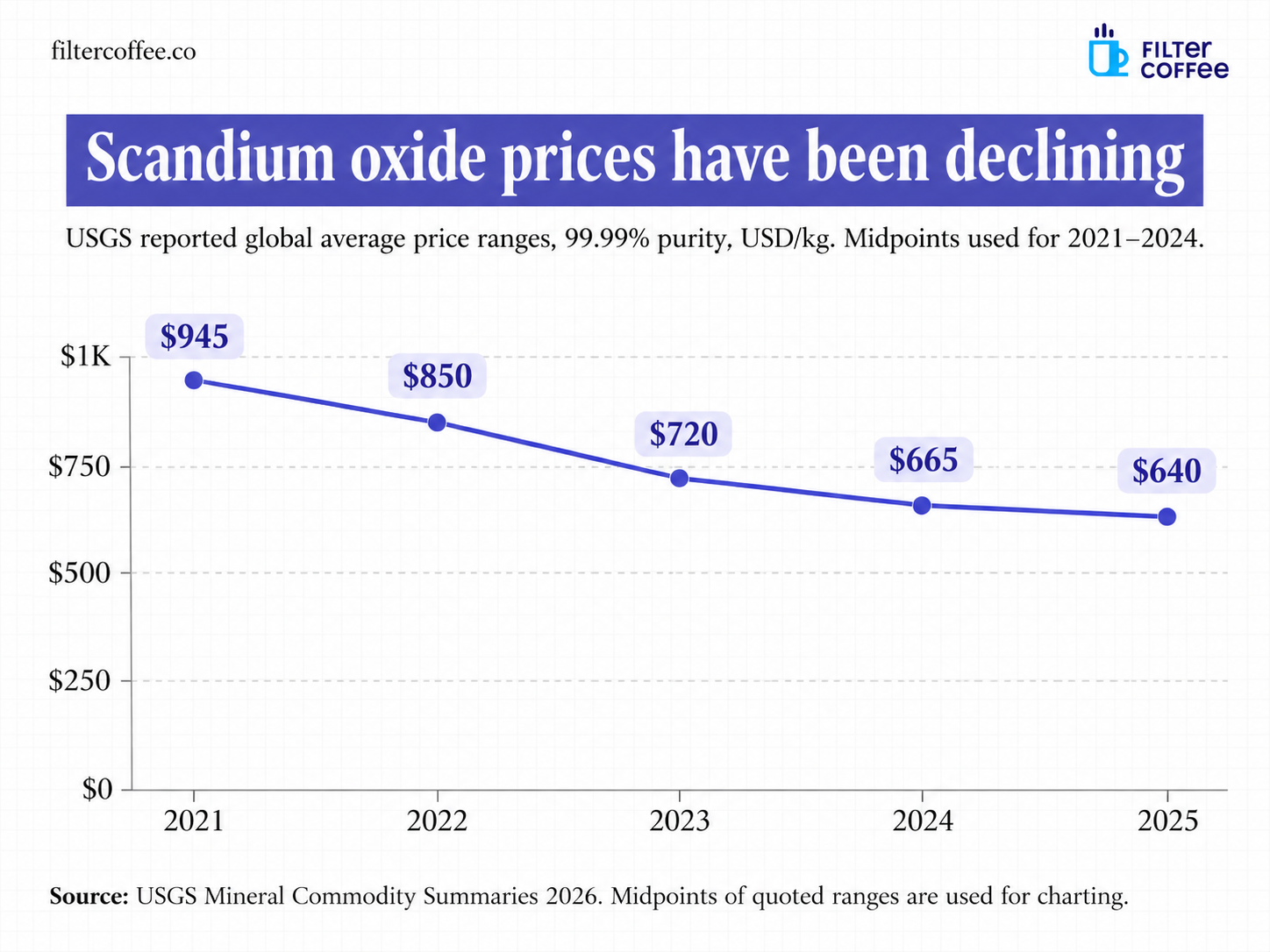
According to the US Geological Survey's 2026 report, high-purity scandium oxide averaged around $640 per kilogram in 2025, while refined scandium metal was priced at approximately $5,200 per kilogram.
The global market is also remarkably small. The USGS estimated that worldwide scandium oxide production reached roughly 80 tonnes in 2025.
So, recovering even small amounts could potentially create an additional source of revenue for an aluminium refinery. But extracting scandium isn't as easy as collecting valuable metal from a pile of waste.
Scandium is usually present in extremely low concentrations, mixed with much larger quantities of iron and other compounds. Refineries need specialised chemical processes to separate, purify and recover it. Those processes require equipment, energy and reagents, all of which cost money.
This is where Russia's RUSAL enters the picture.
In February 2025, RUSAL announced a pilot facility designed to recover 1,550 kilograms of scandium oxide annually from red mud at its Bogoslovsky aluminium plant.
The facility was scheduled to begin operating by the end of 2025, although its subsequent production performance has not been independently established here.And even its proposed capacity reveals how challenging this business can be.
At the 2025 benchmark price of $640 per kilogram, selling all 1,550 kilograms would generate approximately $992,000 in annual revenue, before accounting for processing costs and other expenses.
For a large aluminium company, that's hardly a fortune. The economics could improve if several valuable materials were recovered together, but the technology would still have to prove itself commercially.
NALCO has already been exploring that possibility.
Its FY2025-26 annual report reveals that the company participated in a NITI Aayog-backed project to recover alumina, iron, titanium oxide and rare earth elements from red mud.
In January 2026, it also signed an agreement with the National Metallurgical Laboratory in Jamshedpur to explore recovering metals such as scandium. Separately, NALCO has been developing a 30-tonne-per-day pilot facility to manufacture construction bricks from red mud.
The new RUSAL partnership adds another technological option to these efforts.
There is also a wider reason for India to pursue such projects. Critical minerals are increasingly important for advanced manufacturing, clean energy and defence industries. Recovering them from existing industrial waste could create an additional domestic supply without requiring a new mine.
But commercial viability remains unproven. NALCO and RUSAL have not announced how much scandium can be recovered, what the extraction process would cost or when an Indian facility might begin operating.
Even successful scandium recovery would leave most of the original red mud to be managed.
The opportunity, therefore, depends on recovering enough valuable material to justify the processing costs, while finding productive uses for the remaining residue.
India already produces the waste. Whether it can turn that waste into a commercially useful source of critical minerals will depend on what these trials actually deliver.
Sources