

 Newsletter

India’s biggest infrastructure success story might be hiding in your kitchen tap
When the Union Cabinet recently decided to extend the Jal Jeevan Mission (JJM) until 2028 and nearly doubled down on funding, it was an acknowledgment that one of India’s largest infrastructure projects is entering a completely new phase.
The numbers alone are staggering.
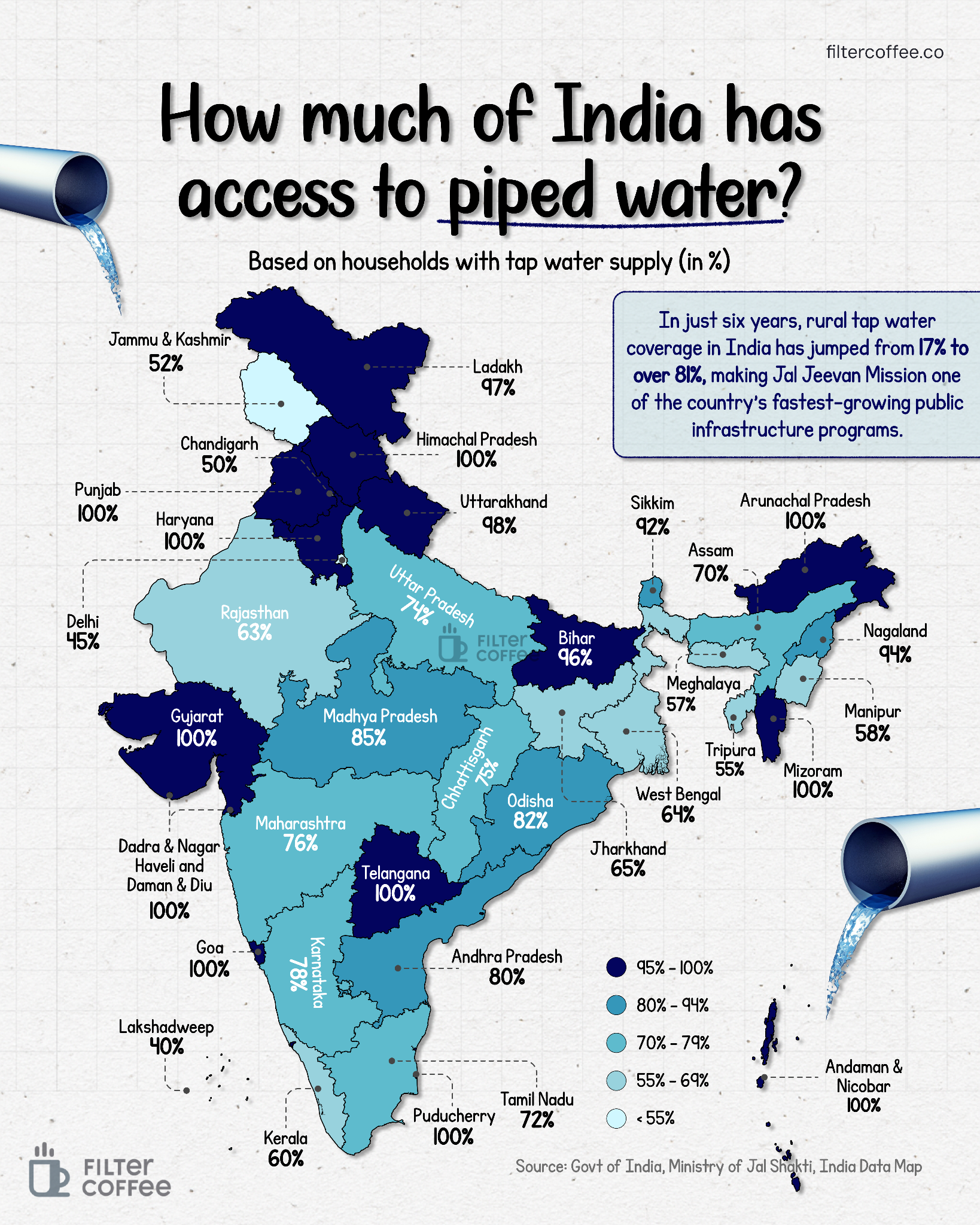
In August 2019, only about 3.2 crore rural households in India had a tap water connection. That translated to roughly 17% coverage. For hundreds of millions of people, fetching water from wells, hand pumps, ponds, rivers, or community taps was simply part of daily life.
Fast forward to 2026, and that number has jumped to nearly 15.8 crore rural households, covering more than 81% of rural India. In just six years, India has added tap water access to over 12 crore households. That's roughly equivalent to providing piped water connections to a population larger than the entire United States.
And yet, despite this remarkable progress, the real story isn't about pipes anymore. It's about what comes out of them.
To understand why, we need to step back.
For decades, India's water challenge was largely treated as an infrastructure problem. Build dams. Lay pipelines. Dig borewells. Install pumps. The assumption was simple: if water infrastructure exists, people will get water.
But reality turned out to be messier.
Many villages technically had water schemes, but supply was irregular. Some households received water only a few days a week. Others got water for just an hour or two. In some regions, groundwater depletion made existing systems unreliable. In others, water quality became the bigger concern, with contamination from fluoride, arsenic, iron, nitrates and bacteria affecting millions.
This is why the Jal Jeevan Mission became different from earlier programmes.
Instead of measuring success through kilometres of pipelines laid or projects sanctioned, the mission focused on something tangible: a Functional Household Tap Connection.
The results have been dramatic. States like Gujarat, Telangana, Haryana, Punjab, Goa and Himachal Pradesh have reported near-universal rural tap water coverage. Several northeastern states have also made rapid gains despite difficult terrain. India has effectively built one of the world's largest rural water distribution networks in record time.
But hitting 100% coverage on paper and delivering water every day are two very different achievements.
That's precisely why the government's next phase, often referred to as JJM 2.0, looks very different. The focus is shifting from construction to sustainability. Can villages maintain these systems? Can local bodies collect user charges? Can water quality be monitored continuously? Can supply remain reliable during droughts and heatwaves? And perhaps most importantly, where will the water come from as climate pressures intensify?
Because India's water challenge has never been just about access.
India has nearly 18% of the world's population but only around 4% of global freshwater resources. Per capita water availability has been steadily declining for decades. Several regions already face groundwater stress, while climate change is making rainfall patterns increasingly unpredictable.
In that context, the Jal Jeevan Mission represents something much bigger than a plumbing project. It is an attempt to fundamentally change how rural India accesses one of life's most basic necessities.
The first chapter was about building the tap.
The second chapter, and arguably the harder one, is ensuring that when someone turns that tap on tomorrow, next year, or ten years from now, clean water still flows out of it.