

 Newsletter

Domestic investors are quietly changing who controls the Indian stock market.
As of August 7, 2026, domestic institutional investors, or DIIs, had already put a net ₹5.13 lakh crore into Indian equities this year. This is the third consecutive calendar year in which their net investment has crossed ₹5 lakh crore. At the same point last year, the figure was ₹4.48 lakh crore, while total DII buying eventually reached ₹7.88 lakh crore in 2025.
But the bigger number is what has happened over the last three years.
Since August 2023, DIIs have invested a net ₹19.21 lakh crore in Indian equities. During roughly the same period, foreign portfolio investors, or FPIs, sold around ₹10 lakh crore worth of Indian stocks.
In simple terms, a huge amount of foreign money left India, but an even larger pool of domestic money kept coming in. That helps explain why repeated bouts of foreign selling have not shaken Indian markets as badly as they might have a decade ago.

To understand why this matters, we first need to understand who these domestic investors actually are. DIIs include Indian mutual funds, insurance companies, banks, pension funds and other large domestic financial institutions.
Much of the money they invest ultimately comes from ordinary Indians through SIPs, insurance premiums, retirement contributions and other savings products. So when we say DIIs are buying stocks, a significant part of that money can eventually be traced back to Indian households putting away a portion of their salaries every month.
That flow has become increasingly regular. According to SEBI data, DIIs were net buyers of Indian equities in every single month during FY25 and FY26, purchasing a net ₹10.44 lakh crore worth of stocks over those two financial years. Even when markets were under pressure, the money continued arriving.
Indian markets traditionally paid enormous attention to what foreign institutional investors were doing. When FIIs entered India aggressively, markets benefited from the additional liquidity. When they pulled money out because US interest rates were rising, the dollar was strengthening or global investors suddenly became risk-averse, Indian markets could feel the pressure almost immediately.
That relationship has not disappeared, but the balance of power is changing. India's SIP boom becomes crucial.
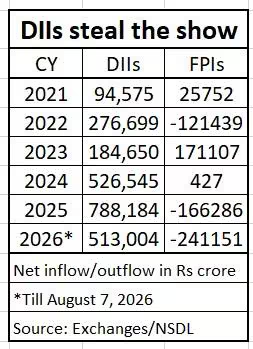
Image credit: Business Standard
A SIP allows investors to automatically invest a fixed amount into a mutual fund every month. Someone investing ₹5,000 does not need to decide whether the Nifty looks expensive on Monday or whether foreign investors might sell on Friday. The money gets invested according to schedule. Multiply that behaviour across millions of investors and mutual funds receive a recurring pool of capital that eventually needs to be deployed.
Insurance and retirement savings work in a similar direction. Premiums continue to arrive at insurance companies, while pension contributions flow into schemes such as NPS and other retirement vehicles. This makes part of DII buying less dependent on whether fund managers suddenly feel optimistic about the market. The underlying savings continue coming in, creating a steady source of domestic capital.
You can see the effect during periods of foreign selling. In Q2 2026 alone, DIIs invested about $22.8 billion in Indian equities, while FIIs withdrew about $13.2 billion. Foreign flows were volatile enough to swing from $4.3 billion of selling in the first half of June to $1.3 billion of buying in the second half. Domestic institutions did not need the same change in global mood to continue investing.
The money is also changing ownership inside individual companies. There were also substantial increases in institutional ownership in companies such as Eternal, Paytm, Aptus Value Housing Finance and Cyient.
Some of this buying reflects active investment decisions, while some is linked to passive money following benchmark indices as companies enter or gain weight in major indices.
At the very top, domestic portfolios remain concentrated in familiar Indian giants. In the June 2026 quarter, the five largest DII holdings by value were HDFC Bank at $47.2 billion, ICICI Bank at $44.3 billion, Reliance Industries at $38.9 billion, ITC at $27.4 billion and State Bank of India at $26.5 billion. Together, these five companies accounted for roughly 20% of the total value of DII holdings.
None of this means foreign investors have stopped mattering. India still competes with other emerging markets for global capital, and foreign investors remain sensitive to US bond yields, the ₹-$ exchange rate, Indian valuations, corporate earnings and opportunities elsewhere. If FIIs sell aggressively, markets can still fall.

What has changed is India's ability to absorb those movements.
For years, Indian households stored a large portion of their wealth in property, gold, bank deposits and other physical or fixed-income assets. As more savings move towards mutual funds, pensions and market-linked products, those households are indirectly becoming much larger owners of Indian companies.
That creates an interesting new structure for the market. Foreign investors can still influence how quickly markets move, especially during global shocks, but they are increasingly dealing with a large domestic pool of money on the other side of the trade. When foreigners sell, Indian institutions now have considerably more firepower to buy.
There are risks to this shift too. Consistent domestic inflows do not guarantee consistent returns, and large amounts of money entering equities can support expensive valuations if corporate earnings fail to keep pace. Retail investors may also behave differently during a prolonged bear market than they have during shorter corrections, so the resilience of SIP flows has not been tested against every possible scenario.
Still, India has spent years worrying about what happens when foreign investors pressed the sell button. Today, those investors remain important, but they are no longer the only heavyweight in the room.