

 Newsletter
HCLTech gave investors something to cheer about on Monday. Its quarterly profit jumped 21%, AI revenue grew 78%, and the company announced one of its strongest quarters for new deal wins. By Tuesday morning, its shares had surged over 4%, making it one of the top gainers on the Nifty 50.
Not bad for a company whose stock had fallen more than 22% since the beginning of 2026.
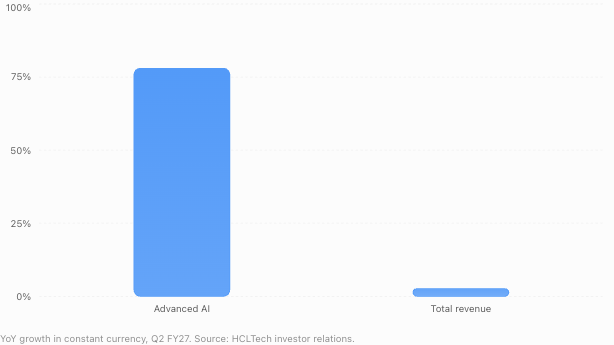
But there's a catch. While HCLTech's AI business is growing at an impressive pace, its overall revenue is moving much more slowly. And that difference tells us quite a bit about where India's third-largest IT services company stands today.
First, the report card
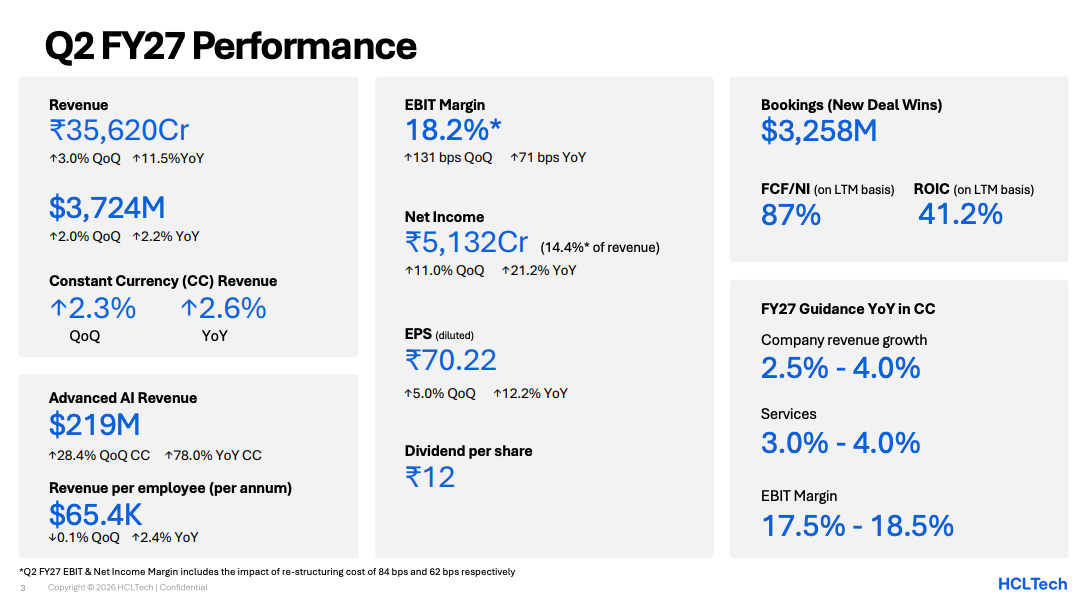
HCLTech reported revenue of ₹35,620 crore for the July–September quarter, up 11.5% from last year. Net profit rose 21.2% to ₹5,132 crore, beating analysts' expectations of roughly ₹4,856 crore.
The company's operating margin also improved to 18.2%, from around 16.9% in the previous quarter. In simple terms, HCLTech is keeping more of what it earns after covering its operating expenses.
But there's an important distinction in those revenue figures.
While revenue grew 11.5% in rupee terms, it increased only 2.6% in constant currency, which removes the impact of exchange-rate movements. Since HCLTech earns much of its revenue overseas, currency movements can make its rupee growth appear stronger than the underlying business growth.
The good news: HCLTech secured $3.26 billion worth of new deals during the quarter, up 27% year-on-year. That's a record for the company.
These are contracts that should translate into revenue over time, although the money won't necessarily arrive immediately.
Management has also raised the lower end of its FY27 revenue growth guidance from 1% to 2.5%, while keeping the upper end at 4%. So, the outlook has improved, but nobody is forecasting explosive growth just yet.
Where does HCLTech make its money?
HCLTech's business goes back to 1976, when Shiv Nadar founded HCL with a group of engineers. The company began with computing hardware before expanding into software and IT services. Over the decades, it became one of India's largest technology exporters, helping global companies manage everything from banking systems to cloud infrastructure.
Today, its business has three major parts.
IT and Business Services: Its largest division generated ₹26,938 crore this quarter. Think of banks, retailers and manufacturers paying HCLTech to manage software, modernise IT systems and run technology operations.
Engineering and R&D Services: This business earned ₹5,973 crore. It helps companies develop and improve technology-intensive products, including automotive systems, industrial equipment and semiconductor-related solutions.
HCLSoftware: The smaller software-products business generated ₹2,709 crore. Unlike traditional outsourcing, where clients pay for engineers and services, this division sells enterprise software products and subscriptions.

That last business has been a particular concern. While HCLTech's IT and engineering services continued growing, its software business has struggled, dragging down overall performance.
And this is where the AI story becomes relevant.
AI is growing fast. But how big is it really?
HCLTech reported $219 million in advanced-AI revenue during the quarter, up 78% year-on-year in constant currency. That works out to an annualised revenue run rate of $876 million.
It's a substantial business, but it still represents only about 6% of HCLTech's total quarterly revenue.
The company has been expanding its AI capabilities through partnerships with technology providers. Its latest deal is with Anthropic, the company behind Claude. The two will work on AI systems that help businesses automate tasks while maintaining security and human oversight.
Here's how HCLTech makes money from that opportunity.
A global bank might want to use AI to review documents, assist customer-service teams or detect suspicious transactions. But installing an AI model is only the beginning. Someone must connect it to existing systems, protect sensitive customer information, test its reliability and maintain it.
That work creates opportunities for IT services companies like HCLTech.
However, partnerships and deal announcements shouldn't be confused with realised profits. HCLTech has demonstrated that customers are paying for AI services. It still needs to show how much that business can contribute to its earnings over the long term.
AI is coming for IT jobs. So why hire 6,000 freshers?
The company's hiring numbers offer another interesting perspective.
HCLTech added 6,450 employees on a net basis during the quarter, taking its workforce to 2,30,339. It also onboarded 6,136 freshers, compared with just 1,056 in the previous quarter.
For an industry supposedly heading towards mass automation, that's quite a hiring spree.
But the nature of recruitment is changing. Around 15% of its fresher intake belongs to a specialised engineering category being prepared for more advanced technology roles, including AI implementation.
There's a business reason behind this.
Traditional IT outsourcing has largely grown by employing more engineers to deliver more work. AI could allow companies to complete some of those tasks with smaller teams. That may improve productivity and margins, but it could also change how much clients are willing to pay for work that now requires fewer people.
HCLTech's annualised revenue per employee stood at $65,400, up 2.4% year-on-year. It's an early metric worth tracking as automation becomes more common.
They also announced a ₹12-per-share interim dividend, which adds to shareholder returns, although dividends alone cannot compensate for weak earnings growth or a falling stock price.
The bottom line
HCLTech's latest quarter was encouraging. Profits improved, deal bookings reached a record, and AI is becoming a meaningful commercial business rather than simply a promising technology.
But the stock's future depends on how quickly those developments translate into sustained revenue and earnings growth.
The next few quarters should provide clearer answers. Investors will be watching whether HCLTech converts its $3.26 billion deal wins into revenue, maintains operating margins near 18%, and grows AI without putting pressure on its existing services business.
For now, HCLTech has shown that it can make money from AI. The harder task is making that growth large enough to move a company earning more than ₹35,000 crore every quarter.