
 Newsletter

A ₹10 lakh opening is usually enough to push a small Hindi film towards the exit. That nearly happened to Hanuman Ansh.
The devotional film on Neem Karoli Baba released on 7 August with 368 shows across 289 venues. Only about 4,500 tickets were sold on the first day, occupancy stood at 7.8%, and collections came to roughly ₹10 lakh. By the end of its first week, the film had earned just ₹1.07 crore.

For a movie made for roughly ₹1.7-2 crore, this wasn't a disaster yet. The problem was what came next.
Director Vishal Chaturvedi says Hanuman Ansh initially released in around 250 theatres. Within a week, that number had fallen to just 25 as bigger releases took over screens. Its second week brought in only around ₹40-50 lakh more. By every normal box-office rule, the film was fading out.
Only the remaining theatres weren't empty.
By then, word of mouth around the film had begun spreading, especially among Neem Karoli Baba's devotees. But with the film reduced to just 25 theatres, many interested viewers simply had no nearby show to attend. Chaturvedi says some were travelling 200-250 km to watch it. As those limited screenings began filling up, exhibitors saw demand that wasn't being served and started adding shows again.
By the fourth week, Chaturvedi says Hanuman Ansh was running across roughly 1,200 screens. And its collections went slightly bonkers.
After making only about ₹1.5 crore across its first two weeks, Hanuman Ansh collected ₹10.4 crore in week three. On its fourth Friday, it earned ₹6.25 crore. Saturday brought ₹9.25 crore. Sunday brought another ₹12.75 crore.
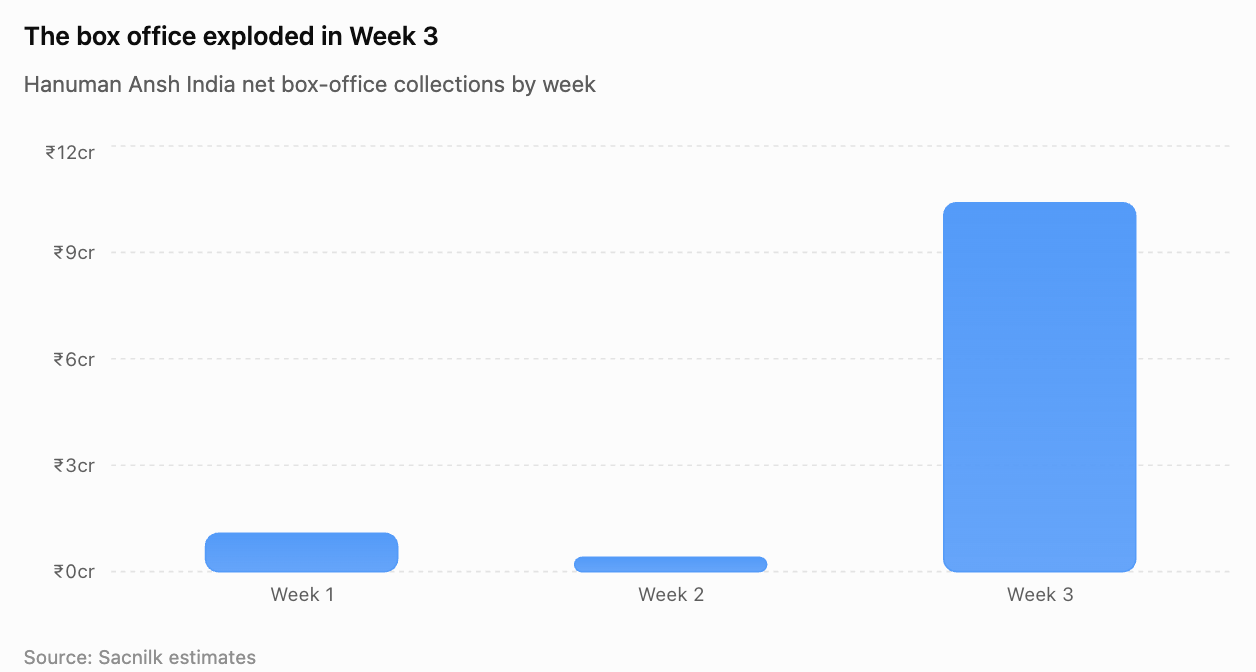
Its fourth Sunday alone earned more than the film had collected during its first three weeks combined.
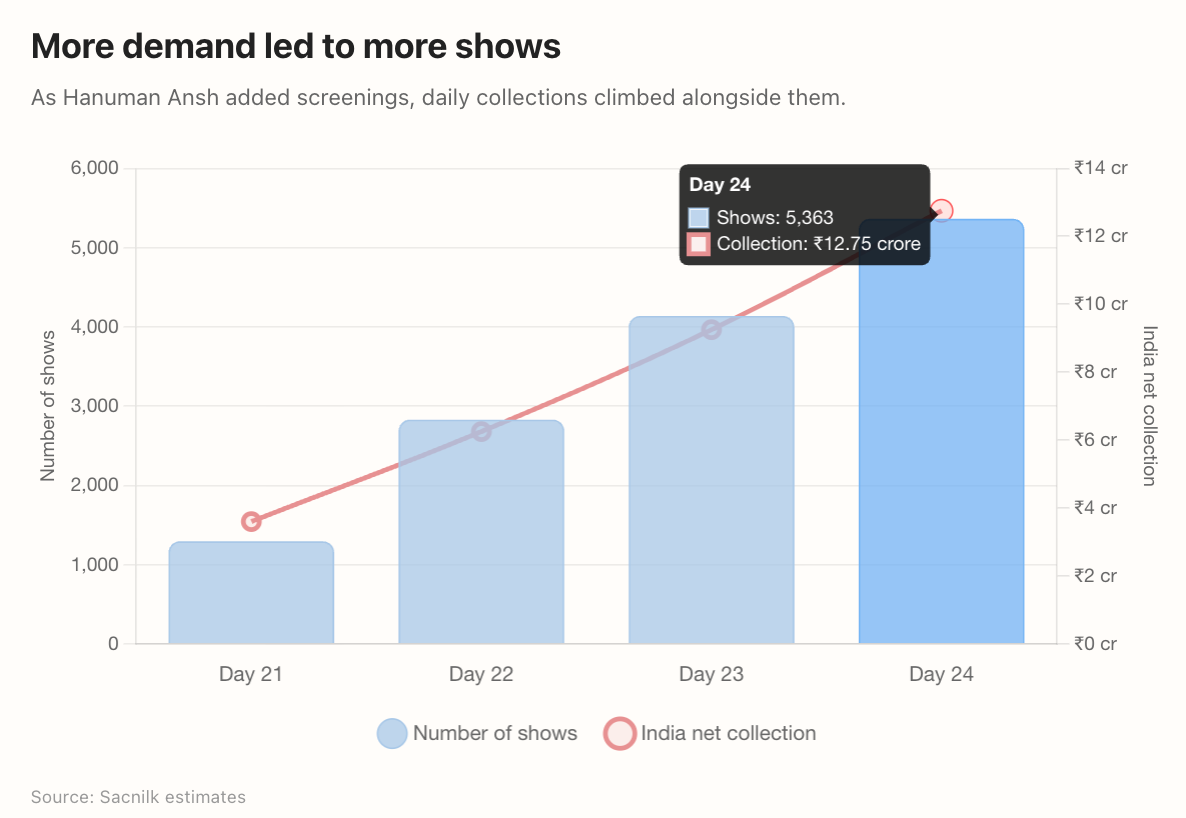
The show count followed the audience. Sacnilk tracked 1,294 shows on day 21. A day later, there were 2,829. By day 23, there were 4,137. On day 24, the film was playing across 5,363 shows.
Basically, Hanuman Ansh did theatrical distribution backwards.
Normally, a Bollywood film tries to arrive as loudly as possible. Producers spend before release on trailers, outdoor ads, interviews, influencer campaigns, city tours and whatever else can drag audiences into cinemas over the first weekend.
Because a multiplex only has so many screens and so many useful time slots. Every new Friday brings another set of films asking for them. Advance bookings, expected demand, distributor strength and actual ticket sales all influence who gets prime shows and who gets pushed to a 10:30 am screening that even the cast's relatives may struggle to attend.
A film that doesn't fill seats loses shows. Those screens can make more money showing something else.
Hanuman Ansh entered this system without much of a conventional marketing machine.
Chaturvedi says the makers simply didn't have the money for a large promotional campaign. Instead, they organised eight bhandaras, using religious gatherings to spread awareness about the movie. Producer Anupriya Nagar has also described a devotee-led campaign that took the film to temples, ashrams and spiritual communities rather than relying heavily on the usual celebrity publicity circuit.
So the movie found its audience in a very different order.
It didn't spend heavily to manufacture one giant opening weekend. It reached a relatively small community already interested in Neem Karoli Baba. Some of those viewers watched the film, recommended it, posted reactions and eventually created demand in places where there weren't enough shows available.
The second weekend captures that mismatch neatly.
Sacnilk estimates occupancy at around 35% on the second Friday, 74% on Saturday and 85% on Sunday. Collections were still tiny because there were so few screenings. Demand was improving before supply caught up.
Once cinemas began adding shows, ticket sales had room to expand.
By 31 August, reported India net collections had crossed ₹40 crore, more than 20 times the film's production budget. You may have seen that translated into claims of “2,000% profit”. That is a little too convenient. Box-office collection isn't producer profit. Cinemas and distributors take their share, and a reported production budget may not capture every distribution or promotional expense.
The economics are still remarkable because Hanuman Ansh began with very little capital at risk.
A ₹100-150 crore movie needs an enormous audience simply to justify what has already been spent. A film costing around ₹2 crore can survive with a much smaller initial audience, provided theatres give it enough time to find one.
And that last bit is usually the problem.
Indian theatrical economics increasingly favour opening weekends. Screens are scarce and new films keep arriving, which means smaller movies often have only days to demonstrate demand. Word of mouth is useful, but word of mouth also needs time.
Hanuman Ansh nearly disappeared from theatres. Its screen count fell from 250 to just 25. But strong occupancy in those remaining shows pushed exhibitors to add screens again. Three weeks after release, the film was entering its strongest phase.
That does not make this a repeatable formula. The film had a recognisable spiritual figure, a loyal faith audience and unusually strong word of mouth. Still, its comeback exposed something Bollywood rarely gets to see: demand being proven after release, not before it.
The audience found the film first. Cinemas followed.