
 Newsletter
For years, Qatar was one of India’s most dependable sources of liquefied natural gas. Now, the US has overtaken Qatar as India’s biggest LNG supplier.
Between May and July 2026, the US shipped 2.19 million tonnes of LNG to India, while Qatar supplied just 0.23 million tonnes. Qatar’s volumes were down a massive 91% from a year earlier. Yet India’s overall LNG imports rose 15% to 7.08 million tonnes.
That tells you something important.
India did not suddenly need less gas. It simply had to find it somewhere else. The problem began in West Asia. Qatar’s LNG facilities were hit during the conflict, while shipping through the Strait of Hormuz was severely disrupted.
Since Qatar’s LNG exports depend heavily on this route, supplies to countries including India were thrown into uncertainty. QatarEnergy subsequently halted production and declared force majeure on some contracts.
India had little choice but to look elsewhere. Natural gas consumption reached 197 million standard cubic metres a day in June, while LNG consumption climbed to 110 mmscmd. And because domestic gas production cannot meet the country’s requirements, India’s import dependence stood at 56%.
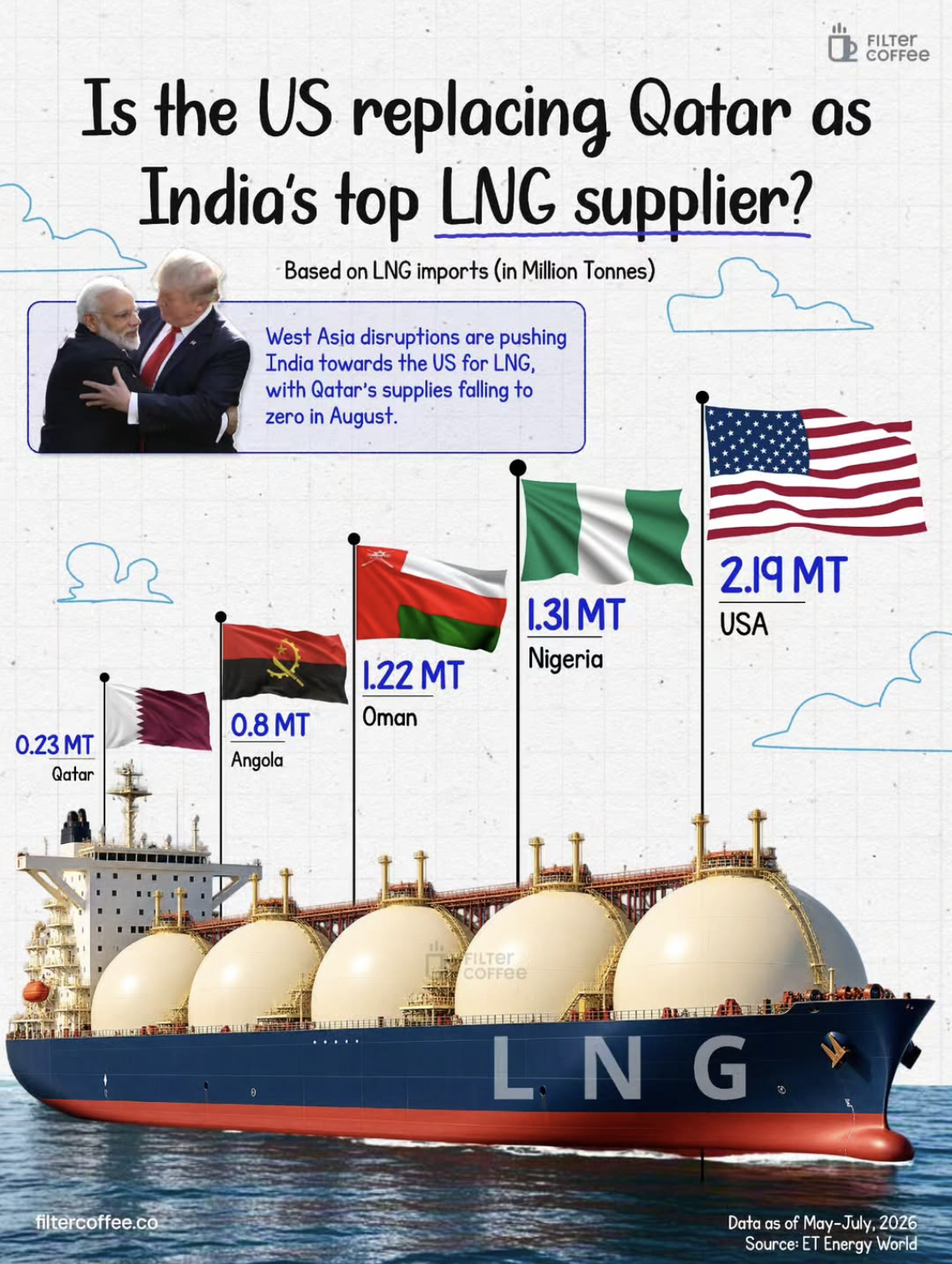
This is where the US stepped in. American LNG shipments to India jumped 253% year-on-year during May-July. Nigeria supplied another 1.31 million tonnes, Oman 1.22 million and Angola 0.8 million. India was effectively spreading its purchases across multiple suppliers.
But diversification comes with a price.
US LNG has to travel much farther to India, while Indian buyers are competing with customers across Europe and Asia. Some recent September cargos have reportedly cost more than $23 per unit of energy, making replacement supplies significantly more expensive.
And Qatar is not going away. Petronet LNG still has a long-term agreement to import 7.5 million tonnes of Qatari LNG annually, with supplies under the latest agreement beginning in 2028.
So this is not really a story about India choosing America over Qatar. It is a story about what happens when a country that imports more than half its gas suddenly loses access to one of its biggest suppliers.