
 Newsletter

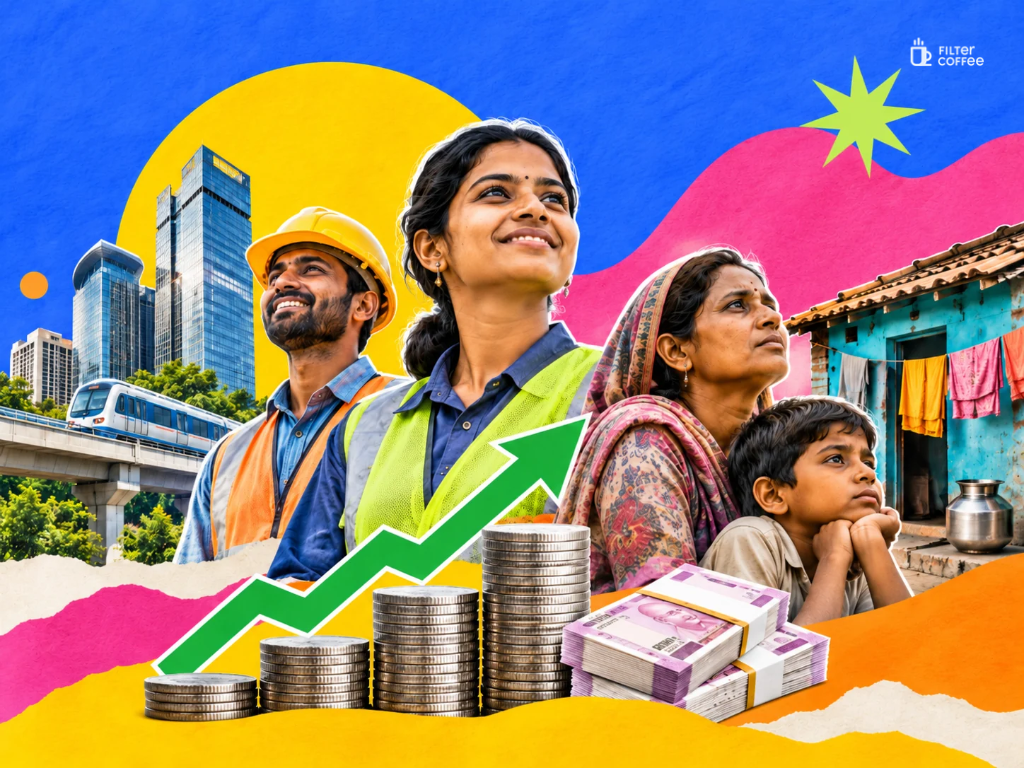
India has managed to pull nearly 50 crore people out of poverty in just 12 years. That's according to the World Bank's latest Poverty and Equity Brief, released in October 2026. Yet the same report reveals that the country's highest-earning 10% of workers make roughly 13 times what the lowest-earning 10% do.
It's an interesting contradiction. India has become considerably better at reducing poverty, but millions of people still struggle to earn a decent living.
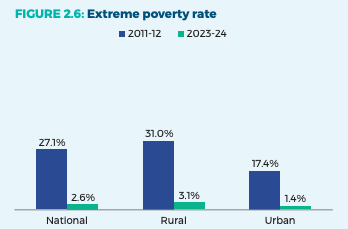
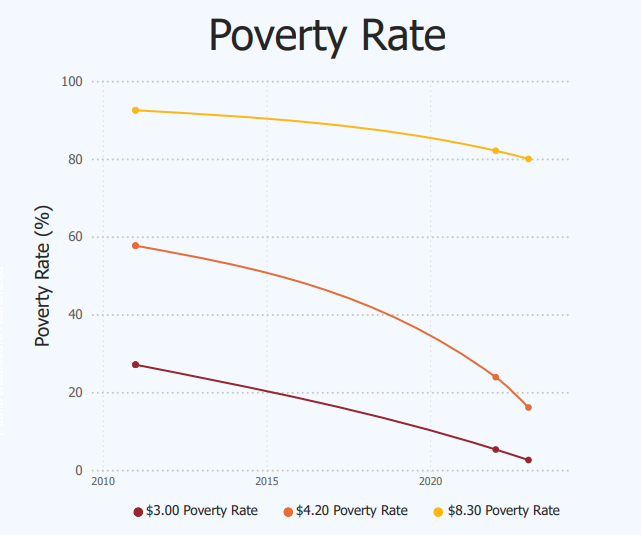
According to the World Bank, the share of Indians living below the lower-middle-income poverty line fell from 57.7% in 2011-12 to just 16.1% in 2023-24. Extreme poverty declined even more sharply, from 27.1% to 2.6%.
But before we celebrate these numbers, we need to understand what the World Bank actually considers poverty.
It uses a threshold of $3 per person per day to measure extreme poverty and $4.20 for lower-middle-income countries like India. These amounts are adjusted for purchasing power, rather than converted at today's exchange rate. In Indian terms, the $4.20 threshold works out to approximately ₹82 per person per day in 2021 prices.
For a family of four, that's roughly ₹9,840 a month, again at 2021 prices. And the calculation measures consumption, including goods and services, rather than household income.
Crossing this threshold certainly indicates an improvement in living standards. But it doesn't necessarily mean that a family can afford quality healthcare, higher education or an unexpected financial emergency.
In fact, around 23.2 crore Indians still live below the $4.20 threshold.
So how did India manage such a substantial reduction in poverty?
The World Bank attributes much of the progress to rising household consumption, increased employment and government welfare programmes.
Take food subsidies. The government currently provides free food grains to approximately 80 crore Indians. That reduces what households need to spend on food, leaving more money for other expenses. Cash transfers and improvements in housing, sanitation and drinking water have also helped improve living conditions.
Employment has contributed too, particularly as more women have joined the workforce. When another family member starts earning, household consumption can increase even if individual wages haven't improved significantly.
But much of this employment growth has been concentrated in self-employment and relatively low-productivity activities, where earnings are often modest or unpredictable.
Someone working on a family farm or running a small roadside business may technically be employed, but that doesn't guarantee a stable monthly income. The World Bank notes that real earnings have remained broadly unchanged despite employment growth.
And the problem extends beyond informal workers.
According to Azim Premji University's State of Working India 2026 report, nearly 40% of graduates aged 15-25 were unemployed. Among graduates aged 25-29, the figure was approximately 20%.
The report also found that relatively few graduates secured stable salaried jobs within a year of completing college. India has expanded access to higher education, but the creation of suitable employment opportunities hasn't kept pace.
Meanwhile, the benefits of economic growth remain highly concentrated.
The World Inequality Report 2026 estimates that the richest 10% of Indians receive approximately 57.7% of the country's national income. The bottom 50% receive just 15%.
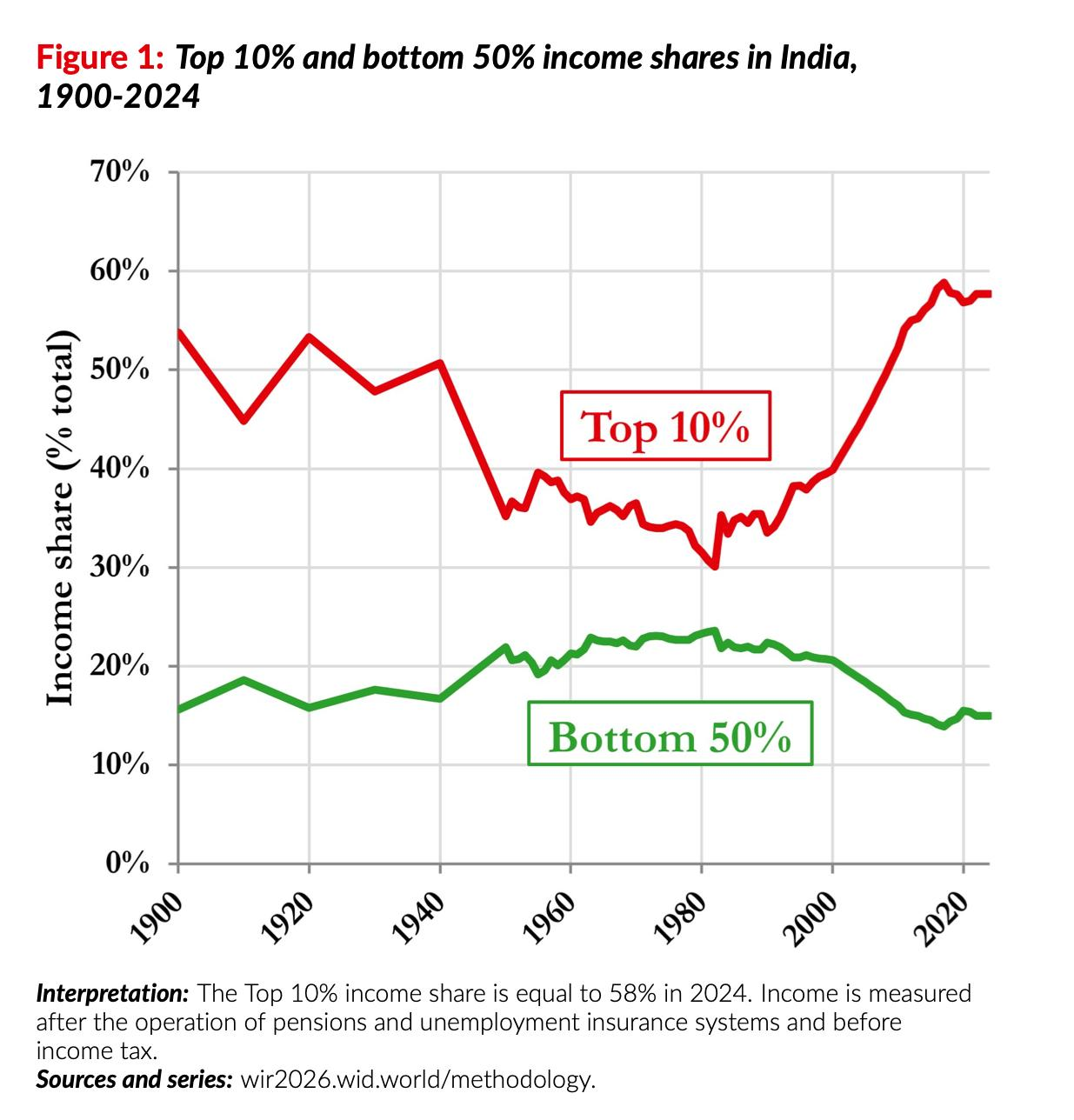
Wealth is even more unevenly distributed. The richest 10% own about 65% of India's total wealth, with the top 1% alone controlling approximately 40%.
There is a difference between these statistics and the World Bank's poverty estimates. Poverty is measured using household consumption, while income and wealth inequality examine how earnings and assets are distributed. It is entirely possible for people at the bottom to improve their living standards while those at the top continue to control a disproportionately large share of economic resources.
The inequality report also finds that India's income gap has remained broadly stable since 2014, although at a very high level.
There is another complication with the poverty estimates themselves.
India's household consumption surveys have changed considerably since 2011-12. The newer surveys collect more detailed information through multiple household visits, capturing expenses and government benefits that older surveys may have missed.
The World Bank has adjusted its estimates to improve comparability. However, economists including Himanshu, Peter Lanjouw and Philipp Schirmer have questioned whether the surveys can be compared reliably. Their independent research also finds poverty declining, but at a slower pace than some prominent estimates.
So while there is strong evidence that India has reduced poverty, the exact magnitude remains debated.
The World Bank expects the poverty rate at the $4.20 threshold to decline further, reaching approximately 12.1% by 2028.
That would be further progress. But India's longer-term economic challenge is increasingly about the quality of employment and how much households can earn without relying heavily on government assistance.
Food subsidies and social welfare can protect families from severe deprivation. Sustained wage growth, productive jobs and accessible healthcare can help them build financial security.
India has made remarkable progress in helping people meet their basic needs. Whether those gains translate into lasting economic mobility will depend on how effectively the country creates better-paying work.
Key sources: World Bank Poverty and Equity Briefs, State of Working India 2026, World Inequality Report 2026 and Independent research on India's poverty estimates.