

 Newsletter

On 30 October, ISRO launched NVS-03, a navigation satellite carrying an Indian-made atomic clock alongside imported ones. By 4 November, it had completed four orbital manoeuvres and reached geosynchronous orbit. That was a welcome result for India's homegrown alternative to GPS, which had spent months unable to independently work out a user's location.
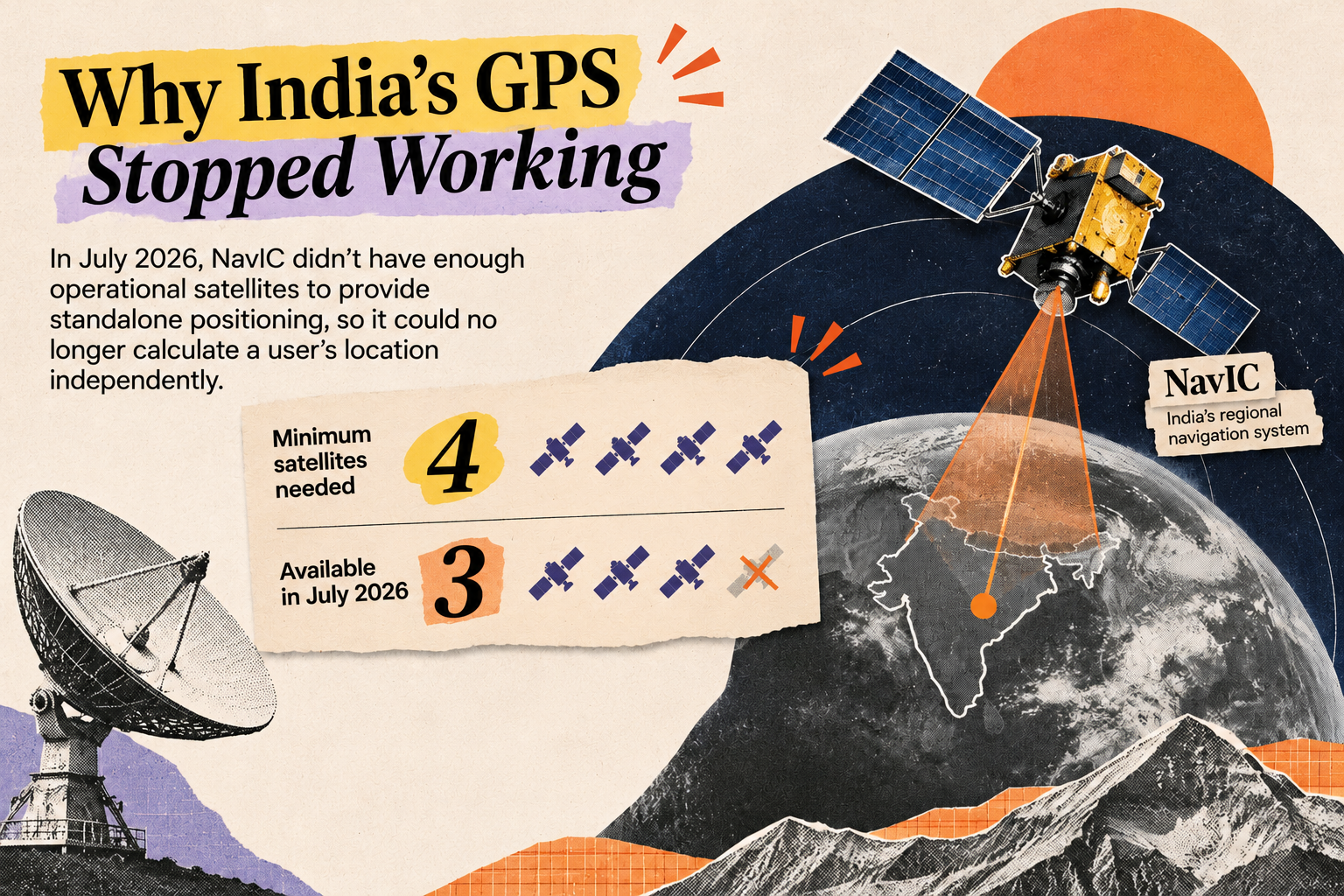
In July, the government told Parliament that NavIC had just three satellites capable of providing positioning, navigation and timing services. It needed at least four to calculate a location independently. Its timing service still worked, and devices using other satellite networks were largely unaffected. But a system built to reduce dependence on foreign navigation services had become unable to provide standalone positioning.
NavIC was designed around seven satellites to cover India and roughly 1,500 km beyond its borders. Its signals can guide ships, track trains and fishing vessels, and support military operations. And like GPS, it relies on extraordinarily accurate clocks.
A navigation satellite broadcasts where it is and precisely when it sent a signal. Your receiver measures the signal's travel time to work out the satellite's distance. With signals from multiple satellites, it can calculate your position. A timing error of just one microsecond translates into roughly 300 metres of distance error. Atomic clocks are essential because their exceptionally stable frequencies keep those errors small.
India originally imported rubidium atomic clocks from a Swiss supplier. In 2017, all three aboard IRNSS-1A had failed. A government investigation linked the problem to a component affected by excessive heat. IRNSS-1A could still relay messages, but it could no longer do its intended navigation job. Replacing an entire satellite because its clocks stop working is an expensive way to discover a supply-chain vulnerability.
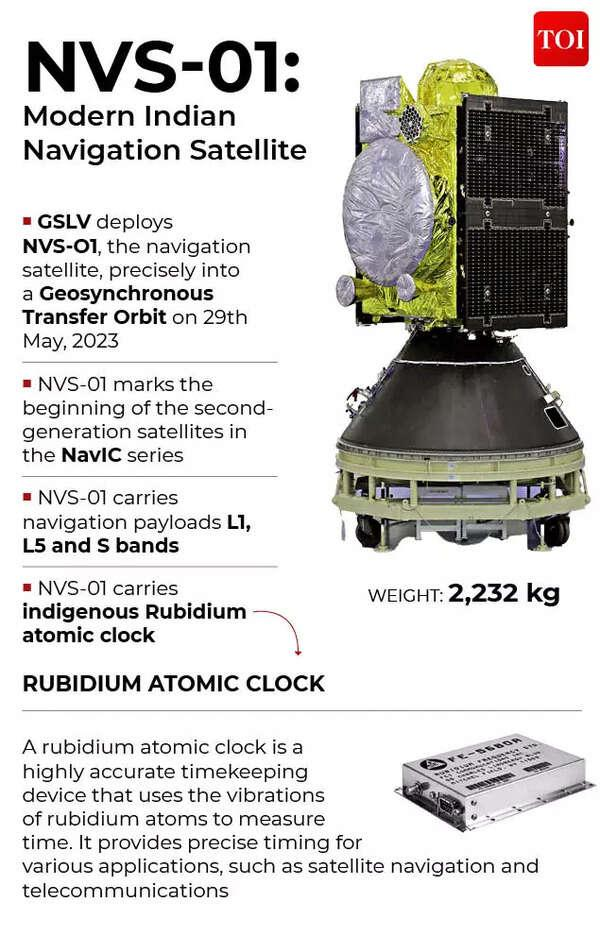
ISRO's response included building an indigenous rubidium atomic clock at its Space Applications Centre in Ahmedabad. The first flew on NVS-01 in May 2023 and was tested in orbit before being selected as the satellite's primary clock. NVS-03 continues that effort; it is not India's first homegrown clock in space.
Producing the clock domestically gives ISRO more control over a component central to NavIC's reliability. Engineers can investigate faults, refine designs and qualify replacements without depending entirely on overseas vendors. For defence, the advantage is strategic: India wants a navigation signal it can maintain under its own control, including for authorised users of NavIC's encrypted service. An Indian-made clock cannot prevent every satellite failure, but it removes one potential dependence.
There is a commercial case as well. ISRO says an Indian-made atomic-clock monitoring unit, the supporting electronics rather than the clock itself, saves around ₹3 crore per navigation satellite. Precise timing also supports telecommunications, power grids and financial infrastructure, which need trustworthy synchronised clocks. India's new Indian Standard Time framework involves the National Physical Laboratory and ISRO in building domestic time-distribution infrastructure; NavIC offers one satellite-based route for that service.
NavIC already has practical users. Government figures from February 2026 counted more than 10,400 locomotives tracked in real time, 40,000 fishing vessels with NavIC receivers and over 60 compatible phone models. NVS-03 adds an L1 signal commonly used by civilian receivers, improving compatibility. That benefit comes from the satellite's signal design, not simply from the origin of its atomic clock.

The urgency grew after NVS-02, launched in January 2025, could not reach its intended orbit because of a propulsion-system electrical fault. Then in March 2026, the imported clock on the ten-year-old IRNSS-1F stopped functioning. NVS-03 has now passed the orbit-raising stage that defeated NVS-02, but ISRO's latest update confirms its orbit and health, not completed navigation-service commissioning. Even with four working satellites, NavIC would have little room for another failure. Two more satellites, NVS-04 and NVS-05, are planned.
India has shown it can make the clock. The tougher job is keeping enough reliable satellites in service for years, so its independent navigation system can genuinely operate independently.
Sources
- ISRO: Final Orbit Manoeuvring of NVS-03 Spacecraft, 4 November 2026.
- Department of Space: Lok Sabha reply on the operational status of NavIC, 29 July 2026.
- Department of Space: Rajya Sabha reply on replacement navigation satellites and atomic-clock failures, 19 July 2018.
- ISRO: Annual Report 2023–24, Navigation Systems, including NVS-01's indigenous atomic clock.
- ISRO: NVS-02 Spacecraft On-Orbit Observations and Apex Committee Recommendations, 25 February 2026.
- ISRO: IRNSS-1F Successfully Completed Its Mission Life of 10 Years, 13 March 2026.
- ISRO: Atomic Clock Monitoring Unit, Atmanirbhar Bharat technology documentation.
- Department of Space: Parliament reply on applications of satellite-based services, 12 February 2026.
- Ministry of Science & Technology: Legal Metrology (Indian Standard Time) Rules, 2026, notification and timing infrastructure, 2 September 2026.