
 Newsletter

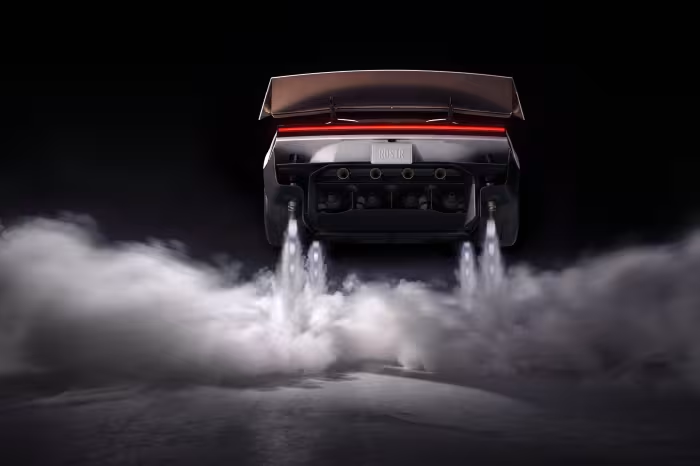
On Thursday night, a white Tesla drove up a curved ramp at SpaceX's rocket-testing facility in Texas. The ramp bent backwards until the car was hanging upside down. Instead of crashing, it released itself, twisted through the air and landed on its wheels. Then it cleared a row of five Tesla vehicles, including a Cybertruck and a Semi truck, in another airborne stunt. There was nobody behind the wheel.
Turns out the future does have flying cars pic.twitter.com/6fexPp6SXI
— Elon Musk (@elonmusk) October 16, 2026
This was Tesla's big reveal of the second-generation Roadster on 15 October. The company also showed the sports car going from 0 to 60 mph (about 97 kmph) in just 0.81 seconds, according to its own demonstration clock. For once, Elon Musk's promise of a car that could briefly fly came with an actual flying car. The catch is that it was a prototype, and customers still cannot buy one for delivery.
Musk had made that promise in May 2021. Replying to a video of the Roadster, he wrote on X, "This will actually be able to fly very briefly. I always laughed at flying cars & now making one." But the Roadster's story began even earlier, in 2017, when Tesla unveiled a shiny electric supercar that was supposed to arrive in 2020.
This will actually be able to fly very briefly. I always laughed at flying cars & now making one. Fate 🖤 irony haha.
— Elon Musk (@elonmusk) May 21, 2021
It promised four seats, a range of 620 miles (nearly 1,000 km), a top speed above 250 mph and acceleration to 60 mph in 1.9 seconds. Tesla quoted a starting price of $200,000 and started collecting reservations, including $50,000 deposits and $250,000 commitments for a Founders Series. In 2018, Musk even sent an older Roadster into space aboard a SpaceX rocket. Getting its successor into customers' garages has taken rather longer.
Nine years later, there is finally a working demonstration of something far stranger than that original sports car. Tesla achieved its stunts using two systems with very different jobs. Electric fans under the car remove air from beneath it, creating suction that presses the tyres against the surface. Tesla says this produces enough force for the Roadster to grip a ramp even while upside down. The same system could help it corner at high speeds, rather than simply perform party tricks.
Once the wheels leave the ground, suction is no use. That is where SpaceX-inspired cold-gas thrusters take over. The Rocket version carries two high-pressure tanks with a combined capacity of 600 litres and around 250 kg of compressed gas, which is fired out through ten nozzles. Releasing gas in different directions creates the force needed to lift, turn and stabilise the car. These are not fire-breathing rocket engines. Think of the force that sends an untied balloon shooting across a room, developed into a considerably more complicated piece of engineering.
The thrusters also explain the extraordinary acceleration. A normal electric car relies on its tyres gripping the road to move forward. Blasting compressed gas backwards adds another source of forward force. Tesla's 0.81-second sprint was demonstrated under controlled conditions and has not been independently verified, so it should not yet be treated as a production-car record.
Tesla now describes three versions of the Roadster. Performance is the road-focused two-seater with the suction system. Thrust adds rear-mounted gas thrusters for even quicker acceleration. Rocket is the single-seat version with ten thrusters for those short flights and mid-air rolls. Tesla is asking $50,000 to reserve Performance and $250,000 to reserve Thrust, while Rocket is invitation-only. Those are reservation amounts, not confirmed final prices.
The new Tesla Roadster accelerates faster than a fighter jet taking off from an aircraft carrier https://t.co/oPxOvs75u8
— Elon Musk (@elonmusk) October 18, 2026
There is an unexpected trade-off hidden beneath all that technology. Tesla now advertises more than 300 miles of range (roughly 480 km), compared with the 620 miles it promised in 2017. The new Roadster seats two people at most, rather than the original four. The machine has become much more ambitious in what it can do for a few seconds, even as some everyday specifications have become less ambitious.
Tesla has also opened Roadster reservations in India. But getting on the waiting list isn't cheap. Buyers must pay a total of ₹50.06 lakh to reserve the Performance version or ₹2.50 crore for Thrust. These are reservation payments, not final car prices. And while production is targeted for 2028, Tesla has yet to confirm when Indian customers will receive their cars.
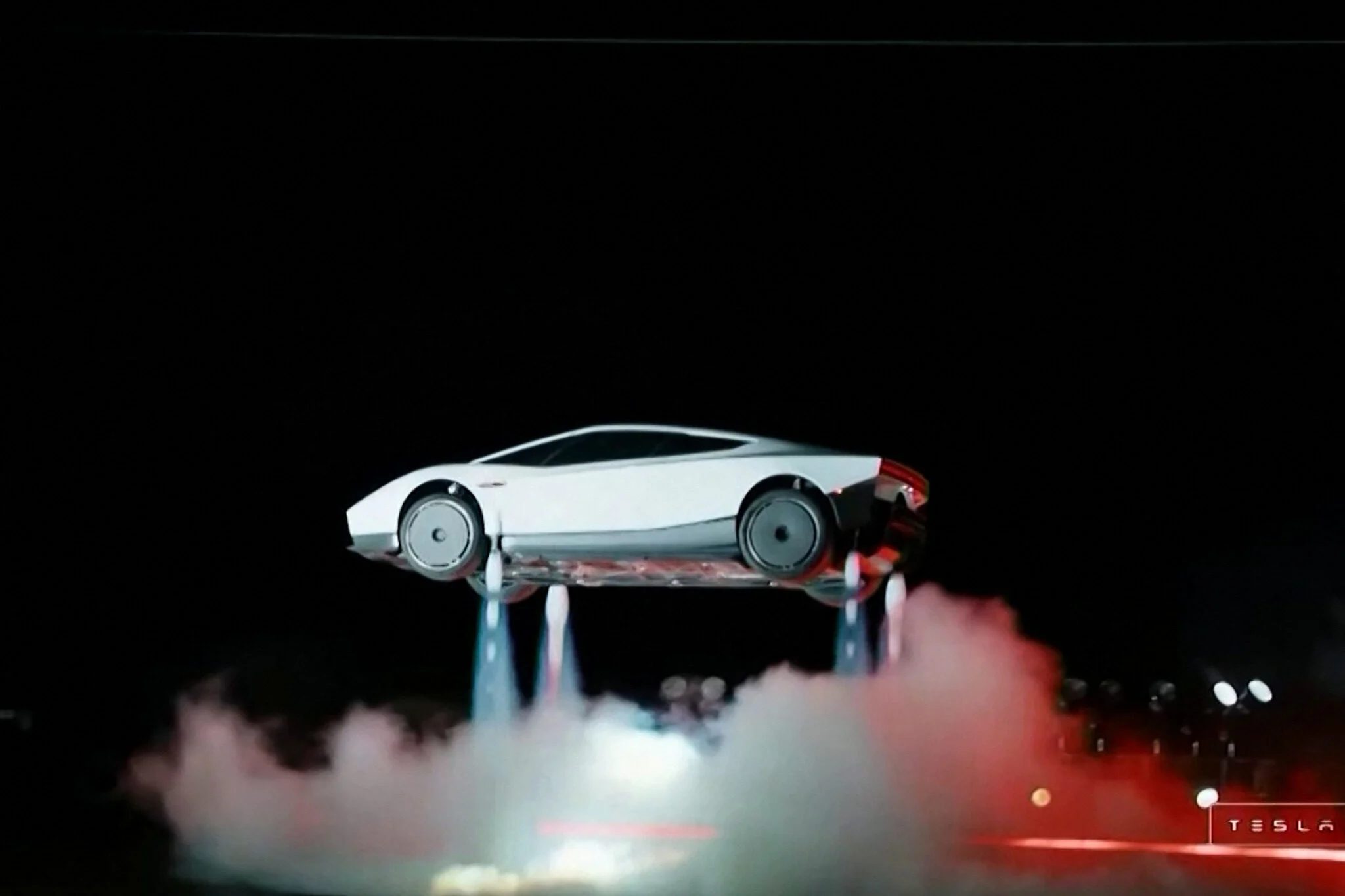
And calling it a flying car needs a qualification. The Roadster has demonstrated short, controlled airborne manoeuvres, not the ability to cruise above a city or replace an aircraft. No human rode inside during the stunts. The flying Rocket version is not approved for public-road use, and Tesla has not shown how it will obtain the approvals needed for people to use its flight features safely. Musk himself conceded at the reveal that this was not necessarily a car optimised for safety. Flying over Bengaluru traffic is still not an option.
Even paying customers have learnt to be patient. Tech reviewer Marques Brownlee cancelled a paid Roadster reservation in 2025 after waiting nearly eight years, while Sam Altman also sought a refund on a reservation made in 2018. And the fresh production target is 2028, eight years after the original delivery deadline. Tesla has not committed to a customer delivery date.
So why spend years building a sports car that is unlikely to sell in large numbers? The Roadster is what carmakers call a halo car: a costly showcase for the engineering and image of the entire brand. Musk has acknowledged that it is unlikely to contribute much to Tesla's revenue. As the company increasingly sells investors a future built around robotaxis, artificial intelligence and robots, the Roadster gives it a very physical way to demonstrate technological ambition. Musk even says it could eventually be Tesla's only manually driven car.
Tesla has proved that its prototype can leave the ground, flip and land. That is a real engineering achievement. But the tests that matter next will be less theatrical: producing the vehicle repeatedly, making the flying features safe and legal, setting a final price and delivering cars to people who have already waited most of a decade. The Roadster has finally taken off. Its commercial launch is still on the runway.
Memes:
Sources
- Reuters: Tesla's new Roadster turns in air with SpaceX thrusters, won't land until 2028, 16 October 2026.
- Tesla: Official Roadster product page, vehicle features, configurations and restrictions.
- MotorTrend: 2028 Tesla Roadster first look, 16 October 2026.
- Car and Driver: How the Roadster's thrusters and fan system work, 17 October 2026.
- Associated Press: Tesla Roadster unveiling, production delays and safety concerns, October 2026.
- Engadget: Tesla's original second-generation Roadster reveal, 17 November 2017.
- NASA: First flight of Falcon Heavy and its Tesla Roadster payload, 6 February 2023.
- Business Insider: Marques Brownlee cancels his paid Roadster reservation, September 2025.
- TechCrunch: Sam Altman's Tesla Roadster refund, 1 November 2025.