

 Newsletter

Have you noticed something strange about the AI conversation lately? Every few weeks, a new headline appears warning us that AI will take jobs, reshape industries, or change how we work forever. But hidden beneath all that noise is a statistic that almost nobody is talking about: Indian women are quietly becoming some of the most AI-skilled professionals in the world.
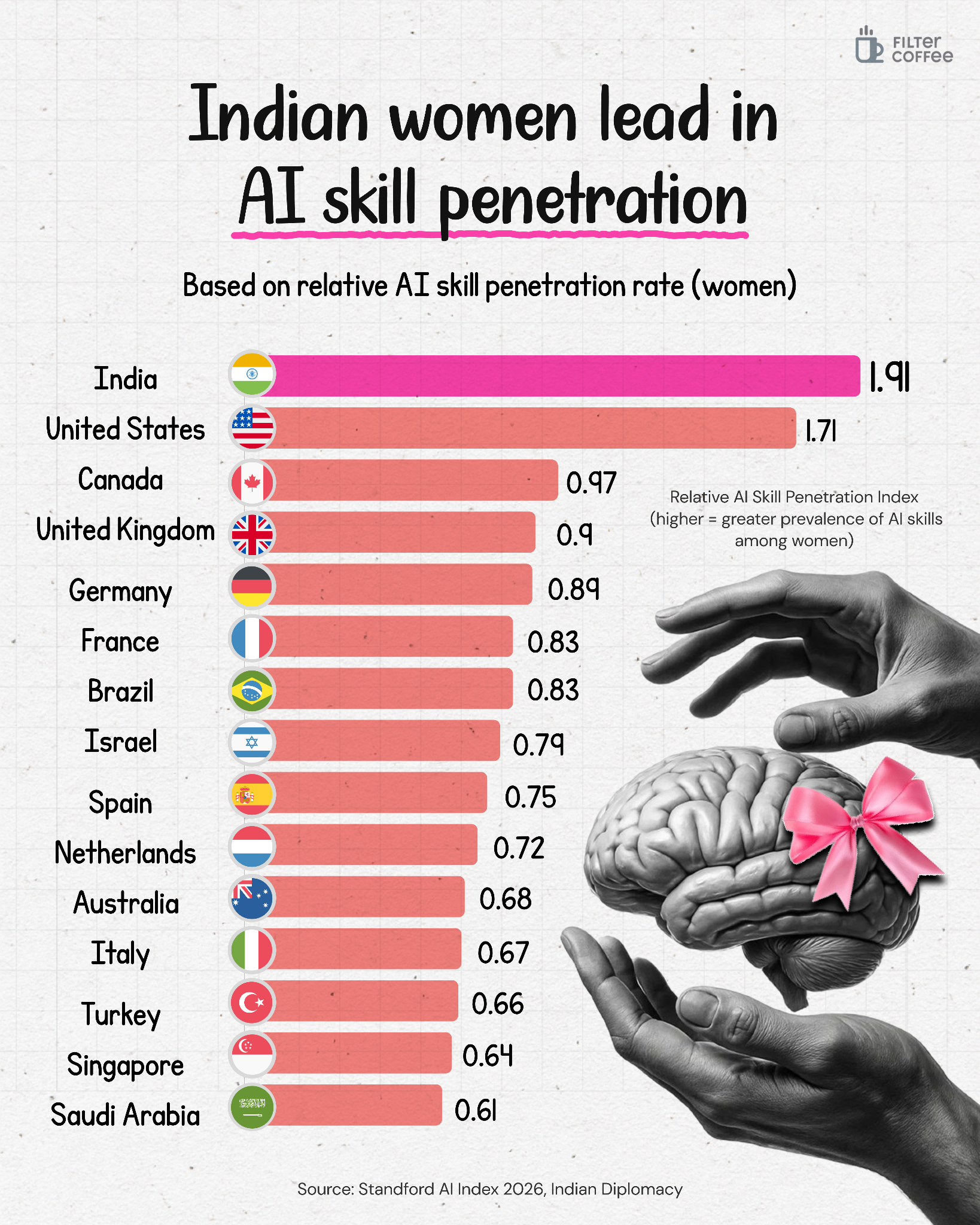
According to the Stanford AI Index 2026, India ranks first globally in relative AI skill penetration among women, with a score of 1.9. The United States comes second at 1.71, while countries such as Canada, the United Kingdom, Germany and France trail significantly behind. This reveals something much bigger about where India's workforce may be headed over the next decade.
To understand why this matters, we need to go back a few years.
For decades, India's technology story was largely a male-dominated one. Women entered engineering colleges in growing numbers, but their representation often dropped as careers progressed. Leadership positions remained limited, career breaks were common, and participation in emerging technologies lagged behind the overall workforce.
Then AI happened.
Unlike previous technology waves that required expensive infrastructure, specialised degrees or years of experience, generative AI arrived through something almost everyone already had: a laptop, a smartphone and an internet connection. Learning AI became less about accessing elite institutions and more about curiosity, experimentation and self-learning.
India happened to be in a unique position when this shift arrived.
The country already had one of the world's largest pools of STEM graduates. It had affordable internet thanks to the data revolution triggered by Reliance Jio. It had millions of young professionals active on digital platforms. And perhaps most importantly, it had a generation of women increasingly looking for flexible, technology-driven career opportunities.
> Also read: Why cheap data became India's superpower?
The result is now visible in the data.
Stanford's ranking measures the prevalence of AI skills among women relative to global benchmarks. India is not merely participating in the AI economy. Indian women are adopting AI skills at a faster rate than women in many advanced economies.
The momentum is also being reinforced by policy and industry initiatives. In 2025, Microsoft's "AI Careers for Women" programme was launched in partnership with the Ministry of Skill Development and Entrepreneurship.
The initiative plans to establish 30 Centres of Excellence across women's colleges in six Indian states and train around 20,000 women through specialised AI curricula. By early 2026, the programme had expanded through partnerships involving Microsoft, LinkedIn and SAP, signalling growing industry commitment to building a female AI talent pipeline.
At the same time, the government's IndiaAI Mission is investing heavily in compute infrastructure, datasets, startup support and AI education programmes. The goal is straightforward: create an ecosystem where AI talent can move from learning to building.
But there is another reason this story deserves attention.
AI adoption is increasingly becoming an employability issue. The India Skills Report 2026 found that overall employability in India rose above 56%, with women surpassing men in job readiness for the first time. Employers are increasingly looking for candidates who understand automation, data tools and AI-assisted workflows, regardless of whether they are working in software, marketing, finance, operations or healthcare.
In other words, AI is slowly becoming what spreadsheets became in the 1990s or what internet literacy became in the 2000s. It is shifting from a specialised skill to a baseline expectation.
Of course, there are reasons to be cautious.
The Stanford data primarily captures professional AI skill visibility through platforms like LinkedIn. It reflects digitally connected professionals rather than the entire female workforce. Millions of women in rural India still face barriers related to internet access, digital literacy, language and workforce participation. Being skilled in AI is also not the same as securing AI jobs, launching startups or reaching leadership positions.
That distinction matters because India's challenge is no longer producing talent. It is converting talent into economic opportunity.
Still, something important is happening here.
For years, conversations around women in technology focused on closing gaps. The discussion was usually about underrepresentation, missed opportunities and structural disadvantages. For perhaps the first time, the AI era is creating a conversation around leadership rather than participation.
India's women are not simply catching up with a global technology trend. In many ways, they are helping define it.
And if these skills translate into careers, businesses, research breakthroughs and leadership roles, this ranking may eventually be remembered as more than just another statistic. It could be one of the earliest signals that India's next technology advantage will not come from cheaper labour or larger talent pools.
It may come from a generation of women who decided to learn the most important technology of the decade before everyone else realised how valuable it would become.


