

 Newsletter
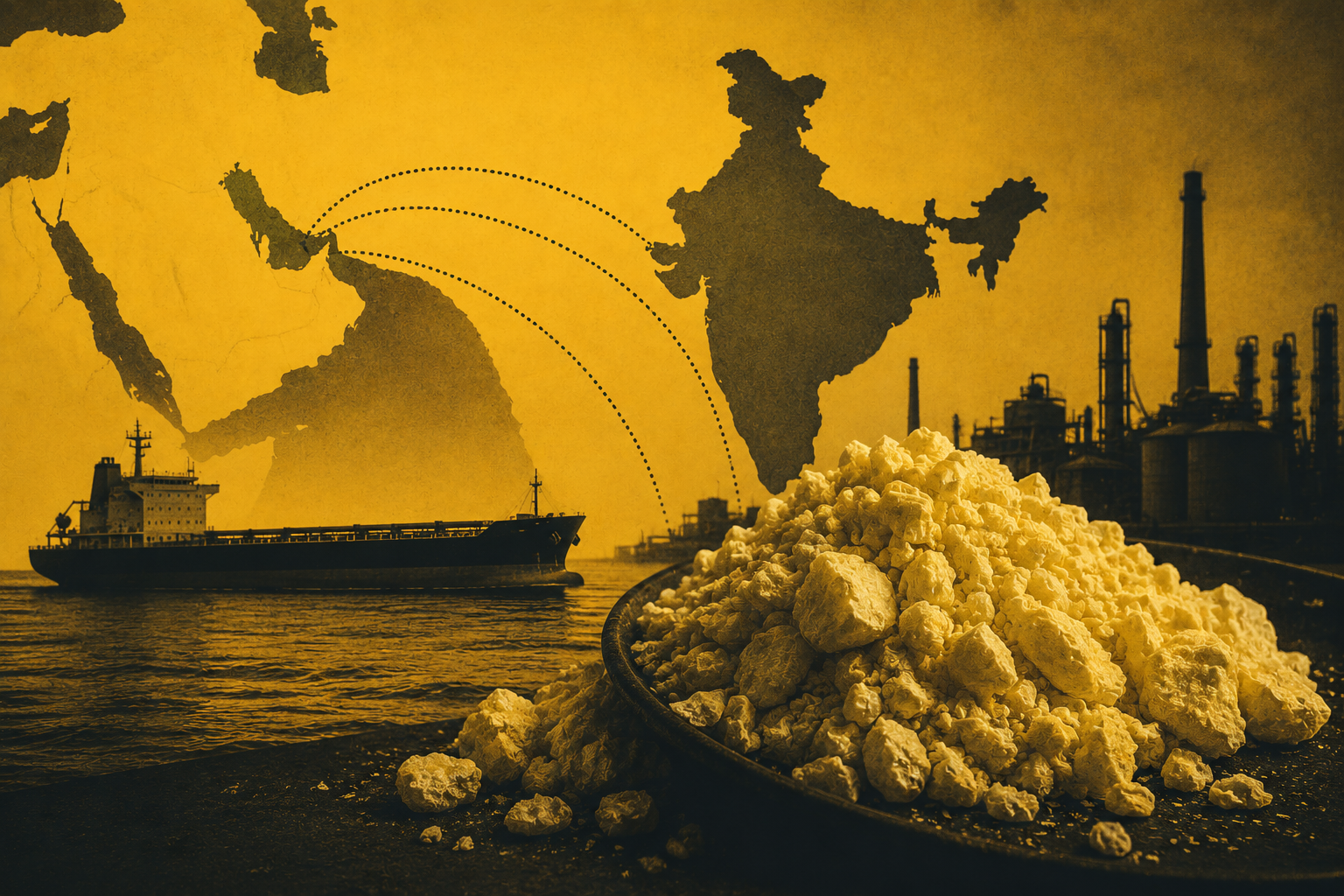
India may be staring at a quiet but serious supply risk, and it’s not oil or gas this time. It’s sulphur.
Industry bodies in 2026 have already begun flagging potential shortages of sulphuric acid, warning that inventories in some sectors could fall to barely 2 to 3 weeks.
That might sound like a niche chemical problem, but sulphur sits at the heart of India’s fertiliser ecosystem, and any disruption here can ripple straight into agriculture, food prices and industrial output.
To understand why this matters, you need to look at where India’s sulphur actually comes from.
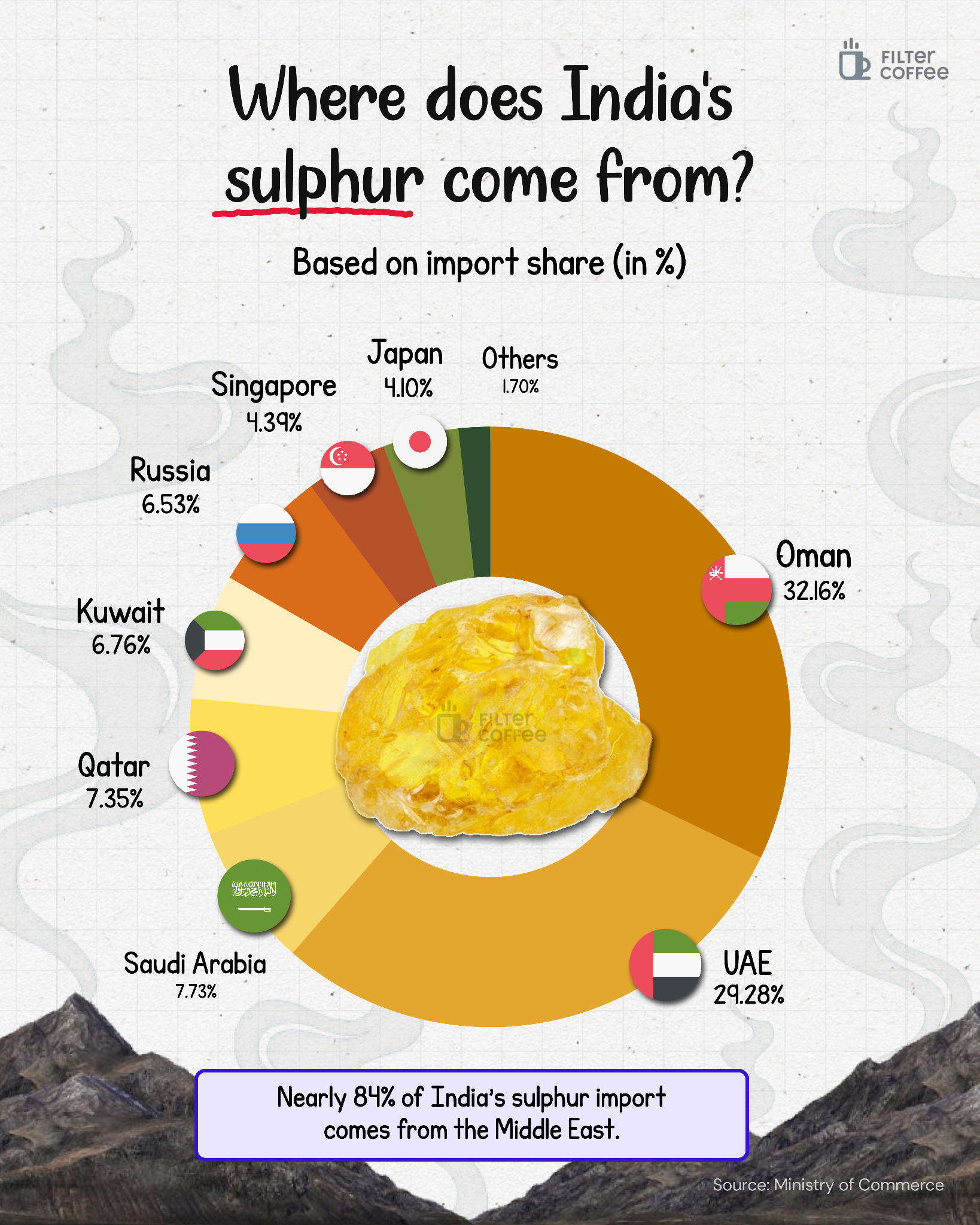
India barely produces any sulphur of its own and relies heavily on imports. More importantly, those imports are extremely concentrated geographically.
Roughly four-fifths of India’s sulphur imports come from the Middle East. Countries like Oman and the UAE alone account for over 60% of supply, while Saudi Arabia, Qatar and Kuwait add another meaningful chunk.
In more recent global trade data, this dependence looks even sharper. In 2024, India imported around 1.96 million tonnes of crude or unrefined sulphur worth about 248 million dollars, with the UAE, Qatar, Oman, Kuwait and Saudi Arabia together contributing close to 94% of that volume.
This concentration creates a structural vulnerability as sulphur is not primarily mined today. It is mostly recovered as a byproduct when oil and natural gas are processed to remove impurities.
That means India’s sulphur supply is indirectly tied to refinery operations and energy flows in West Asia. Any disruption in that region, whether geopolitical tensions, shipping bottlenecks or production cuts, can tighten sulphur availability almost instantly.
Now look at India’s demand.
Sulphur is rarely used directly. It is converted into sulphuric acid, one of the most widely used industrial chemicals in the world.
In India, its biggest role is in fertilisers. Sulphuric acid is essential for producing phosphoric acid, which in turn is used to make fertilisers like DAP. That connects sulphur imports directly to India’s food security.
If sulphur becomes scarce or expensive, fertiliser production gets squeezed. If fertiliser supply tightens, farm output and food prices can feel the impact.
This is already playing out in subtle ways.
Global sulphur and sulphuric acid markets have been tightening, with price volatility driven by shifts in refinery output and fertiliser demand cycles.
At the same time, India is trying to secure its fertiliser supply chain through long term deals.
In 2025, Indian fertiliser companies signed a five year agreement with Saudi Arabia’s Maaden to secure 3.1 million tonnes of DAP annually.
While that deal is about finished fertiliser, it indirectly reflects the same concern. India is trying to lock in inputs because upstream supply chains are becoming less predictable.
There is also a multiplier effect that makes sulphur disruptions more dangerous than they appear.
One tonne of sulphur can produce roughly three tonnes of sulphuric acid. So even a small shortfall in sulphur supply can translate into a much larger gap in acid availability, amplifying the impact across industries like chemicals, metals, textiles and detergents.
What makes this story even more interesting is how invisible it is. Unlike crude oil, sulphur rarely makes headlines. Yet India is now one of the world’s largest importers of sulphur, ranking among the top 5 globally.
So when industry bodies warn about sulphuric acid shortages, it is not just about a chemical. It is a signal of how tightly India’s agricultural and industrial backbone is linked to a handful of suppliers thousands of kilometres away.
And in a world where supply chains are becoming more fragile, even something as obscure as sulphur can suddenly become a strategic risk.