
 Newsletter
A few years ago, celebrity brands in India felt like side quests.
Actors launched perfumes, fairness creams, handbags, protein powders, deodorants and sometimes even toothpaste, only for most of them to quietly disappear from shelves a few years later.
Consumers saw them as vanity projects. Retailers saw them as marketing gimmicks. But something has changed over the last three years.
India’s biggest retail companies are no longer just endorsing celebrity brands. They are buying them, investing in them and building them like long-term businesses.
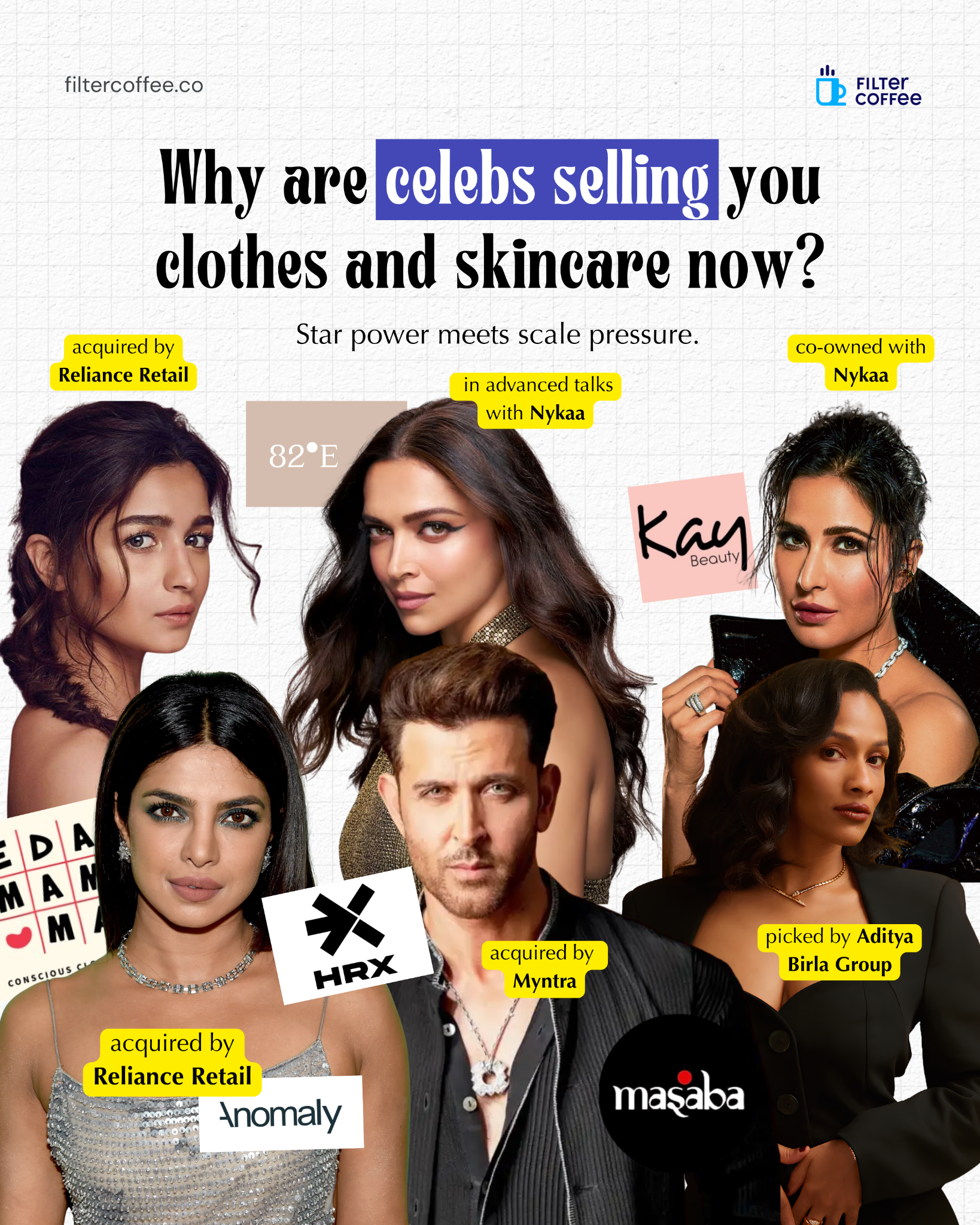
The clearest sign came recently when reports emerged that Nykaa was in advanced talks to acquire a majority stake in Deepika Padukone’s skincare brand 82°E.
Around the same time, Reliance Retail moved to acquire Priyanka Chopra Jonas’ haircare brand Anomaly for the Indian market, while keeping Priyanka involved as the creative face. Earlier, Reliance had already bought a 51% stake in Alia Bhatt’s Ed-a-Mamma.
Aditya Birla Fashion Retail bought into House of Masaba. Myntra had done it years earlier with Hrithik Roshan’s HRX.
Billion-dollar retailers are increasingly backing celebrity-led startups in beauty and fashion because attention has become the scarcest commodity in consumer internet businesses. Launching a skincare or fashion label today is not difficult, but getting people to notice it is extremely expensive.
Customer acquisition costs across digital platforms have surged over the years as every D2C startup competes for the same Instagram feed, the same influencer network and the same Google ads inventory.
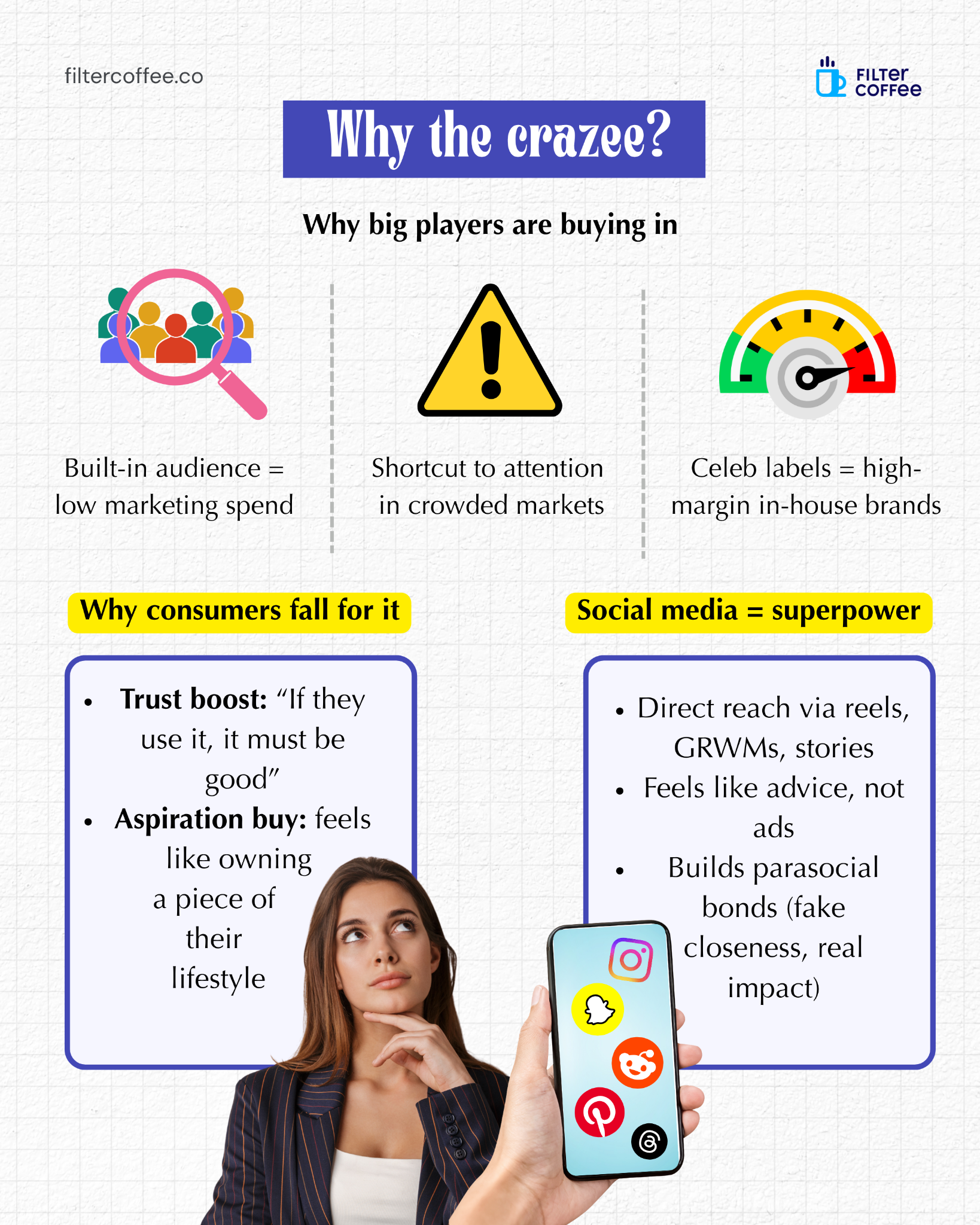
A celebrity brand changes the business side of retail in a big way. Most new brands spend years and huge amounts of money trying to get noticed, attract customers and earn trust. Celebrity brands skip a lot of that struggle because the audience already exists and retailers know people will pay attention from day one.
That is why companies like Nykaa and Reliance are not just buying skincare or fashion brands. They are buying ready-made consumer attention that can scale much faster than a normal startup.
And the numbers show why this matters.
India’s beauty and personal care market is expected to touch roughly $27 billion by 2029 according to industry estimates, driven by premiumisation, social commerce and rising spending from younger consumers.
Nykaa’s own house-of-brands business crossed ₹2,100 crore in gross merchandise value in FY25. Kay Beauty reportedly crossed ₹240 crore in GMV and expanded internationally into markets like the UAE and the UK through premium retailer Space NK.
But celebrity alone is not enough anymore, and that is where the story gets interesting.
Consumers today are both easier and harder to influence. Easier because social media creates intimacy at scale. Harder because audiences now compare products obsessively. A celebrity can drive the first purchase, but only the product can drive the second one.
That explains why some celebrity brands are thriving while others are struggling.
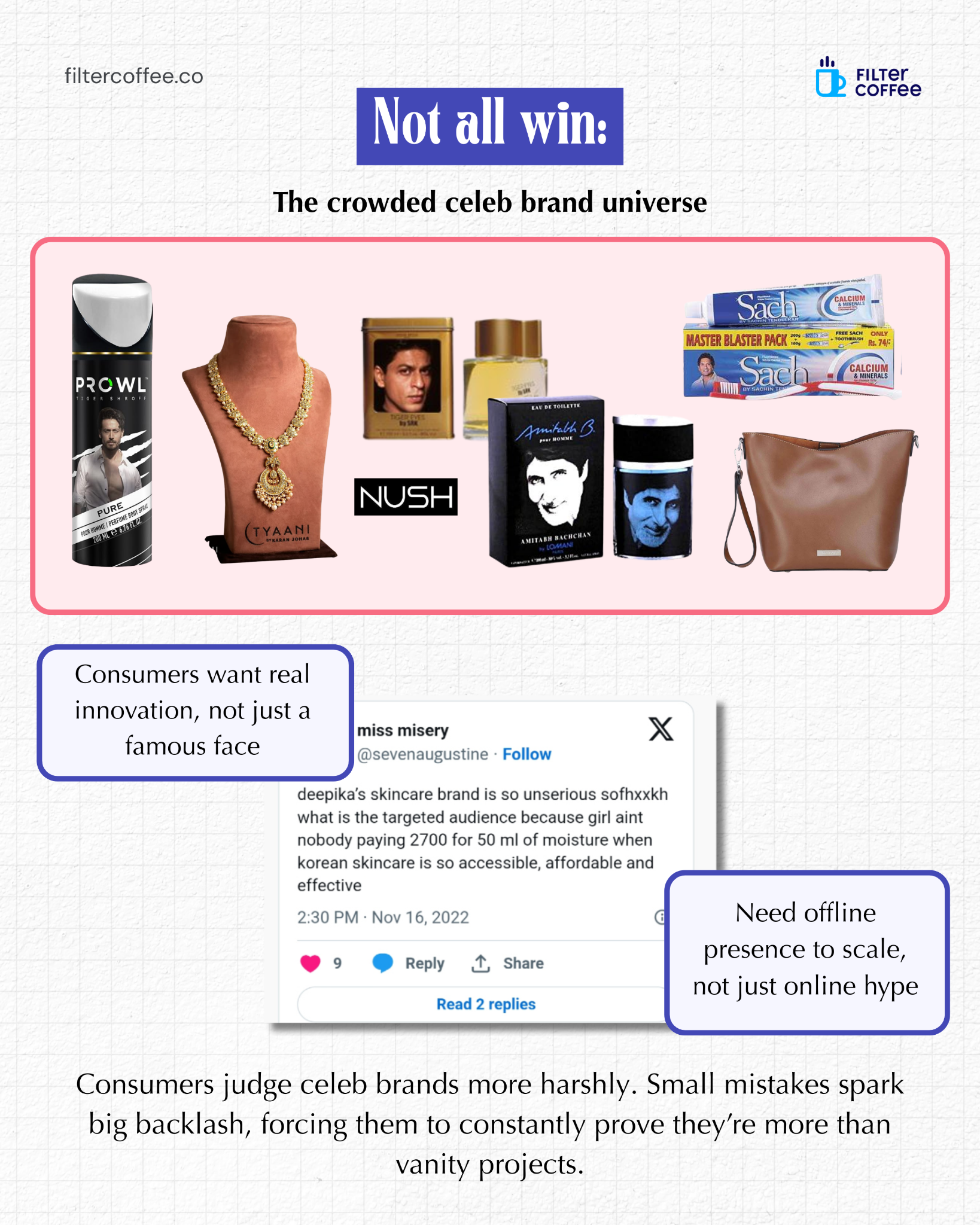
82°E became one of India’s most talked-about skincare launches largely because of Deepika Padukone’s star power. But the brand also faced criticism for its premium pricing in a market already crowded with Korean skincare, pharmacy-backed products and ingredient-focused Indian brands.
Recently, the company reported losses of over ₹12 crore while revenue remained relatively modest, highlighting an important shift in consumer behaviour. Indian consumers today are willing to pay for quality, but not simply for celebrity branding.
This is also why retailers are stepping in now. Celebrities bring audience trust. Retail giants bring the critical machinery needed to scale a brand: supply chains, offline stores, warehousing, pricing discipline, data analytics and distribution muscle.
India’s next phase of consumer brands will likely belong to companies that combine all three things together: attention, operations and community.
However, retailers are no longer satisfied being marketplaces that merely sell other people’s brands. Nykaa, Reliance and Aditya Birla increasingly want ownership over brands because owned brands offer far higher margins than third-party products.
If a retailer owns both the shelf and the brand sitting on the shelf, it controls pricing, storytelling and profit pools simultaneously. Celebrity founders become the customer acquisition engine while retailers quietly own the backend economics.
Social media has accelerated this shift.
Earlier, celebrity endorsements looked like advertisements. Today they look like lifestyle documentation. Consumers watch skincare routines, “get ready with me” videos and behind-the-scenes content that blur the line between recommendation and marketing.
A celebrity no longer appears once in a TV commercial. They appear daily through reels, stories and personal updates. That repeated visibility creates parasocial trust, which is incredibly valuable in beauty and fashion categories where perception matters almost as much as performance.
Beauty is still a category where people want to touch, test and compare products before buying. That is why this celebrity brand wave feels very different from the past.
Earlier celebrity brands like Salman Khan’s Being Human products outside fashion, Sachin Tendulkar’s Sach perfumes or celebrity deodorant lines launched by actors often created short-term buzz but struggled to build lasting consumer businesses.
Today the approach is far more structured as these celebrities are now being treated as brand-building assets inside much larger retail ecosystems with offline stores, supply chains, distribution and expansion plans built around them.
Earlier celebrities mainly helped promote products. Now their audience and influence are becoming the foundation of entire consumer brands.