

 Newsletter
If you have followed India's startup ecosystem, you've probably heard about the long-running battle between Zostel and OYO. What started as an acquisition deal nearly a decade ago has turned into one of the country's biggest startup legal disputes.
Let's break it down.
First, who are these companies: Zostel is one of India's oldest backpacker hostel chains.
It was founded in August 2013 by seven entrepreneurs: Dharamveer Singh Chouhan, Akhil Malik, Paavan Nanda, Tarun Tiwari, Chetan Singh Chauhan, Abhishek Bhutra, and Siddharth Janghu.
Inspired by Europe's backpacking culture, they wanted to build a hostel ecosystem for young travellers in India. Their first hostel opened in Jodhpur on August 15, 2013.

OYO, on the other hand, is a hospitality company founded by Ritesh Agarwal in 2013. It operates leased and franchised hotels, homes and living spaces across several countries.
So what went wrong?
On November 26, 2015, OYO's parent company, Oravel Stays, signed a term sheet with Zostel Hospitality and two of its investors, Tiger Global and Orios Venture Partners. The proposal was simple.
OYO would acquire ZO Rooms (Zostel's hotel aggregation business), and in return, Zostel's shareholders would receive 7% equity in OYO. But this did not happen.
The document both companies signed was a term sheet, not a final acquisition agreement.
What's a term sheet: it is a rough outline of a deal. It lists the broad commercial terms but is usually non-binding, meaning either side can still walk away if the final agreement isn't signed.
A definitive agreement, on the other hand, is the final legally binding contract that contains all the detailed terms of the transaction.
OYO argues that since a definitive agreement was never signed, the acquisition never officially happened.
Then why did Zostel sue?
Zostel says it had already done everything it was supposed to do. According to the company, it transferred its intellectual property, customer contracts and employees to OYO, believing the acquisition would go through.
Since OYO never issued the promised 7% stake, Zostel initiated arbitration in 2018.
Arbitration is a way of settling a dispute without going to a regular court.
Who won?
Initially, Zostel did. In March 2021, the arbitration panel ruled that OYO should transfer the promised 7% stake to Zostel, saying the term sheet had become binding based on how both parties had acted after signing it.
But OYO challenged the award. In February 2022, the Delhi High Court stayed the arbitration order. Then came the biggest twist. On May 8, 2025, a division bench of the Delhi High Court completely set aside the arbitral award.
The court ruled that:
- the term sheet was clearly non-binding,
- there was no final agreement on key deal terms, and
- a court cannot enforce a deal that was never formally concluded.
In short, the court sided with OYO.
Why is it back in the news?
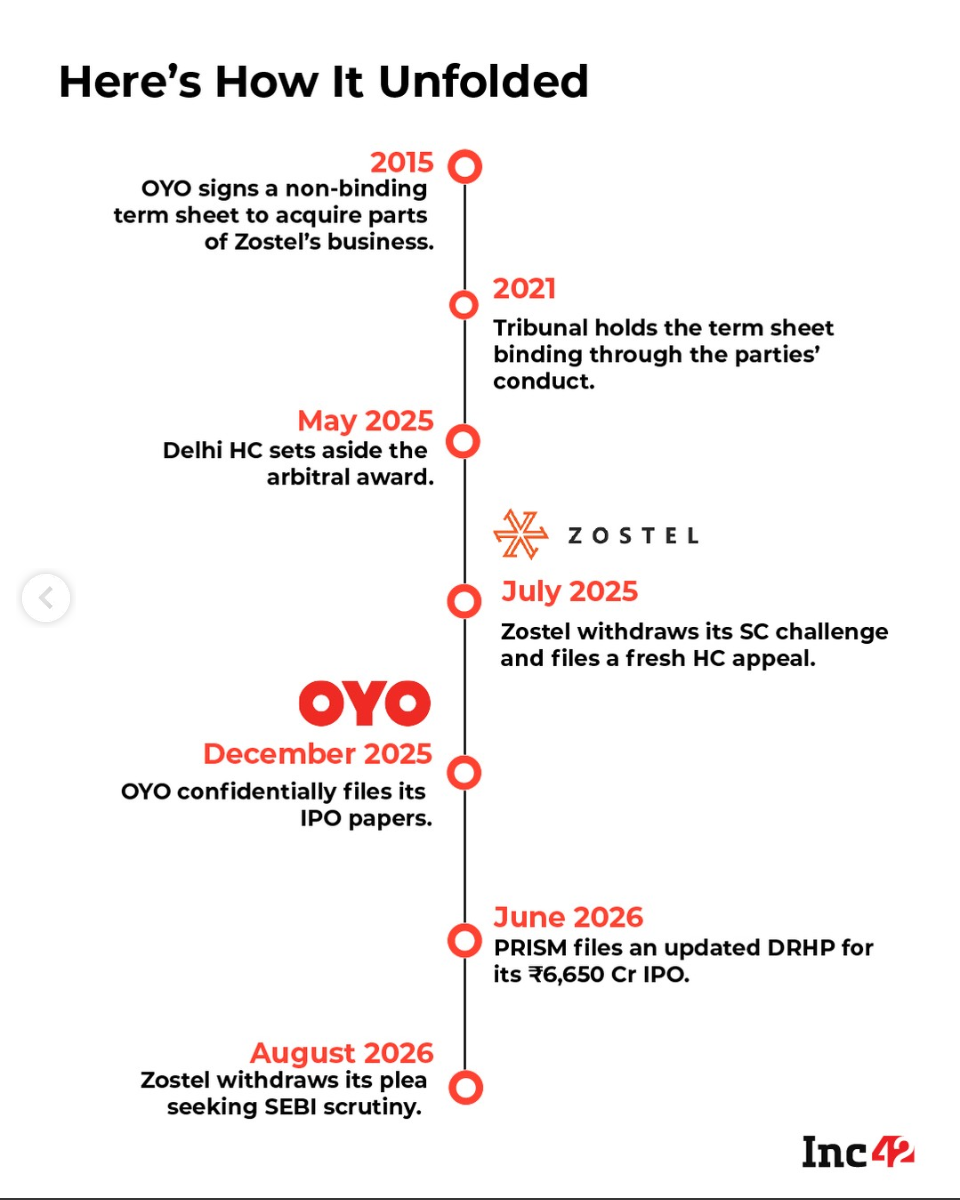
Last month, Zostel approached SEBI, alleging that OYO had made incomplete and misleading disclosures in its updated draft IPO papers. Zostel wanted SEBI to ensure these disclosures were corrected before OYO's proposed IPO moved ahead.
More recently, Zostel filed an application before the Delhi High Court. However, on August 10, it withdrew the application, while keeping the option open to approach the court again later.
The court also declined to intervene in Zostel's complaint before SEBI. Meanwhile, OYO continues to move ahead with its IPO plans after filing draft papers in June, proposing to raise up to ₹6,650 crore through a fresh issue of shares.
Why does this matter?
This case has become one of India's most closely watched startup disputes because it highlights an important lesson.
A term sheet is not the same as a signed acquisition agreement.
Even if both sides appear to move forward with a deal, the absence of a final legally binding contract can completely change the outcome years later.
That's exactly what the Zostel-OYO dispute has come to represent.