

 Newsletter
Every time a big tax raid hits the news, there’s a familiar reaction. Shock for five minutes, memes for ten, then life moves on. But zoom out a bit and something interesting shows up. Despite years of digitisation, demonetisation, tighter tax laws and endless PAN Aadhaar linking, black money in India hasn’t vanished. It has simply changed parking spots.
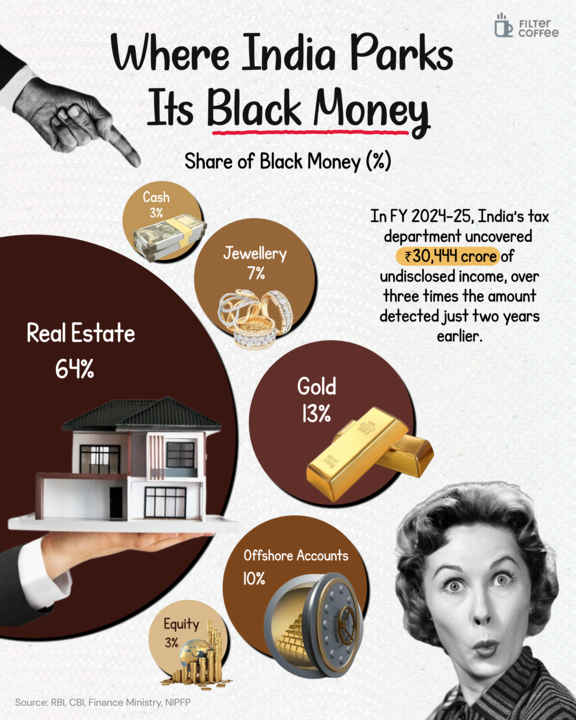
In FY 2024–25 alone, the Income Tax Department detected over ₹30,000 crore of undisclosed income. That’s more than three times what was detected just two years ago. And this happened even though the department carried out fewer physical surveys. Which tells you one thing clearly. Enforcement is getting sharper,and the system is no longer fishing with a net. It’s using a spear.
Now here’s the part that really tells you how India still thinks about money. When tax authorities trace where undeclared income is actually parked, most of it turns out to be sitting in very familiar places. Nearly two thirds of black money is still locked into real estate. Not crypto, not complex offshore structures, but plain old brick, cement, land and buildings. These are assets that don’t send alerts, don’t require logins, and don’t automatically show up in a database. Once money turns into property, it becomes slow, silent, and much harder to question.
Real estate has always been black money’s favourite hiding place for a reason. Property deals still allow room for cash components. Valuations are subjective. Stamp duty is high, which creates incentives to underreport transaction values. And unlike bank accounts, land does not flash alerts when something looks odd. Even after demonetisation and RERA, behaviour on the ground has changed far slower than policy on paper.
Demonetisation was the 2016 move where the government scrapped ₹500 and ₹1,000 notes overnight. The idea was to flush out black money, especially cash-heavy sectors like real estate. People who had piles of unaccounted cash were expected to either declare it or lose it.
RERA, or the Real Estate Regulatory Authority, came in to clean up the property market. It forced builders to register projects, disclose approvals, follow timelines, and keep buyer money in escrow accounts. In theory, this was supposed to reduce under-the-table dealings and shady accounting.
Gold comes next. Around 13% of black money sits quietly in gold. And this is not hard to understand. Gold is culturally trusted, easy to store, easy to move, and holds value across generations. Jewellery purchases, especially during weddings and festivals, often slip under reporting thresholds. Small ticket transactions across multiple buyers rarely trigger scrutiny. And once gold turns into heirloom jewellery, tracing its origin becomes almost impossible.
Jewellery as a category adds another layer. About 7% of undeclared wealth flows into high value jewellery beyond just bullion through diamonds, luxury pieces, custom designs. These assets are portable, discreet and emotionally justified. Nobody questions jewellery in a family locker. That’s precisely the point.
Offshore accounts still matter, but they are no longer the main villain of the story. Roughly 10% of black money is estimated to be parked overseas. This includes foreign bank accounts, shell companies and undisclosed investments. The government has raised over ₹40,000 crore in tax and penalty demands under the Black Money Act for undisclosed foreign assets so far. But actual recoveries are far lower. Not because the law is weak, but because money parked abroad is layered through complex structures and multiple jurisdictions.
What has changed is information flow. India now receives financial data from over 100 countries under global information sharing agreements. Bank balances, interest income, asset ownership details. This has made hiding money abroad much harder than it was a decade ago. Which explains why offshore parking has stopped growing as fast as before, and why domestic assets like property and gold remain more popular.
Cash, interestingly, now forms only a small slice of around 3%. After demonetisation, hoarding large volumes of cash became risky and inconvenient. Cash has also become harder to deploy at scale without leaving footprints. Try buying a house or luxury asset fully in cash today and alarms go off quickly. Cash is still used, but mostly as a transit tool, not a final destination.
Equities form another small slice at around 3%. That might sound counterintuitive in a booming stock market, but it makes sense. Markets are transparent. Transactions are logged. KYC is strict. Parking black money here without being noticed is difficult unless it is routed through multiple layers, which again raises complexity and risk.
What makes this entire picture more interesting is how enforcement itself has evolved. Instead of random raids, tax authorities now rely heavily on data analytics. GST filings, bank transactions, property registries, customs data, social media signals, all cross referenced. That jeweller with excess stock. That builder whose sales don’t match input costs. That trader whose lifestyle does not match declared income. Patterns are flagged first. Action follows later.
There is also a clear shift in intent.
Yet, for all this progress, one uncomfortable truth remains. No one actually knows how much black money exists in India. There is no official consolidated figure. What we see are detections, demands and estimates. Think of it like seeing only the ice that floats above water. The rest remains hidden by design.
And maybe that’s the real takeaway here. Black money is not just a tax problem. It’s a behavioural one. As long as high value transactions allow opacity, as long as social acceptance of cash components exists, and as long as enforcement remains reactive rather than preventive, the money will keep finding places to hide.
FAQs
What is black money in India?
Black money refers to income or wealth that is not reported to tax authorities. It is usually generated through underreporting income, cash transactions, or illegal activities, and is kept outside the formal financial system to avoid taxes.
Where is most of India’s black money stored today?
Most of India’s black money is still parked in real estate. A large share is also held in gold and jewellery, while smaller portions are kept overseas, in cash, or routed through complex financial structures.
Why is real estate the biggest parking spot for black money?
Real estate allows undervaluation of property deals and partial cash payments. Property prices are subjective, transactions are infrequent, and once money is converted into land or buildings, it becomes harder to trace digitally.
Did demonetisation eliminate black money?
No. Demonetisation reduced large-scale cash hoarding but did not eliminate black money. Instead, undeclared wealth shifted away from cash into assets like property, gold, and jewellery.
What role did RERA play in controlling black money in real estate?
RERA improved transparency and accountability among developers, but it did not fully stop cash components in property deals. Compliance increased, yet informal practices still exist at the transaction level.
Is black money still being sent to foreign accounts?
Yes, but at a lower scale than before. Stricter global information-sharing agreements have made hiding money overseas more difficult, pushing more undeclared wealth to stay within India.
Why is gold still used to hide black money?
Gold is easy to buy in small amounts, store privately, and pass across generations. Jewellery purchases often escape strict reporting, making gold a convenient way to convert unaccounted cash into a stable asset.
How does the Income Tax Department detect black money now?
Authorities rely heavily on data analytics, using bank transactions, GST filings, property records, and lifestyle indicators to identify mismatches between income and spending before initiating action.
Why is cash no longer the main form of black money?
Holding large amounts of cash has become risky after demonetisation and increased scrutiny. Cash is now mostly used as a temporary tool rather than a long-term store of undeclared wealth.
Has India solved its black money problem?
Not entirely. Enforcement has improved and detection has become sharper, but black money still exists. The challenge now is reducing opportunities for hiding wealth rather than just catching it after the fact.