

 Newsletter
You're walking into an electronics store to buy a new laptop. The salesperson tells you the same model now costs ₹20,000 more than it did a year ago. Your first instinct is probably to blame tariffs, inflation or maybe the rupee. But what if the real culprit is a tiny chip inside the machine that most people have never thought about?
The world may be entering a new kind of inflationary cycle, one driven not by oil, wheat or metals, but by memory.
Artificial intelligence has triggered one of the biggest infrastructure races in modern history. Companies like OpenAI, Microsoft, Amazon, Google, Meta and Anthropic are spending hundreds of billions of dollars building data centres to train and run increasingly powerful AI models. Nvidia has become the face of this boom because its GPUs power these systems. But there is another component becoming just as critical: memory.
If GPUs are the engines of AI, RAM and storage are the fuel tanks. And right now, the world cannot make enough of them.
Every computer has two kinds of memory. RAM, technically called DRAM, temporarily stores data while a device is running. NAND flash stores data permanently, whether that's your photos, operating system or applications. Every smartphone, laptop, server, gaming console, SSD, smartwatch and even many connected appliances rely on these two technologies. AI has suddenly become their biggest customer.
According to Bloomberg Intelligence, Microsoft, Amazon, Alphabet and Meta alone are expected to spend well over $330 billion on capital expenditure in 2026, with a significant portion going towards AI infrastructure. Several estimates suggest total AI infrastructure spending across hyperscalers could soon cross $500 billion annually, with some projections moving towards $700 billion as competition intensifies. Much of this spending is not just on GPUs, but also on the memory systems required to keep those processors fed with data.
This is where things get interesting.
Most people think Nvidia is the bottleneck in AI. In reality, Nvidia's latest AI chips are paired with enormous amounts of High Bandwidth Memory, or HBM, an advanced form of DRAM that offers dramatically faster data transfer. Nvidia's Blackwell Ultra platform, for example, comes equipped with up to 288 GB of HBM3E memory. A single AI server contains multiple such chips. A large AI cluster contains tens of thousands of these servers. The amount of memory required quickly becomes staggering.
Unlike processors, memory manufacturing is remarkably concentrated. Three companies, Samsung Electronics, SK Hynix and Micron, account for almost the entire global DRAM market.
The NAND market is similarly dominated by Samsung, SK Hynix, Kioxia, Western Digital and Micron. When demand suddenly surges, there are very few suppliers capable of increasing production. Building new fabrication plants costs tens of billions of dollars and typically takes three to five years before meaningful output begins.
That creates an unusual situation. Demand can rise almost overnight. Supply cannot.
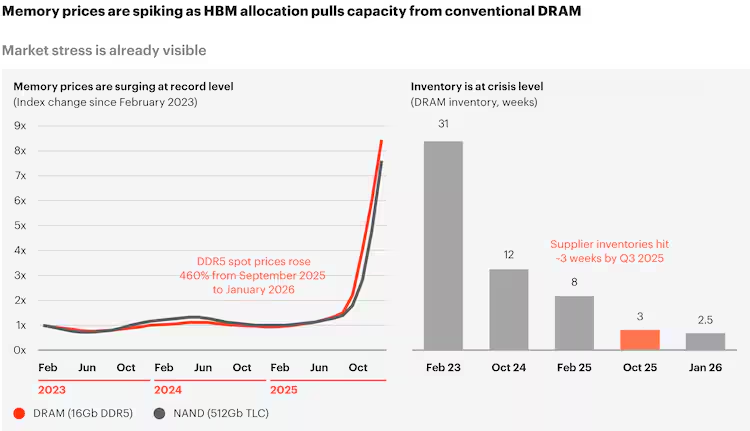
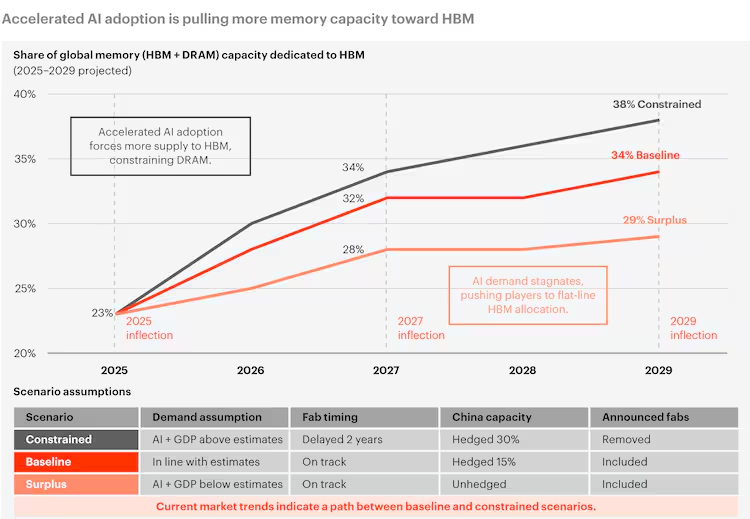
This isn't the first time the memory industry has experienced shortages. But this cycle looks different because manufacturers are making a rational business decision. AI memory is significantly more profitable than conventional laptop or smartphone memory. Instead of producing standard DRAM used in PCs, companies are increasingly allocating production capacity to HBM because hyperscalers are willing to pay premium prices. IDC says this shift represents a structural reallocation of manufacturing capacity rather than a temporary supply disruption.
The consequences are already visible.
Micron recently revealed that it has secured roughly $100 billion worth of long term supply agreements, with customers reserving production years in advance. Some buyers are reportedly even making advance payments simply to guarantee future supply. That is not how commodity electronics components were traditionally bought. It is how strategic resources are secured.
Industry executives believe this imbalance is unlikely to disappear anytime soon. Micron has repeatedly guided that demand for AI memory continues to exceed supply and that meaningful relief could still be several years away as new manufacturing capacity gradually comes online.
The immediate impact is obvious. Consumer electronics become more expensive.
Memory is one of the costliest components inside a smartphone or laptop after the processor and display. When DRAM and NAND prices rise sharply, manufacturers either absorb lower margins or pass those costs to consumers. Companies across the PC ecosystem, from Dell and HP to Apple and Lenovo, eventually face the same economics.
But the bigger story lies beyond gadgets.
Modern businesses run on computers. Hospitals use servers to manage patient records. Banks operate massive data centres. Airlines equip crews with tablets. Retailers depend on cloud infrastructure. Even your neighbourhood diagnostic lab relies on storage systems to archive medical images. As enterprise IT infrastructure becomes more expensive, those costs eventually find their way into the prices consumers pay.
It is admittedly different from an oil shock. When crude prices rise, transport becomes costlier almost immediately, pushing up the price of food, logistics and manufacturing within weeks. Memory inflation works much more slowly. Companies replace laptops every few years, upgrade servers periodically and expand data centres gradually. But over time, higher technology costs ripple through balance sheets before eventually appearing in the prices of goods and services.
There is also a geopolitical layer making the situation more complicated.
The United States has tightened restrictions on advanced semiconductor exports to China while also limiting access to some critical chipmaking technologies. China, meanwhile, is investing heavily in domestic memory companies such as ChangXin Memory Technologies (CXMT) and Yangtze Memory Technologies (YMTC) to reduce dependence on foreign suppliers. As AI becomes a strategic priority for governments, memory chips are beginning to resemble geopolitical assets rather than ordinary electronic components.
Of course, there are reasons not to overstate the comparison between memory and oil. Oil powers virtually every economic activity. Memory does not. A shortage of DRAM is unlikely to trigger economy-wide inflation on the same scale as an energy crisis. Technology products also tend to become cheaper over time through innovation and manufacturing efficiencies. New fabs under construction in South Korea, Taiwan, the United States and Japan could eventually ease supply constraints later this decade.
Yet the broader shift is difficult to ignore.
The next time you hear about inflation, crude oil will probably still dominate the headlines. But in the background, another commodity is becoming just as important for a world increasingly powered by software instead of fuel.
The economy may still run on oil. But the digital economy now runs on memory. And that makes RAM far more important than most of us ever realised.