

 Newsletter

Amazon triggered a mini panic across the global logistics industry this week. UPS and FedEx shares fell more than 9% in a single trading session. DHL slipped over 7%. GXO Logistics crashed nearly 13%. Even Delhivery fell in India after investors started wondering whether Amazon was preparing to do to logistics what it once did to cloud computing.
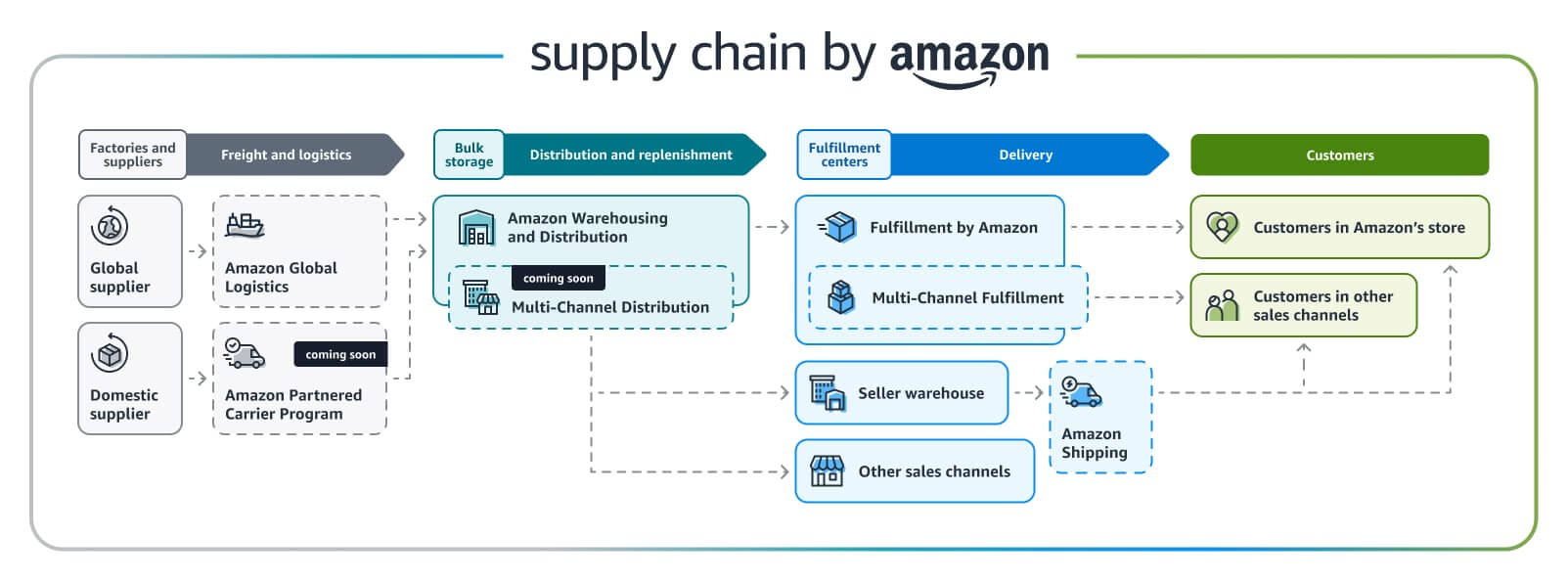
The trigger was Amazon’s announcement of Amazon Supply Chain Services, or ASCS, a new business that opens Amazon’s logistics infrastructure to outside companies. Businesses can now use Amazon’s freight network, warehouses, fulfilment centres and parcel delivery systems even if they do not sell products on Amazon.
For years, Amazon built one of the world’s largest logistics systems purely to support its own ecommerce operations. The company now operates across ocean freight, trucking, rail, warehouses, sorting centres, fulfilment hubs and cargo aircraft. Amazon says its logistics network includes more than 80,000 trailers, 24,000 intermodal containers and over 100 aircraft.
Reports estimate the company operates more than 250 cargo flights every day and runs over 1,200 logistics facilities globally, including around 350 large fulfilment centres.
Most consumers never really noticed this transition because they experienced Amazon only through Prime deliveries and fast shipping. But internally, Amazon has spent nearly two decades transforming itself into a logistics powerhouse.
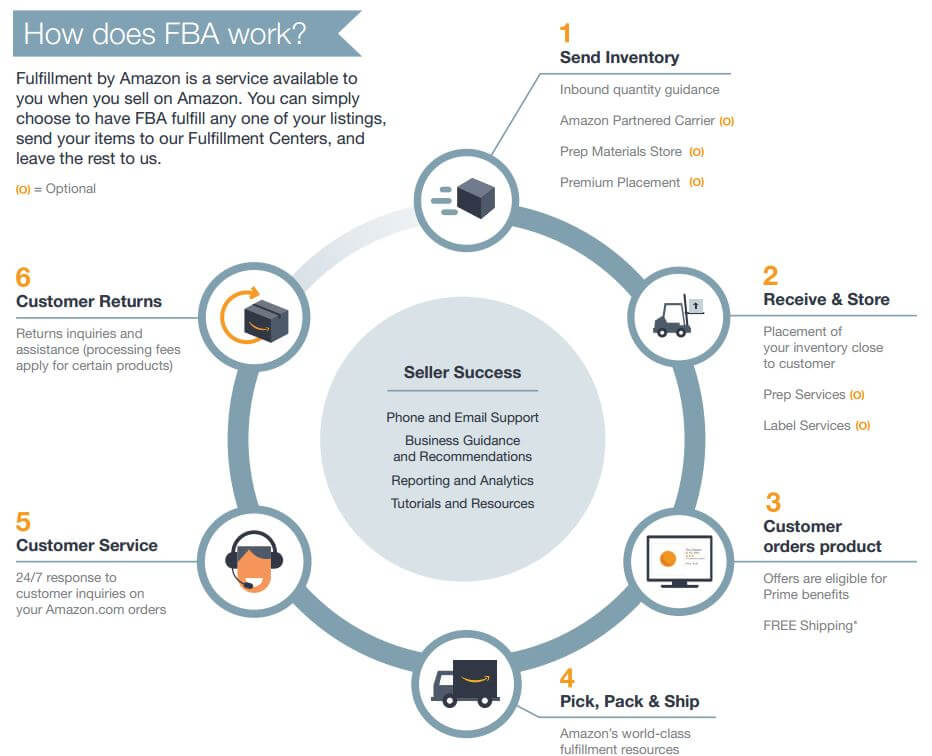
The story actually begins in 2006 with Fulfillment by Amazon, or FBA. Before FBA, most small online sellers had to handle storage, packaging, shipping and returns themselves. It was operationally painful and expensive. Amazon offered a different model. Sellers could simply send inventory to Amazon warehouses while Amazon handled the rest.
The model exploded.
Since launch, more than 80 billion units have been shipped through FBA. But Amazon quickly realised that ecommerce logistics was not just about delivering packages to homes. The bigger challenge was everything happening before that final delivery.
Products had to move from factories to ports, through customs, into warehouses and eventually closer to customer demand centres. Inventory needed forecasting. Multi-city distribution needed coordination. Different sales channels required different fulfilment systems.
Traditionally, companies stitched all this together through multiple vendors. One company handled freight. Another managed warehousing. A third handled fulfilment. A fourth delivered parcels.
Amazon decided to build the entire stack itself.
Around 2015 and 2016, Amazon accelerated investments into cargo aviation through Amazon Air. It leased Boeing freighters, created regional air hubs and expanded trucking infrastructure between fulfilment centres. Eventually, Amazon overtook the US Postal Service to become America’s largest package delivery company by volume.
India quietly became part of this strategy too. In 2023, Amazon launched Amazon Air in India with QuikJet Cargo Airlines using Boeing 737-800 aircraft connecting Hyderabad, Bengaluru, Delhi and Mumbai. At the time, Amazon called itself the first ecommerce company in India to launch a dedicated air cargo network.
And the company itself is framing the business in a very specific way.
Amazon executives repeatedly compared ASCS to AWS, or Amazon Web Services.
AWS also began as an internal capability. Amazon originally built massive computing infrastructure to support its own retail business. Later, the company realised other businesses needed the same infrastructure. So it converted internal systems into an external platform.
Today, AWS dominates global cloud computing.
Now Amazon is trying something similar with logistics.
Peter Larsen, Amazon’s Vice President for Supply Chain Services, said Amazon was bringing the “infrastructure, intelligence and scale” of its logistics network to businesses much like AWS did for cloud computing.
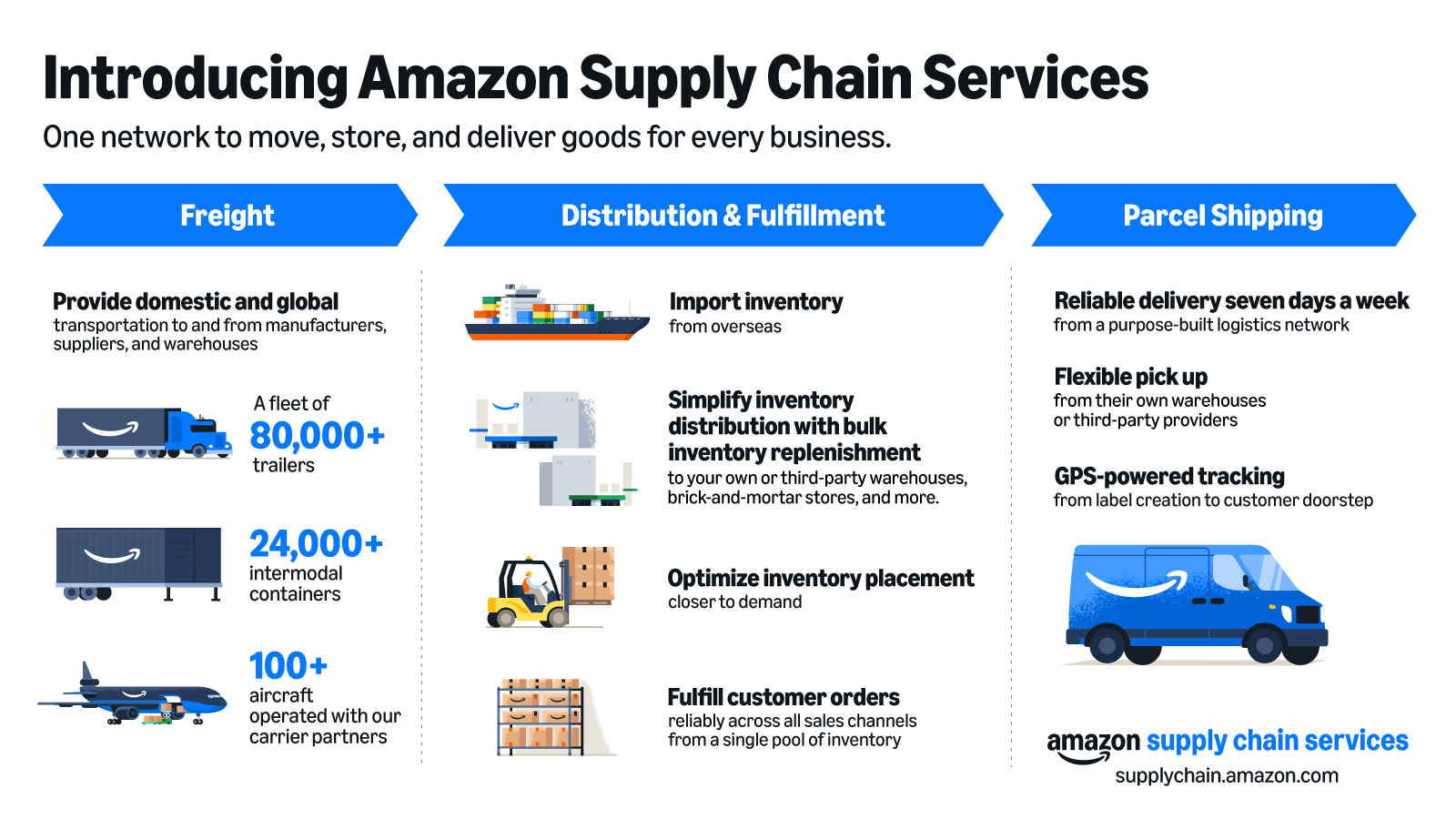
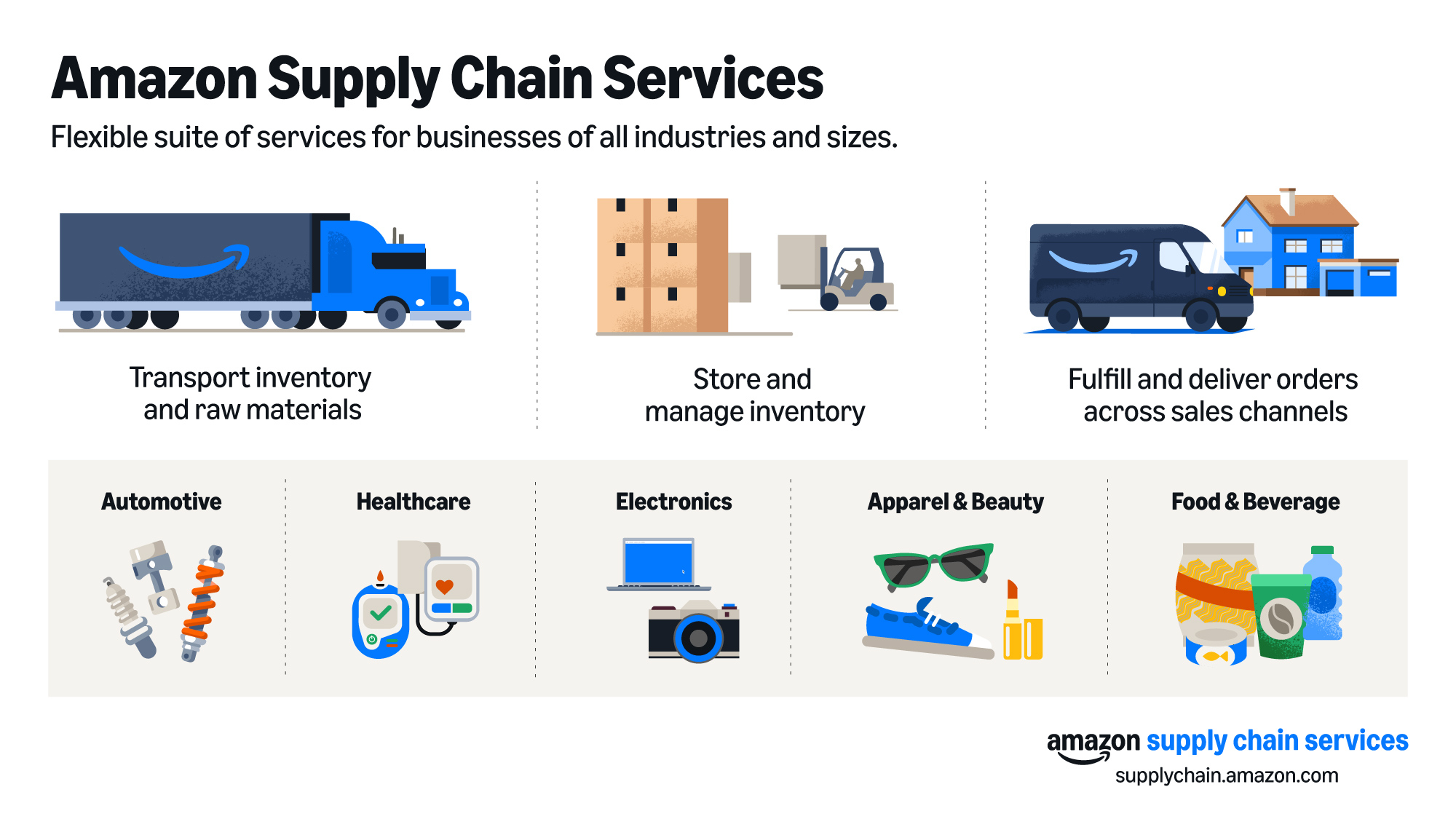
In practical terms, ASCS gives businesses access to freight services across ocean, air, rail and trucking networks. Amazon also offers customs clearance, shipment visibility, inventory forecasting and multi-channel fulfilment. Companies can store inventory within Amazon’s network and distribute products through their own websites, physical stores, social commerce platforms and marketplaces.
Amazon says sellers using its end-to-end logistics solutions have seen nearly 20% higher sales.
Logistics is no longer just a backend operational function. Faster delivery improves conversion rates. Better inventory placement reduces stockouts. Efficient fulfilment improves customer retention. Forecasting lowers working capital pressure.
In other words, supply chain efficiency now directly affects revenue growth.
That explains why some major global companies have already signed up for ASCS.
Procter & Gamble is using Amazon’s freight network to transport raw materials and move finished products through distribution channels. 3M is using Amazon’s network to move products from manufacturing sites to global distribution centres. Lands’ End is using Amazon’s inventory pooling systems for multi-channel fulfilment, while American Eagle Outfitters is using Amazon’s parcel network for ecommerce deliveries.
This is exactly why traditional logistics players reacted so sharply.
For decades, companies like UPS, FedEx and DHL controlled global parcel movement and enterprise logistics. But Amazon enters this market with unusual advantages.
It already handles billions of packages every year. It has enormous consumer demand data. It understands regional buying patterns in real time. It positions inventory close to high-demand urban clusters. And unlike traditional logistics firms, Amazon is extremely comfortable operating low-margin businesses if scale creates long-term strategic advantages.
Still, this does not automatically mean Amazon will crush the logistics industry.
In fact, several analysts believe the market reaction may have been too dramatic. Delivering ecommerce packages from nearby warehouses is one thing. Running full-service enterprise logistics across sectors like healthcare, industrial manufacturing and cross-border freight is another challenge entirely.
Companies like UPS and FedEx spent decades building sorting networks, customs expertise, enterprise shipping systems and specialised logistics capabilities. Healthcare logistics, temperature-sensitive transportation and industrial freight require operational complexity that cannot be replicated overnight.
Margins are another major reality check.
AWS generated operating margins of roughly 35% last year. Logistics businesses operate nowhere close to those levels. UPS’ supply chain solutions business operates around 10% margins, while Amazon’s own North American ecommerce business operates at margins of around 6.9%. International ecommerce margins are even lower at roughly 2.9%.
So even if ASCS scales massively, logistics remains a capital-intensive and operationally difficult business.
But Amazon’s strategy has never depended purely on margins. The company consistently prioritises scale, network density and long-term infrastructure advantages.
And that is where the India story becomes especially interesting.
India’s logistics ecosystem remains large but fragmented. Mordor Intelligence estimates India’s freight and logistics market could grow to nearly $592 billion by 2031. India’s ecommerce logistics market alone could cross $11 billion over the next five years, while the domestic courier and parcel market could exceed $10 billion.
This fragmentation creates opportunities for integrated platforms.
Industry experts quoted by Business Standard said ASCS could reduce fragmentation by combining transportation, warehousing and fulfillment into one technology-driven system. That becomes especially useful for Indian SMEs that struggle with inventory visibility, warehouse coordination and multi-channel deliveries.
But the pressure on existing logistics firms could increase significantly.
Parcel delivery and fulfilment-led warehousing appear most vulnerable because these are the areas where Amazon already operates at enormous scale. Companies like Delhivery, Blue Dart, XpressBees, Shadowfax and Ekart could face tougher competition in standardised ecommerce logistics.
Interestingly, Indian ecommerce companies have already been moving in this direction. Reports cited by ET suggest Amazon, Flipkart and Meesho together controlled roughly 82% of India’s ecommerce parcel volumes, putting pressure on independent third-party logistics providers.
That pressure has already triggered consolidation. Delhivery acquired Ecom Express for ₹1,369 crore in 2025 as logistics firms tried to build larger networks and improve profitability.
At the same time, specialised logistics players still retain important advantages. Enterprise relationships matter. Compliance-heavy logistics matters. Industrial freight expertise matters. Healthcare logistics matters.
Which means the future probably does not look like Amazon wiping out the logistics industry. Instead, Amazon may end up forcing the logistics sector to behave more like a technology industry.