

 Newsletter

Amazon made nearly $202 billion in revenue in just three months. Its operating profit jumped 61%, and its cloud business recorded its fastest growth in nearly five years. Yet, when the company announced its September-quarter results on Thursday, investors weren't entirely pleased.
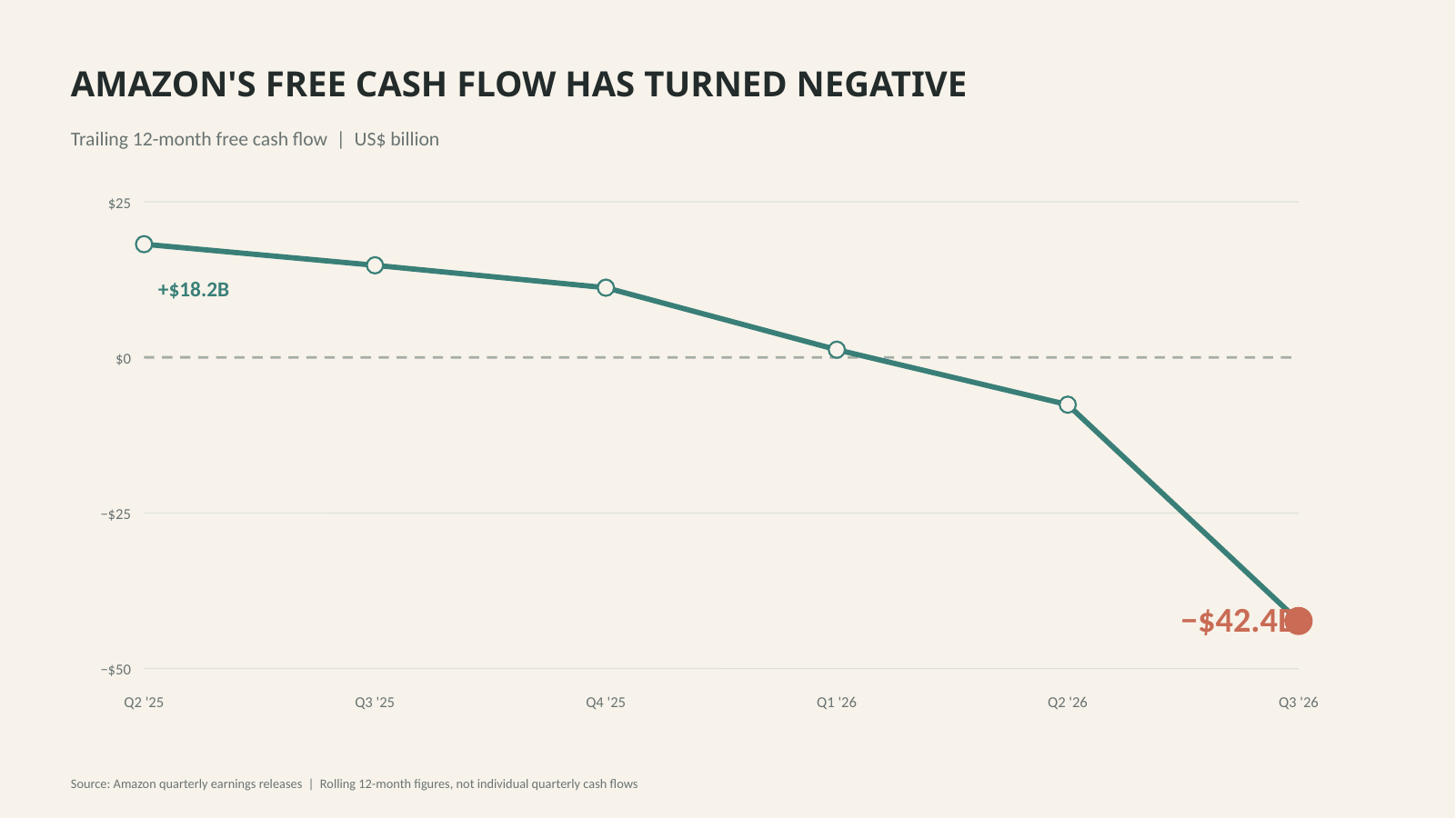
Amazon's shares fell around 7% in after-hours trading as its earnings missed Wall Street's expectations. But buried in its financial statements was another striking figure. The company's free cash flow had fallen to negative $42.4 billion for the 12 months ending September 2026, compared with a positive $14.8 billion a year earlier.
And Amazon has no plans to slow its spending. It expects to invest approximately $220 billion in capital expenditure this year, with much of that money going towards artificial intelligence infrastructure.
So how can one of the world's most profitable technology companies spend more cash than it generates?
The answer lies in the difference between profit and cash flow, and Amazon's increasingly expensive bet on AI.
You see, when a company reports a profit, it doesn't necessarily mean that much cash has landed in its bank account. Accounting profits include revenue and expenses recognised over a particular period, while cash flow tracks the actual money entering and leaving the business.
Free cash flow goes one step further. It measures how much cash remains after a company pays for its day-to-day operations and investments in physical assets such as machinery, buildings and equipment.
Imagine running a business that generates ₹100 crore in cash from its operations. You decide to spend ₹130 crore building a new factory. Your business could still be profitable, but your free cash flow would be negative ₹30 crore because you're investing more than you're generating.
Something similar is happening at Amazon, only on a much larger scale.
Over the past 12 months, Amazon generated $168.3 billion in operating cash flow, up 29% from the previous year. But its net purchases of property and equipment reached $210.7 billion, an increase of nearly $95 billion.
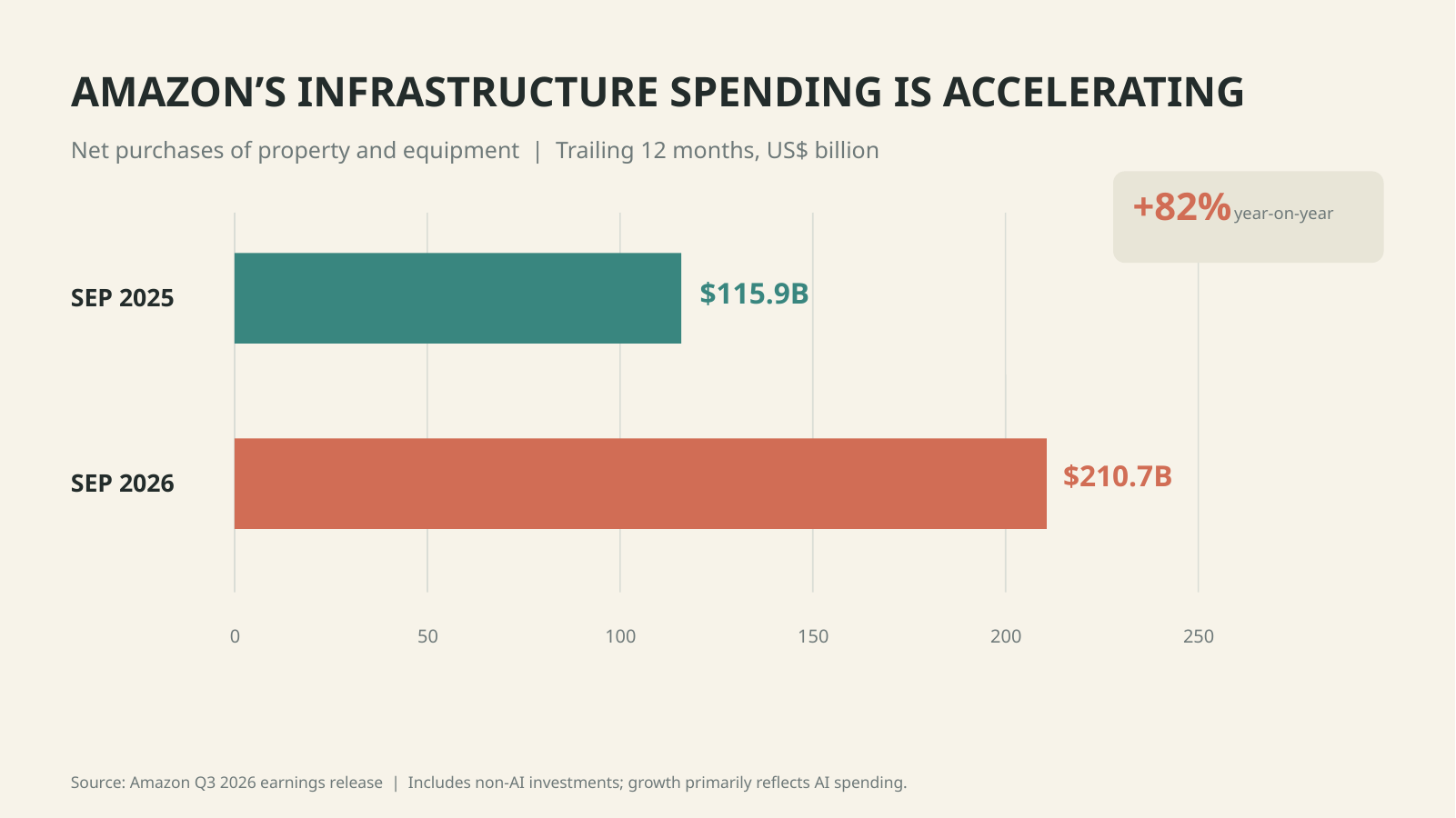
That spending pushed its free cash flow deep into negative territory. And much of it is going towards building the infrastructure needed to power AI.
Amazon Web Services (AWS), the company's cloud computing division, is central to this investment.
AWS rents computing power, storage and other technology services to businesses. When companies build AI models or run AI applications, they need powerful processors, servers and data centres. Amazon wants to supply that infrastructure.
And demand is growing rapidly.
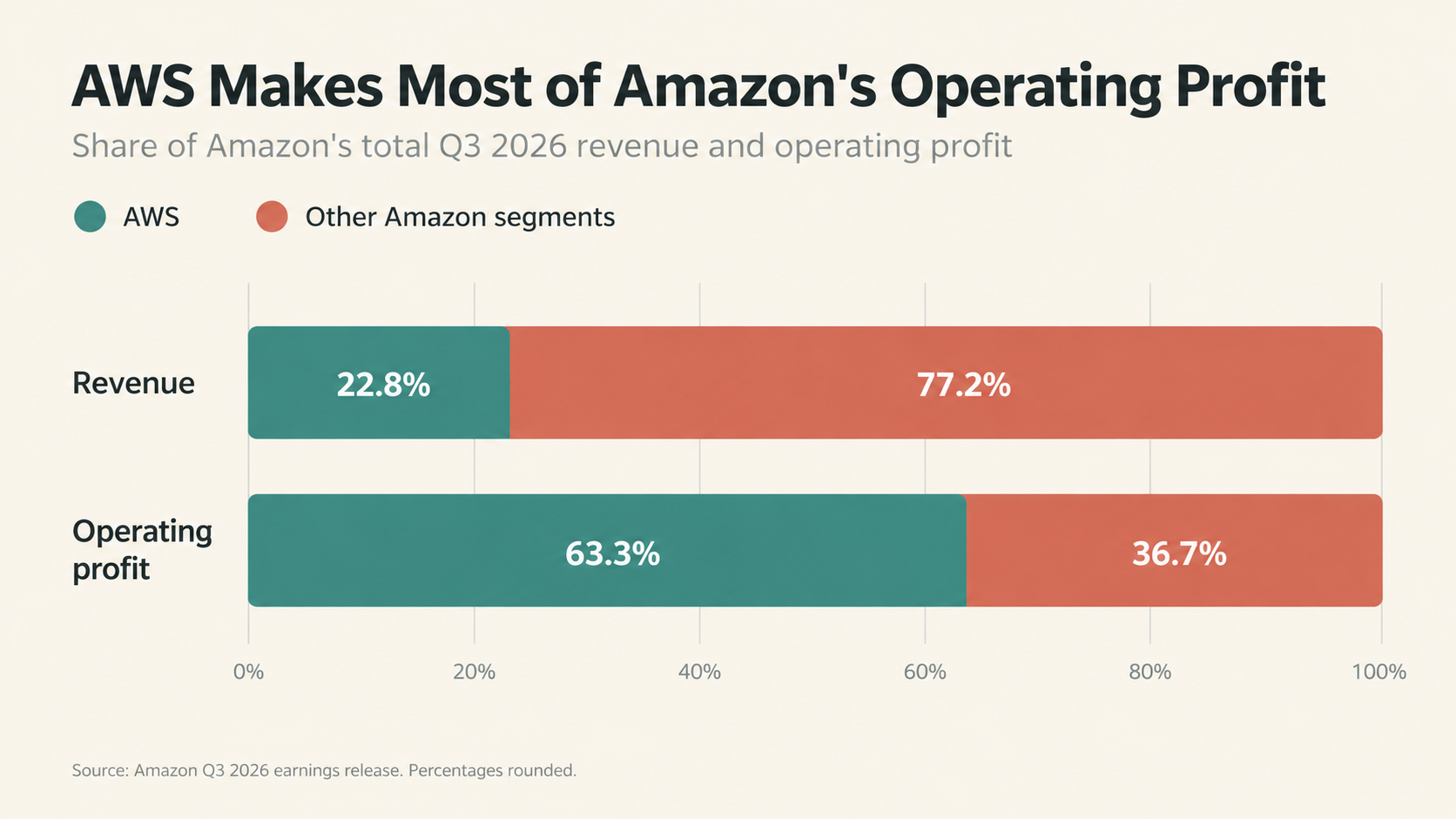
AWS generated nearly $46 billion in revenue during the September quarter, up 39% year-on-year. It also contributed $17.8 billion in operating profit, accounting for roughly 63% of Amazon's total operating profit despite generating less than a quarter of its revenue.
Amazon is spending heavily to accommodate that growth. Building AI data centres requires expensive chips, networking equipment, cooling systems and access to enormous amounts of electricity. Unlike software, where an additional customer can sometimes be served at relatively little extra cost, expanding AI computing capacity requires substantial upfront investment.
But there is a catch.
Much of this infrastructure must be purchased and installed before Amazon can earn revenue from it. And the cash spent buying equipment leaves the business immediately, even though the associated costs are generally recognised gradually in its income statement through depreciation.
That's how Amazon can report strong operating profits while its free cash flow deteriorates.
The company has some evidence that its investment could pay off. AWS reported a backlog of $578 billion in contracted future business, while CEO Andy Jassy expects its revenue to grow by more than 40% annually in both 2027 and 2028.
However, that backlog isn't money already earned. Amazon still needs to deliver the services, collect the revenue and generate sufficient returns on the infrastructure it is building.
And Amazon isn't alone in making this expensive bet.
Meta, which owns Facebook, Instagram and WhatsApp, reported negative free cash flow of $2.12 billion in the September quarter, even after generating $32.79 billion in operating cash. The company expects capital expenditure, including finance-lease principal payments, of $135 billion to $145 billion in 2026.
Both companies are investing enormous sums in anticipation of future AI demand, although Meta primarily uses AI to improve its advertising and consumer products, while AWS sells computing services to other businesses.
For investors, the uncertainty is how long these investments will remain economically productive.
AI hardware is improving rapidly. A chip purchased today might become less competitive as newer processors offer better performance at lower costs. If companies must replace equipment frequently, their infrastructure bills could remain high even as revenue grows.
Still, negative free cash flow doesn't automatically indicate financial trouble. Amazon continues to generate substantial cash from operations and held approximately $114 billion in cash, equivalents and marketable securities at the end of September.
The company is deliberately directing enormous resources towards expansion. Its challenge is ensuring those investments generate attractive returns.
And that will be the test of Amazon's AI strategy over the next few years. AWS revenue is already growing quickly, but investors will be watching whether operating cash flow can eventually catch up with capital expenditure, and whether the expensive infrastructure being built today earns enough to justify its cost.
Amazon has demonstrated that AI computing can be a highly profitable business. It now has to prove that spending hundreds of billions of dollars to expand it is equally profitable.
Sources
- Amazon Q3 2026 Earnings Release | Revenue, operating profit, AWS performance, cash flow and capital expenditure.
- Associated Press: Amazon's Third-Quarter Results | Investor reaction, earnings expectations and AI infrastructure investments.
- Meta Q3 2026 Earnings Release | Meta's operating cash flow, free cash flow and AI capital spending.