

 Newsletter

America has had a rather rough week with technology.
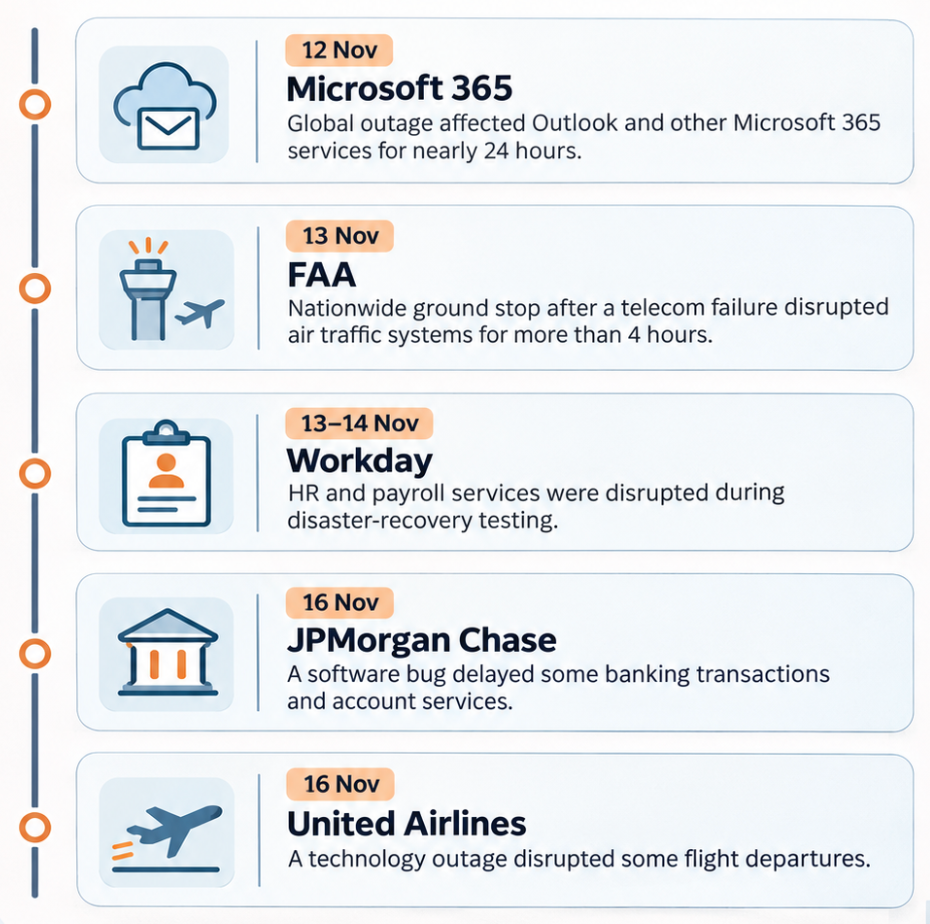
In less than five days, Microsoft, JPMorgan Chase, United Airlines and several other major companies experienced widespread system failures. Emails stopped working, banking transactions were delayed, employees lost access to payroll systems, and thousands of flights were disrupted.
The biggest disruption came on November 13, when a telecommunications failure forced the US Federal Aviation Administration (FAA) to temporarily halt departures nationwide for more than four hours.
And with so many systems failing around the same time, people began wondering whether the incidents were connected. Was it a coordinated cyberattack? Or had artificial intelligence somehow gone wrong?
Even US Homeland Security Secretary Markwayne Mullin floated an AI-related explanation, suggesting that increasingly powerful AI programmes might be overwhelming older computer systems.
But the evidence so far points towards something much more familiar: software bugs, ageing infrastructure and the difficulty of keeping increasingly complicated technology systems running.
Take the FAA incident.
On November 13, a contractor called L3Harris Technologies was carrying out routine maintenance at an FAA facility in Arkansas. The agency was replacing old copper-based telecommunications lines with modern fibre-optic connections.
During the upgrade, a newly installed router became one of the suspected sources of excessive network traffic. The system was receiving roughly 1,000 connection attempts every four to five seconds, overwhelming parts of its older infrastructure.
This disrupted communications and radar feeds used by air traffic controllers. As a precaution, the FAA stopped departures across the country.
More than 3,500 flights were grounded during the emergency, and normal operations took hours to resume.
According to the FAA's explanation, the precise cause of the router malfunction remains under investigation. But the incident exposed a problem with America's ageing aviation infrastructure.
The agency is still transitioning from copper-based communications technology to modern digital networks. And upgrading such systems is difficult when they must remain operational throughout the process.
Microsoft experienced a different version of the same problem.
On November 12, Outlook and several Microsoft 365 services went down globally for nearly 24 hours.
The company later identified a software defect that had been sitting unnoticed in its systems since July. Under normal conditions, everything worked fine. But when additional traffic was redirected to the affected servers, the hidden defect caused them to become overwhelmed.
Microsoft's automated recovery system tried moving users to other available servers. Unfortunately, those servers encountered the same problem.
Within two hours, more than 80% of the affected gateway servers had become unresponsive.
And because Microsoft's systems are interconnected, the disruption spread across regions. The company's preliminary investigation found no connection to cyberattacks or AI agents.
Something similar happened at Workday, the software company that businesses use for payroll, employee records and HR operations.
On November 13, Workday was testing its disaster-recovery environment, essentially a backup system designed to keep services running during emergencies. But during the test, components of the backup environment unexpectedly connected to live production databases, leaving some information inconsistent.
Workday had to temporarily shut down affected services to prevent further problems.
The backup system meant to protect operations had itself contributed to the disruption.
Then, on November 16, JPMorgan Chase experienced delays in processing transactions. The bank identified a software bug in its internal systems and said transactions involving other banks could also be delayed.
United Airlines experienced a separate technology failure that disrupted some departures the same day.
There is no verified evidence that these incidents were connected. But they illustrate a common weakness in modern technology.
Companies depend on multiple layers of software, networks, databases and automated systems working together. When one component fails, the consequences can spread far beyond where the original problem began.
Automation is supposed to make these systems more reliable. Servers can redirect traffic when another server fails. Backup databases can take over during emergencies. Software can automatically detect and respond to problems.
But these safeguards depend on the same underlying infrastructure functioning correctly. As Microsoft and Workday demonstrated, recovery systems can sometimes make an outage harder to contain.
And this brings us back to the AI theory.
Mullin suggested that advanced AI systems might be writing and modifying code faster than older infrastructure can handle. It is a plausible technological risk, particularly as companies increasingly experiment with autonomous coding agents.
However, no investigation has established that AI caused these November outages. Microsoft's report explicitly ruled out AI agents, while the FAA has found no evidence linking its disruption to AI.
The recent failures raise a more immediate concern.
Businesses are building increasingly sophisticated digital services, but keeping the underlying infrastructure reliable is becoming an enormous engineering challenge.
And when essential services such as banking, aviation and workplace software depend on these systems, even a routine maintenance operation or an unnoticed software bug can inconvenience millions of people.
America's technology problems may eventually be compounded by AI. But this week's outages show that ordinary software failures are already capable of causing plenty of disruption.