

 Newsletter
UltraTech Cement announced a milestone on October 5 that had very little to do with cement. The company had crossed 2,024 megawatts (MW) of green energy capacity for its own use. Of this, 1,580 MW comes from renewable sources, while another 444 MW comes from systems that recover heat from cement production and turn it into electricity.
Together, these sources now meet about 48% of UltraTech's power requirements. For a cement manufacturer, that's nearly half its electricity secured through arrangements outside its ordinary grid supply.
And UltraTech has plenty of companies.
JSW Steel has commissioned close to 1,000 MW of renewable capacity, Ambuja Cements has nearly 980 MW of captive renewable capacity, and Tata Steel is developing additional renewable projects. Even carmakers such as Maruti Suzuki and Tata Motors, along with commercial property operators, are finding ways to generate or secure their own electricity.
Which is a little curious. India already has power companies, transmission networks and state electricity suppliers. So why are cement and steel manufacturers increasingly investing in the business of producing electricity?
Well, the explanation begins with something every manufacturer understands: the electricity bill.
Consider a steel factory. Its furnaces need enormous amounts of electricity to melt metal, and production cannot simply stop whenever power becomes expensive. According to a 2026 study by JMK Research, electricity can account for as much as 40% of operating costs at some secondary steel manufacturing units.
That's a substantial portion of the money spent keeping a factory running. And it becomes particularly painful when the electricity purchased from the grid costs more than alternative sources.
The same JMK study found that renewable electricity was available at approximately ₹4.5–6 per unit in several states, compared with industrial grid tariffs of ₹7–8 per unit.
Imagine a factory consuming 10 crore units of electricity annually. At ₹8 per unit, its electricity bill would be ₹80 crore. If the factory could procure that entire quantity at ₹5, the cost would fall to ₹50 crore.
That's a difference of ₹30 crore a year.
Of course, these are illustrative numbers. Factories also need to account for transmission charges, financing, backup electricity and the fact that solar and wind cannot supply power at every hour of the day. But even after accounting for these costs, the potential savings can be meaningful for industries operating on relatively thin margins.
And that brings us to a peculiarity of India's electricity market.
For years, electricity tariffs have worked differently for different consumers. State electricity distribution companies, commonly called DISCOMs, supply electricity to households, farms, shops and factories. Industrial and commercial consumers have traditionally paid relatively high tariffs, partly to support lower electricity prices for certain residential and agricultural consumers.
This arrangement is known as cross-subsidisation. Essentially, some consumers pay more to help keep electricity affordable for others.
Although this cross-subsidy has narrowed considerably in many states, industrial electricity can still be expensive. And since electricity costs directly affect manufacturing profits, businesses have long had an incentive to find another way to power their operations.
In fact, Indian manufacturers were doing this well before solar panels and corporate sustainability targets entered the picture.
During the decades following Independence, India's electricity infrastructure struggled to keep pace with industrial expansion. Power cuts, voltage fluctuations and inconsistent supply created serious problems for factories that needed electricity continuously.
Imagine running an aluminium smelter or steel plant where an unexpected power interruption could disrupt an entire production process. Waiting for the electricity board to restore supply wasn't always practical. Large manufacturers therefore began installing their own coal, diesel and gas-based generating plants.
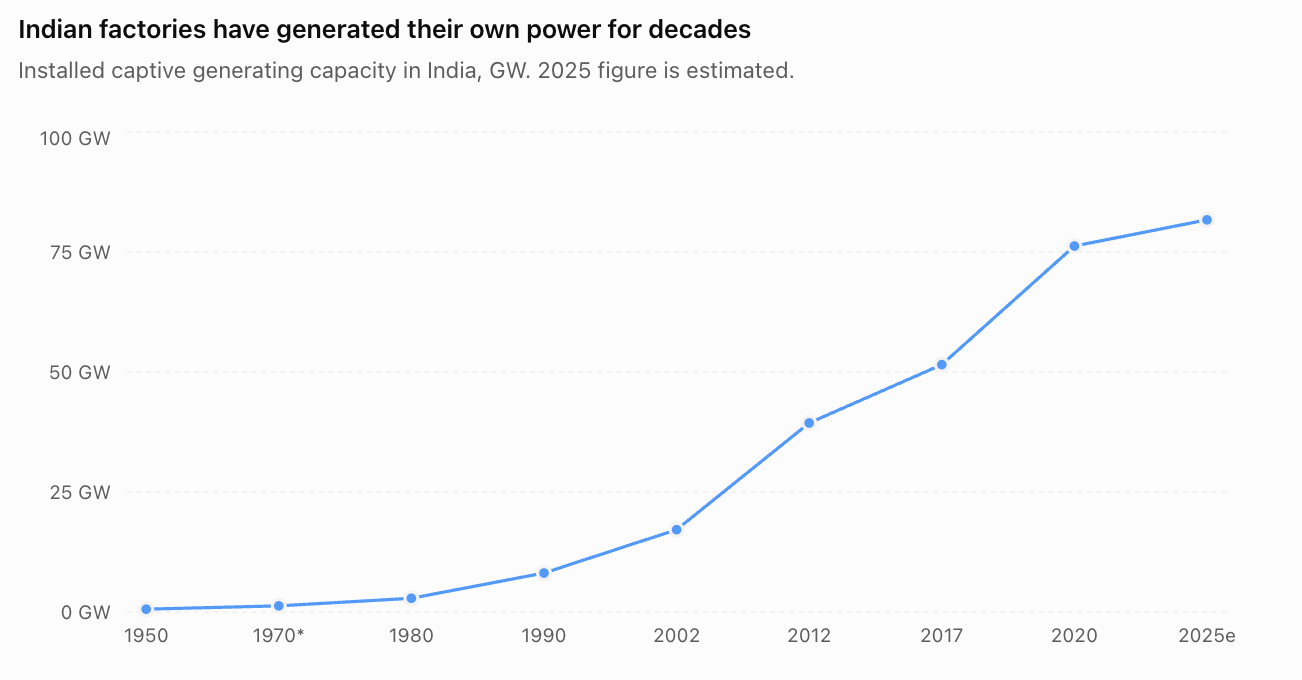
These were called captive power plants, meaning the electricity generated was primarily meant for the company's own consumption.
The practice grew steadily. According to the Central Electricity Authority, India's industrial captive generating capacity increased from approximately 8.1 GW in 1990 to an estimated 81.7 GW by March 2025.
But here's a detail that puts the current developments into perspective. Even in 2025, renewable energy accounted for only around 11% of conventional industrial captive capacity, while steam-based and diesel generation dominated.
Indian factories have been producing electricity for decades. What is changing now is the economics of producing it.
Earlier, the primary concern was ensuring uninterrupted supply. A company might build a coal-fired power plant because it couldn't afford to depend entirely on the grid. Today, cheaper renewable energy allows businesses to secure electricity at competitive rates, sometimes for the next 15 to 25 years.
And they don't necessarily have to build a power station themselves.
Suppose three manufacturers want cheaper electricity but don't have enough land, capital or expertise to develop separate solar projects. Instead, they can jointly invest in one renewable power project developed and operated by a specialist energy company.
This arrangement is called group captive.
Under India's electricity rules, qualifying captive users must collectively own at least 26% of the generating project and consume at least 51% of its annual electricity generation, subject to additional ownership and consumption requirements.
Why go through this trouble? Because qualifying captive consumers can avoid certain surcharges that would otherwise apply when purchasing electricity from an independent power producer through the grid.
For businesses consuming millions of electricity units, these charges can substantially affect the final cost. A group-captive arrangement allows manufacturers to share the investment, secure long-term electricity and potentially reduce what they pay.
Government policy has gradually made these arrangements easier. The Electricity Act of 2003 established a framework for captive generation and open access, which allows eligible businesses to purchase electricity from sources other than their local DISCOM.
Then, in 2022, the government introduced Green Energy Open Access Rules, lowering the general eligibility threshold for renewable electricity procurement from 1 MW to 100 kilowatts. This allowed smaller commercial and industrial consumers to participate. In March 2026, the government further clarified rules concerning captive ownership, electricity consumption and surcharge treatment.
These changes have helped companies explore electricity procurement arrangements that were previously difficult or expensive to implement.
And adoption is picking up.
According to Mercom India, nearly 6 GW of solar open-access capacity was added during the first half of 2026, an increase of 42% over the same period in 2025. India's cumulative solar open-access capacity reached 36 GW by June.
Not all of this represents captive power. Open access also includes electricity purchased from independent producers without an ownership stake. But the growth reflects how rapidly businesses are exploring alternatives to buying their entire electricity requirement from their usual supplier.
Large manufacturers are approaching this differently depending on their operations.
JSW Steel, for instance, reported commissioning nearly 1 GW of renewable energy capacity in FY26, with approvals for a larger 2.5 GW renewable portfolio and 320 MWh of battery storage. Maruti Suzuki, meanwhile, sourced approximately 23% of its manufacturing electricity from renewables in FY26 and wants to increase that share to 85% by FY31, combining its own generation with external green-power procurement.
Cost savings are one incentive. Reducing emissions is another, particularly for companies supplying international markets where customers and regulators are increasingly concerned about the carbon footprint of manufacturing.
Still, producing renewable electricity and running an entire factory on renewables are two very different things.
Take Tata Steel. Despite its renewable energy investments, the company's FY26 annual report shows that renewables accounted for only 2.4% of electricity consumed at its Indian operations. It expects that share to increase to 6.4% in FY27.
That's partly because steelmaking is extremely energy-intensive. Coal, industrial by-product gases and other sources continue to play important roles. And even when manufacturers install substantial solar and wind capacity, they cannot rely on these sources alone for uninterrupted electricity.
Solar generation falls after sunset, wind output fluctuates, and a factory cannot always adjust production around the weather. Companies still need some combination of grid electricity, conventional generation, storage and backup systems.
Which means that even as manufacturers reduce how much electricity they purchase from DISCOMs, many will continue depending on the grid.
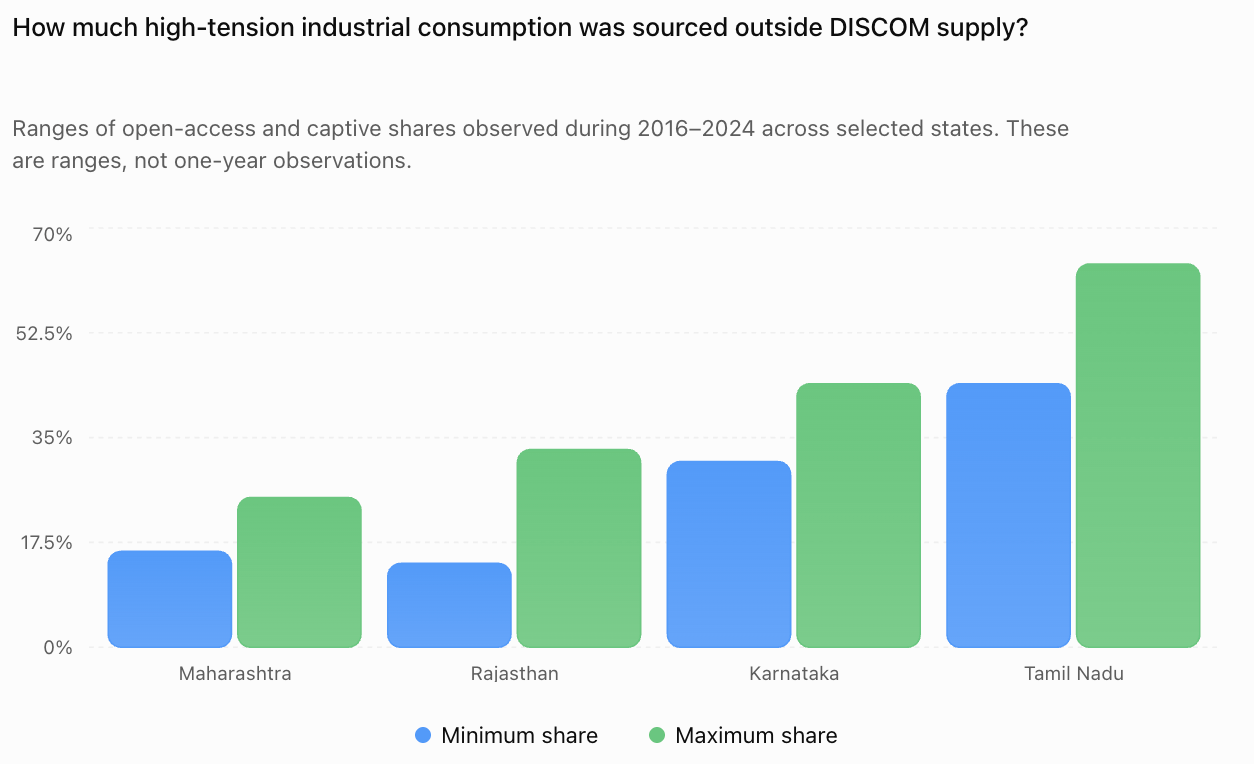
And that's creating a rather complicated situation for India's electricity suppliers.
DISCOMs have traditionally counted on industrial and commercial customers for revenue. When large manufacturers begin generating or procuring electricity elsewhere, these suppliers can lose sales while continuing to maintain the infrastructure those same companies rely on for transmission and backup power.
Research by Prayas Energy Group shows that cross-subsidy revenue has already become a relatively small share of DISCOM revenue in many states. The challenge now increasingly involves recovering the costs of maintaining the grid and providing reliable electricity to customers who purchase less power directly from DISCOMs.
After all, transmission lines, substations and backup arrangements still need to be maintained, even when factories source more electricity independently.
And with India's electricity demand expected to grow, these questions are only becoming more relevant.
The International Energy Agency expects India's electricity consumption to increase by an average of 6.4% annually through 2030, adding more than 570 terawatt-hours to annual demand over five years. Industry is expected to account for roughly one-third of that growth.
New factories, expanding manufacturing facilities and energy-intensive data centres will all need dependable electricity. For businesses planning investments that will operate for decades, securing power at predictable prices can become as important as securing raw materials, land or logistics.
Yet the economics will not work equally well for everyone. Large industrial groups can invest substantial capital and negotiate long-term contracts, while smaller manufacturers may struggle with financing, regulatory requirements or the complexity of arranging renewable supply.
The future of captive power will therefore depend on whether these arrangements become easier and more affordable for businesses beyond India's biggest industrial groups.
India's factories originally began producing electricity because they couldn't always rely on the grid to keep their machines running. Today, more of them are securing their own power because relying entirely on grid tariffs can be expensive.
For manufacturers, that offers an opportunity to lower costs, manage future price increases and improve competitiveness. For the electricity industry, it creates a challenge of its own.
As factories become more independent in how they source electricity, India's power system will have to figure out how to make industrial electricity cheaper while ensuring the shared grid remains financially sustainable.