

 Newsletter

Something as basic as a condom is getting caught in a global geopolitical mess.
The world’s largest condom manufacturer, Karex, which produces over 5 billion units every year and supplies brands like Durex and Trojan, has warned that prices could rise by 20-30%. The reason is not demand, not marketing, but a supply chain shock triggered by the Iran conflict.
Raw material costs have surged, shipping routes have slowed down, and even a single missing component can halt production lines. What sounds like a niche manufacturing issue is actually a ripple effect from oil markets to everyday consumer goods.
To understand why this is happening, you have to start with what condoms are made of. Most modern condoms rely on materials like synthetic rubber, nitrile, silicone lubricants and plastic-based packaging.
All of these are derived, directly or indirectly, from petrochemicals. And petrochemicals come from crude oil. When oil supply chains are disrupted, everything that depends on it starts wobbling. Since the conflict began earlier this year, key inputs like naphtha, a critical petroleum by-product used to make synthetic materials, have seen extreme volatility.
Asia depends on the Middle East for more than half of its naphtha supply, and refining margins have jumped from about $108 per tonne before the war to over $400 per tonne. Plastic resin prices in Asia have also surged by as much as 59%
At the same time, logistics have become a bottleneck. Shipments that used to take one month are now taking close to two months. That means inventory is stuck at sea while shelves run empty.
For a product like condoms, which is high-volume, low-margin, and highly dependent on consistent supply, this kind of delay creates immediate shortages. Demand itself has also gone up by roughly 30% this year, partly because distributors and buyers are stocking up in anticipation of further disruptions.
India is one of the largest condom markets in the world, consuming roughly 2.4 billion units annually. The market itself is estimated to be close to $900 million and is steadily expanding as conversations around sexual wellness become more open and digital platforms make purchases more discreet. Brands like Manforce, Durex, Moods, Skore and KamaSutra have turned what used to be a purely functional product into a lifestyle category, with flavoured variants, premium positioning and aggressive marketing.
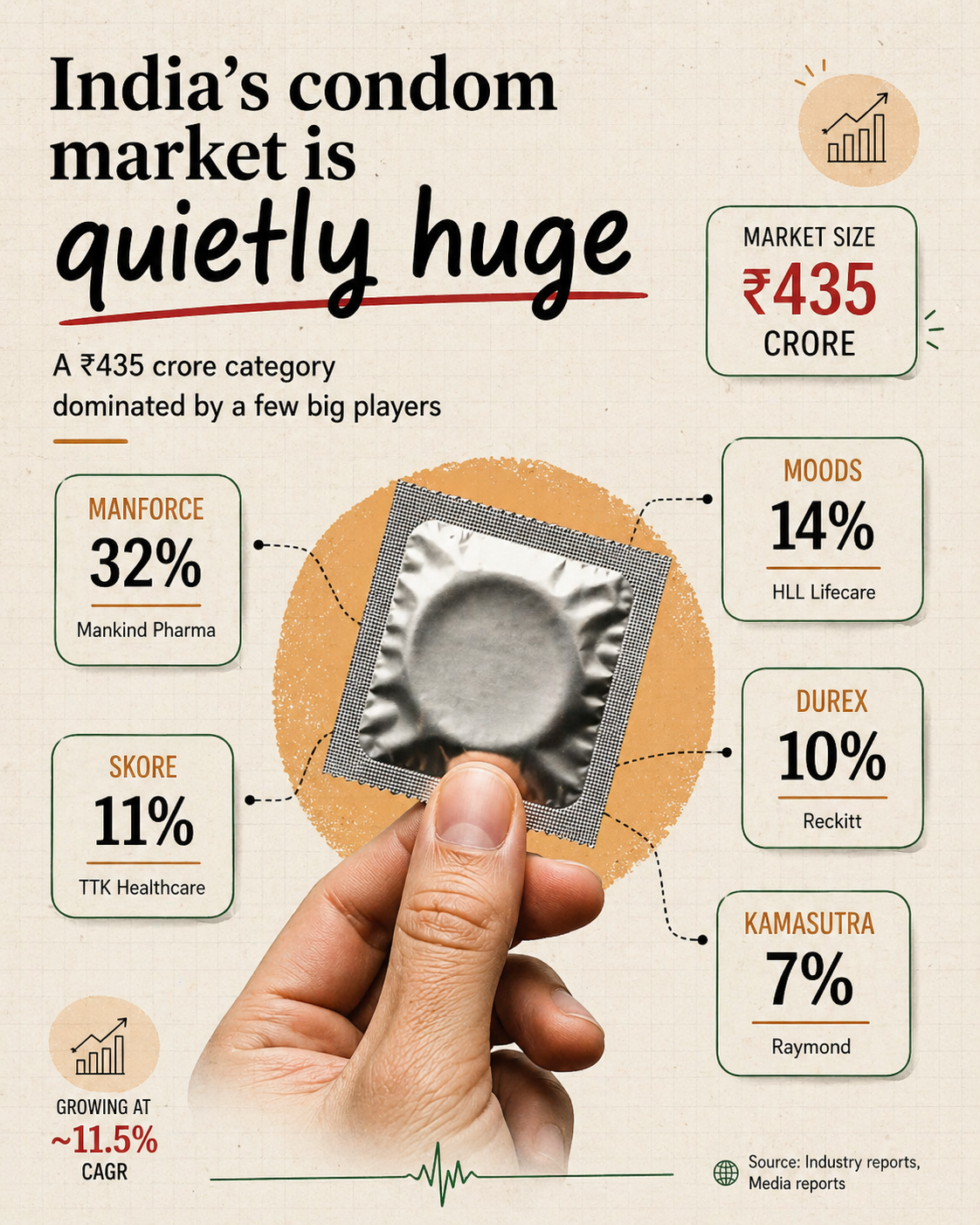
However, economics still remains very sensitive. Condoms remain a critical public health product. For large sections of the population, especially low-income groups, access depends on affordability and availability through public channels.
This is where the global shock hits hardest. If input costs rise sharply and manufacturers pass that on, even partially, retail prices will go up. For urban consumers buying premium variants online, this may just mean paying slightly more. But for mass segments and government procurement, it creates a deeper challenge.
Public health systems already operate within tight budgets. Any increase in procurement costs means either fewer units distributed or higher spending requirements. Neither is easy to manage, especially when demand is not optional.
And the impact does not stop at condoms. What this situation really highlights is how deeply connected everyday products are to global energy markets. The same petrochemical disruption is affecting everything from plastic packaging to medical supplies, food containers and even toys.
In India, there have already been instances of sharp increases in prices of plastic components like bottle caps. When oil supply tightens, it does not just make fuel expensive, it quietly pushes up the cost of living across categories that people rarely connect back to crude oil.
There is also a subtle global reshuffle underway. While Asian manufacturers that rely on Middle Eastern feedstock are under pressure, North American producers are relatively insulated because they use ethane derived from natural gas. That gives them more stable input costs and better margins in times like this. Over time, this could influence where production shifts and how companies rethink their supply chains.
For India, the long-term question is whether domestic manufacturing can buffer some of these shocks. India does have a base in natural rubber production, which is used in certain types of condoms, but a significant part of the industry still depends on synthetic inputs linked to global petrochemical markets.
Building resilience would mean diversifying raw material sources, strengthening local supply chains, and possibly investing more in alternatives.
Over the past decade, India’s sexual wellness market has moved from quiet pharmacy purchases to openly marketed products on quick commerce apps and D2C platforms. If prices rise significantly, there is a risk that consumption becomes more price-sensitive again, especially among younger or lower-income consumers. That could slow down the progress made in normalising safe sex.
What looks like a simple price hike is actually a story about how interconnected the world has become. A conflict thousands of kilometres away is influencing oil flows, which affects petrochemicals, which disrupts manufacturing, which delays shipping, which raises prices, which finally shows up in a product that sits at the intersection of health, behaviour and economics.
For consumers, it may soon mean paying a bit more for something they rarely think twice about. For businesses and policymakers, it is a reminder that even the most basic products depend on fragile global systems. And for India, it highlights the importance of building stronger, more self-reliant supply chains in categories that may seem small, but carry outsized importance.