
 Newsletter
Walk into a bookstore, a craft store or even a niche hobby club today and you will notice something that feels slightly out of place in 2026.
You’ll see Gen Zs browsing shelves. The same generation that grew up on TikTok, now flipping through journals, buying film rolls, picking up crochet kits and signing up for pottery workshops.
They are quietly stepping away from them.
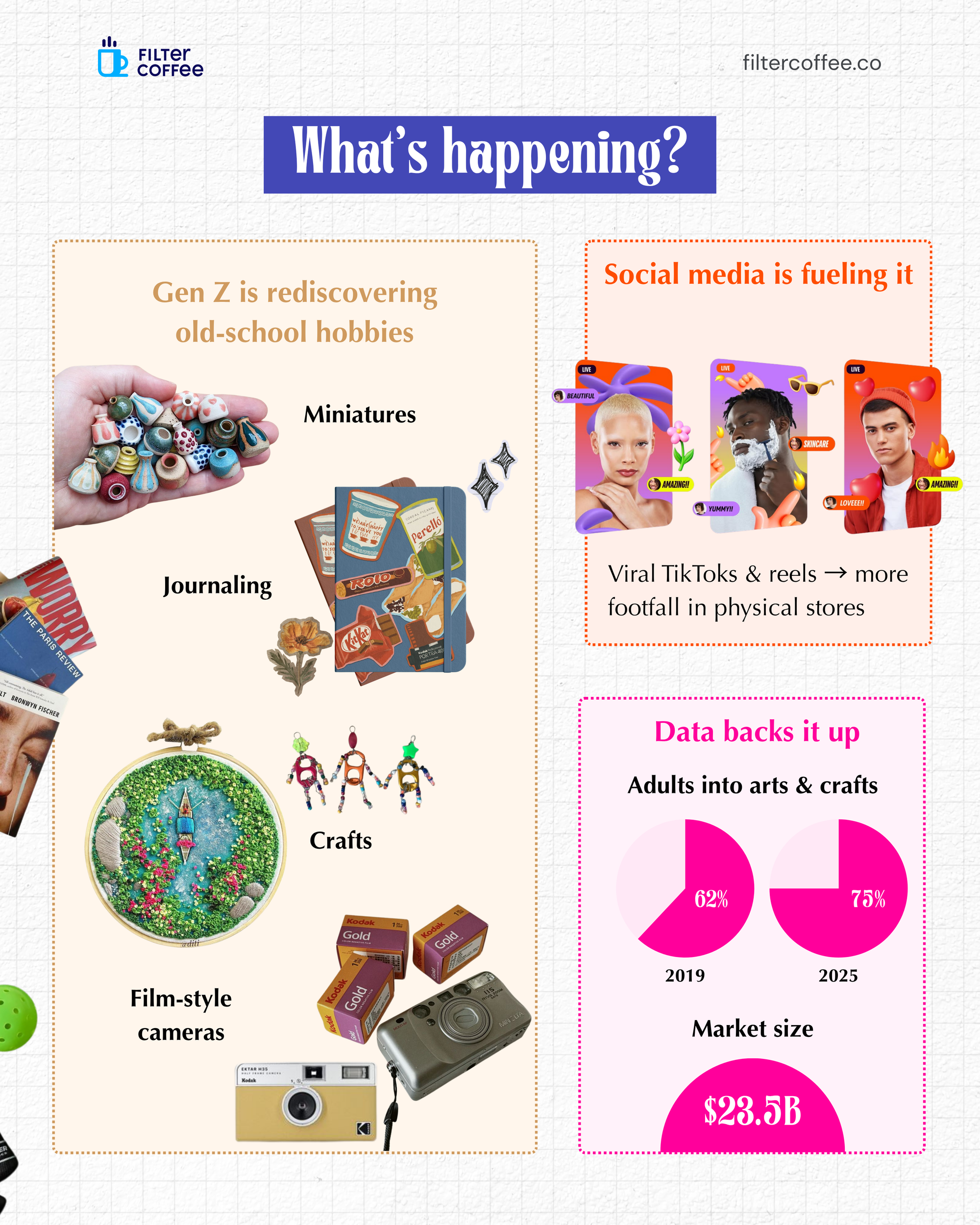
Data shows that adults engaging in arts & crafts have jumped from about 62% in 2019 to nearly 75% in 2025, and the global market for these categories has already crossed 23.5 billion dollars.
But this is not just about crafts. It is part of a broader behavioral pivot where Gen Z is rediscovering anything that feels physical, slow and real.
Miniatures, journaling, film cameras, board games, vinyl records, hobby kits and even sudoku books are seeing renewed demand.
Ironically, the internet is the biggest reason this is happening, as social media is not losing influence, it is redirecting it.
Viral TikToks and reels are turning niche hobbies into mainstream trends overnight. A single video of someone building a miniature house or filling a journal can rack up millions of views, and that translates into real-world demand.
Stores are reporting higher footfall because people are not just watching anymore, they want to try it themselves. Discovery is digital, but consumption is becoming physical.
And this is where the story gets interesting. Gen Z is not rejecting technology. They are reacting to its excess.
After years of endless scrolling, algorithm fatigue and always being online, there is a growing need for control, calm and tangible output.
Offline hobbies offer something screens cannot. You can hold them, finish them, display them and most importantly, disconnect while doing them. In a world where everything feels fast and fleeting, these activities slow things down.
That explains why what people call “grandma hobbies” are suddenly cool again.
Needlepoint, knitting, scrapbooking and journaling are being rebranded as wellness tools.
In fact, searches for things like needlepoint canvases have surged sharply, with some categories seeing growth of over 170% in a year.
Crafting is no longer just a pastime, it is being positioned as self care, a way to manage stress and anxiety without a screen. Even the idea of leisure is being redefined.
There is a growing concept of what some reports call “offline luxury”. It is about choosing experiences that disconnect you from digital noise.
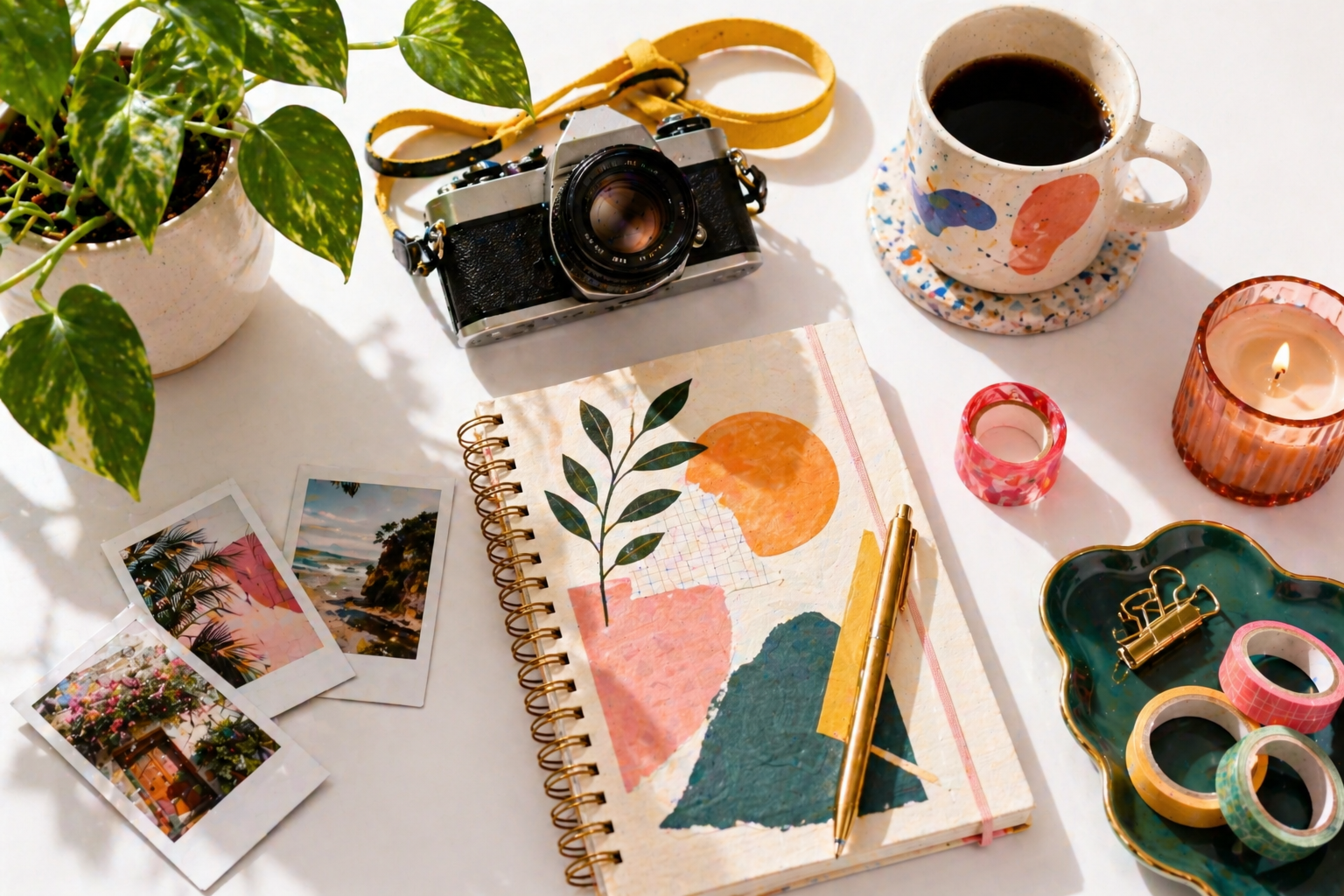
One of the clearest examples of this is the rise of what people are calling the “analog bag”. Young consumers are carrying books, sketchpads, puzzles or knitting kits so they have something to do instead of reaching for their phones.
An analog bag is a small bag people carry with offline things to keep them occupied without using their phone. It usually includes items like a book, journal, puzzle, film camera, sketchpad or knitting kit.
Platforms like Pinterest are also picking up on this change.
Trends around pen pals, poetry, outdoor exploration and nostalgic aesthetics are gaining traction among Gen Z. These are not high adrenaline, high dopamine activities. They are slow, intentional and deeply personal. That is exactly the point.
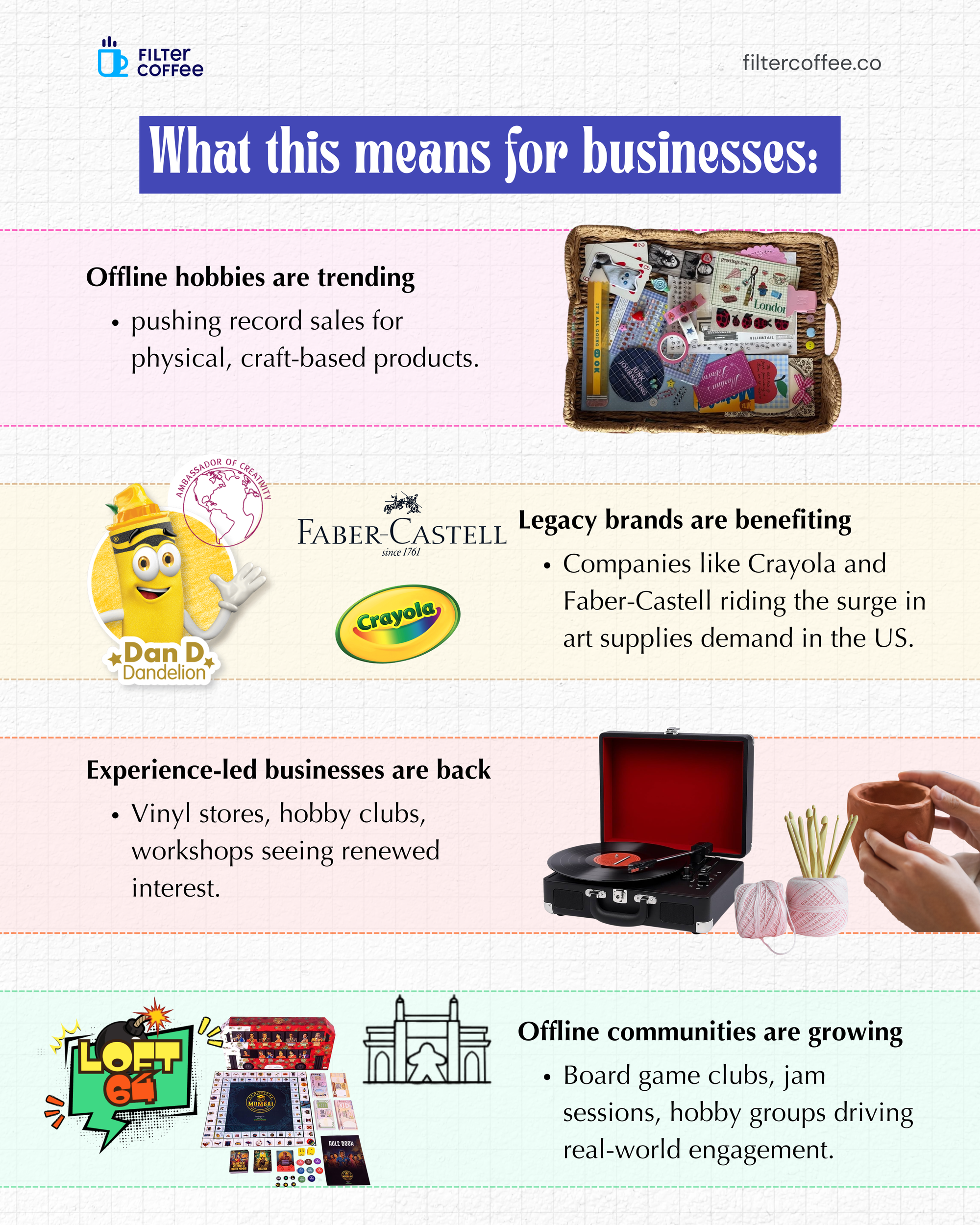
For businesses, this is turning into a massive opportunity.
Legacy brands like Crayola and Faber-Castell are benefiting from a surge in art supply consumption.
But the bigger winners are those who understand that Gen Z is not just buying products, they are buying experiences. This is why hobby kits, DIY bundles and guided workshops are booming. A crochet kit is not just yarn and needles, it is a complete experience packaged for someone who wants to try something new.
Physical spaces are also making a comeback.
Vinyl stores, hobby clubs, pottery studios and board game cafes are seeing renewed interest. These places offer something that online platforms cannot replicate easily, real-world interaction.
Communities are forming around shared hobbies, from jam sessions to craft meetups. In a generation often described as digitally connected but socially isolated, these offline communities are filling a gap.
There is also a subtle economic layer to this trend.
Many of these hobbies are relatively affordable compared to other forms of entertainment or luxury. A journal, a film camera roll or a craft kit gives hours of engagement at a fraction of the cost of bigger experiences.
At a time when economic uncertainty is shaping spending behavior, this makes offline hobbies even more appealing.
But the most fascinating part of this entire shift is the loop it creates.
Social media fuels the discovery of these hobbies, people try them in the real world, and then they bring the results back online.
A finished journal spread, a miniature build or a crochet piece becomes content again, inspiring someone else to start. It is a recalibration of how it is used.
Instead of being passive consumers, Gen Z’s are using digital platforms as a starting point and moving the experience offline. In doing so, they are bringing back a kind of leisure that feels more human, more tactile and more intentional.