
 Newsletter

India just switched on something it has been building for over two decades.
On April 6, 2026, the country’s 500 MW Prototype Fast Breeder Reactor (PFBR) at Kalpakkam reached “criticality”, which basically means the nuclear chain reaction has successfully begun and is now self-sustaining. And this is actually a turning point in how India plans to power itself for the next 50 years.
To understand why this matters, you need to step back a bit.
India today generates only about 3% of its electricity from nuclear power. That’s roughly 8.7-9 gigawatts of installed capacity in a country that is the world’s third-largest energy consumer. At the same time, India’s energy demand is only going one way, up. So the government has set an aggressive target: scale nuclear capacity to 100 gigawatts by 2047. That’s more than a 10x jump. The PFBR is not just another plant in this journey. It is the bridge that makes this ambition even remotely possible.
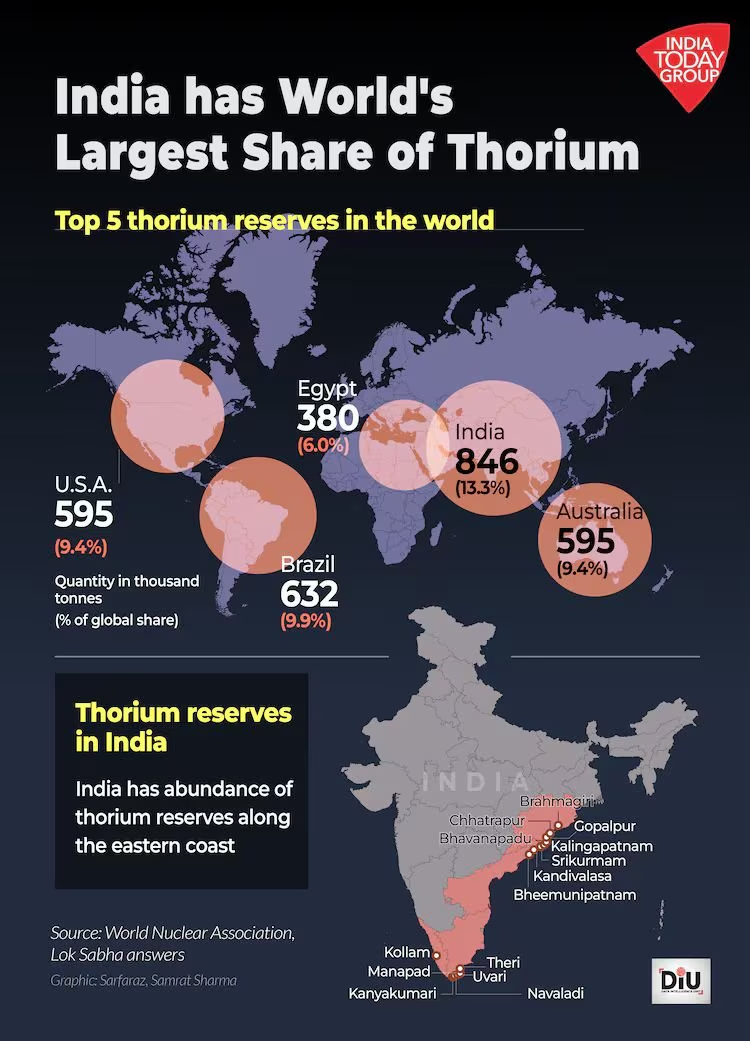
Here’s the core problem India has always faced. It doesn’t have much uranium. Globally, India holds barely around 1% of uranium reserves. But it has something far more valuable sitting largely unused, nearly 25% of the world’s thorium reserves.
The catch is thorium cannot directly power nuclear reactors. It needs to be converted into a usable fuel first. That’s where India’s famous three-stage nuclear program comes in, a strategy designed decades ago by Homi Bhabha.
In the first stage, India runs pressurised heavy water reactors using natural uranium. These reactors generate electricity but also produce plutonium as a byproduct. In the second stage, which India has just entered, fast breeder reactors like the PFBR use that plutonium as fuel. But here’s the twist. They don’t just consume fuel, they create more of it.
The PFBR uses a mix of uranium and plutonium, and through fast neutrons, it converts uranium-238 into more fissile plutonium-239. In simple terms, it breeds fuel while generating power. This is why it is called a breeder reactor.
This is a big deal because it stretches India’s limited uranium resources much further. But more importantly, it sets up the third stage. The reactor is designed to eventually use thorium in its outer blanket. Through a process called transmutation, thorium-232 can be converted into uranium-233, which is a usable nuclear fuel. Once that loop is established, India can theoretically run a large part of its nuclear fleet on thorium, something it has in abundance.
So this one reactor is not just producing electricity. It is unlocking a long-term fuel strategy that could reduce India’s dependence on imported uranium and fossil fuels.
But here’s where things get interesting. While the science sounds futuristic, the journey has been anything but smooth. The PFBR project started in the early 2000s. It has taken over 20 years to reach this stage. The cost has ballooned to over ₹8,000 crore, more than double the original estimate. It is also at least 15-16 years behind schedule. And this is not unique to India. Globally, fast breeder reactors have had a patchy record, with challenges around cost, materials, and efficiency.
Even today, nuclear power faces a tough competitor. Solar and wind have become significantly cheaper and faster to deploy. In fact, some estimates suggest electricity from the PFBR could be much more expensive than renewable alternatives. So why is India still betting on nuclear?
The answer lies in reliability and scale. Solar works when the sun shines. Wind works when the wind blows. Nuclear works all the time. It provides what is called base-load power, a steady supply of electricity that can keep the grid stable. And when you’re trying to power a billion-plus people and a fast-growing economy, that stability matters.
Also, land-wise, nuclear plants require far less property compared to solar farms for the same amount of electricity. In a country where land is scarce and biodiversity concerns are rising, this becomes a non-trivial advantage.
In the last couple of years, the Indian government is no longer treating nuclear as a slow-moving legacy sector. In the Union Budget 2025-26, it launched a Nuclear Energy Mission with a ₹20,000 crore allocation. The focus is not just on large reactors but also on Small Modular Reactors or SMRs. These are smaller, more flexible, and theoretically faster to build. India wants at least five of these operational by 2033.
At the same time, the government passed the SHANTI Act in 2025, which opens the door for limited private sector participation in nuclear energy. This is a big shift because nuclear has traditionally been tightly controlled by the state. There are also discussions around easing liability laws and allowing foreign investment, something that had earlier scared off global players.
On the ground, there is movement too. India currently has 25 operational reactors and more than 10 under construction, adding roughly 8.7 gigawatts of capacity. New indigenous 700 MW reactors are being rolled out. Rajasthan Unit 7 was commissioned in 2025, with more units lined up. Tarapur Unit 1, one of India’s oldest reactors, was restarted in 2026 after upgrades. Projects like Kudankulam continue to expand with Russian collaboration. New sites like Mahi Banswara are coming up.
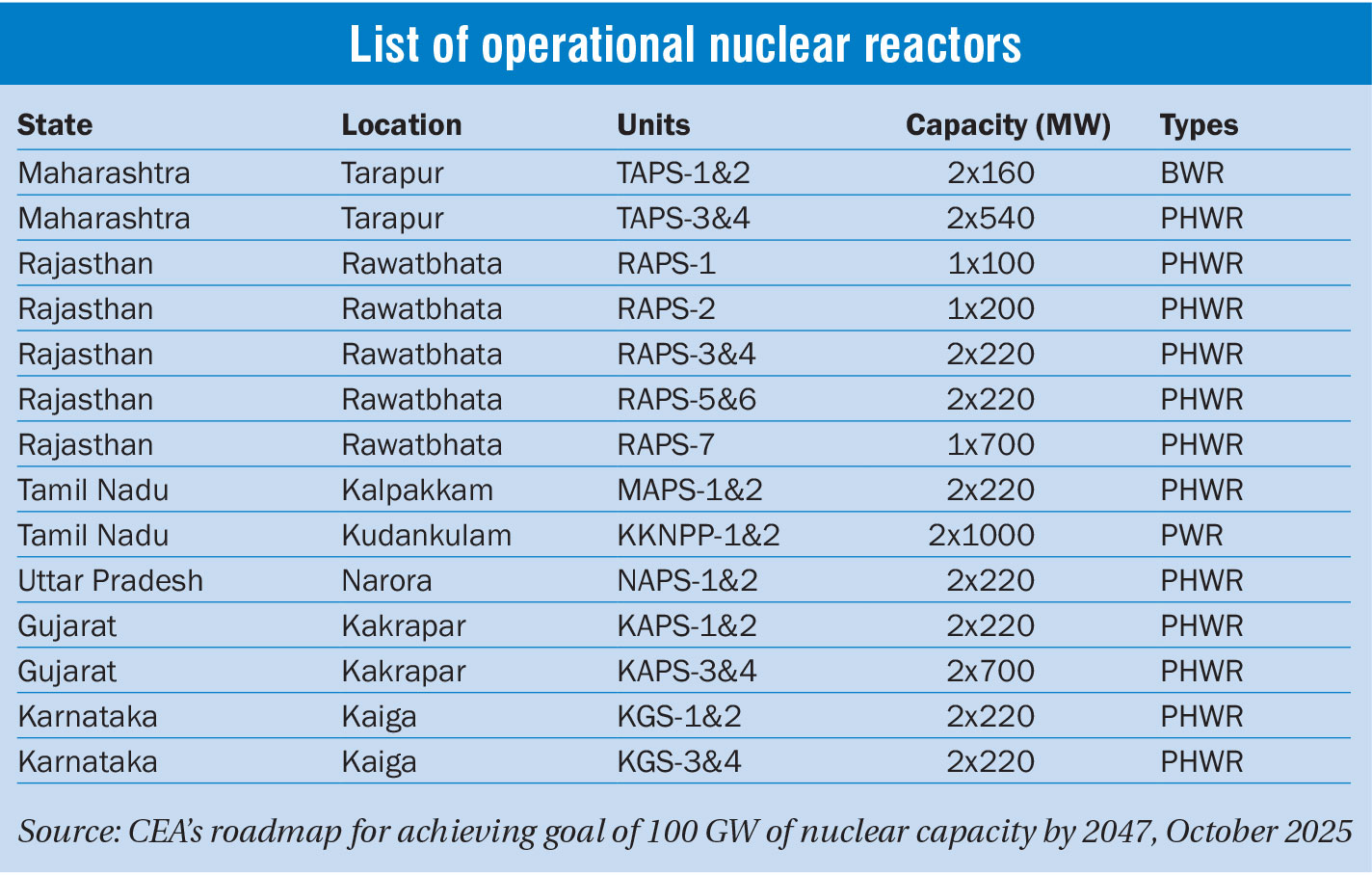
Image Credit: Powerline
So the PFBR is not a standalone story. It sits within a broader push to scale nuclear power across technologies, from large reactors to SMRs to future thorium-based systems.
But there are still hard questions. Can India build reactors faster? China built a similar fast breeder reactor in about six years. India took over two decades. Can costs be controlled? Can regulation become more transparent, especially when the same ecosystem often acts as both promoter and regulator? And most importantly, can nuclear compete economically with renewables over the long run?
Because at the end of the day, energy policy is not just about technology. It is about trade-offs.
What India has done with the PFBR is prove that it can build one of the most complex nuclear technologies in the world, largely on its own. That’s no small feat. But the real test begins now. Scaling it, commercialising it, and making it economically viable.
If India can pull that off, it could rewrite its energy story by shifting from a country dependent on imported fuel to one powered by its own resources, especially thorium. If not, this risks becoming another ambitious project that showed promise but struggled in execution.
Either way, one thing is clear. With this reactor, India hasn’t just generated power. It has unlocked a new path. The question now is how far it can go.