

 Newsletter

Every few months, India celebrates another milestone in science, technology, or innovation. An Indian startup raises money to build AI models. ISRO launches another successful mission. A homegrown pharmaceutical company develops a new treatment. A researcher of Indian origin wins global recognition. Patent filings hit a new record. The country's engineering colleges continue to produce millions of graduates every year.
From the outside, India looks like a country rapidly transforming into a knowledge economy. But buried beneath all this progress is a statistic that rarely gets attention: India spends just 0.65% of its GDP on research and development (R&D).
To put that into perspective, Israel spends 6.3% of GDP on R&D. South Korea spends 5.3%. The United States spends 3.5%. Japan spends 3.5%. Germany spends 3.1%.
Even countries with smaller economies than India devote a much larger share of their national income to scientific research and technological development.
That raises an uncomfortable question: if India wants to become a global innovation powerhouse, why is it spending so little on the thing that drives innovation in the first place?
The answer is more complicated than it appears. Every year, the country produces one of the world's largest pools of STEM graduates. Engineering colleges, universities, medical institutions, and science programs collectively generate millions of technically trained professionals. Doctoral enrolments have also been rising steadily, growing from around 1.17 lakh in FY15 to more than 2.13 lakh in FY22.
The country clearly isn't running out of scientists, engineers, or researchers.
In fact, India's innovation output has improved significantly over the past decade.
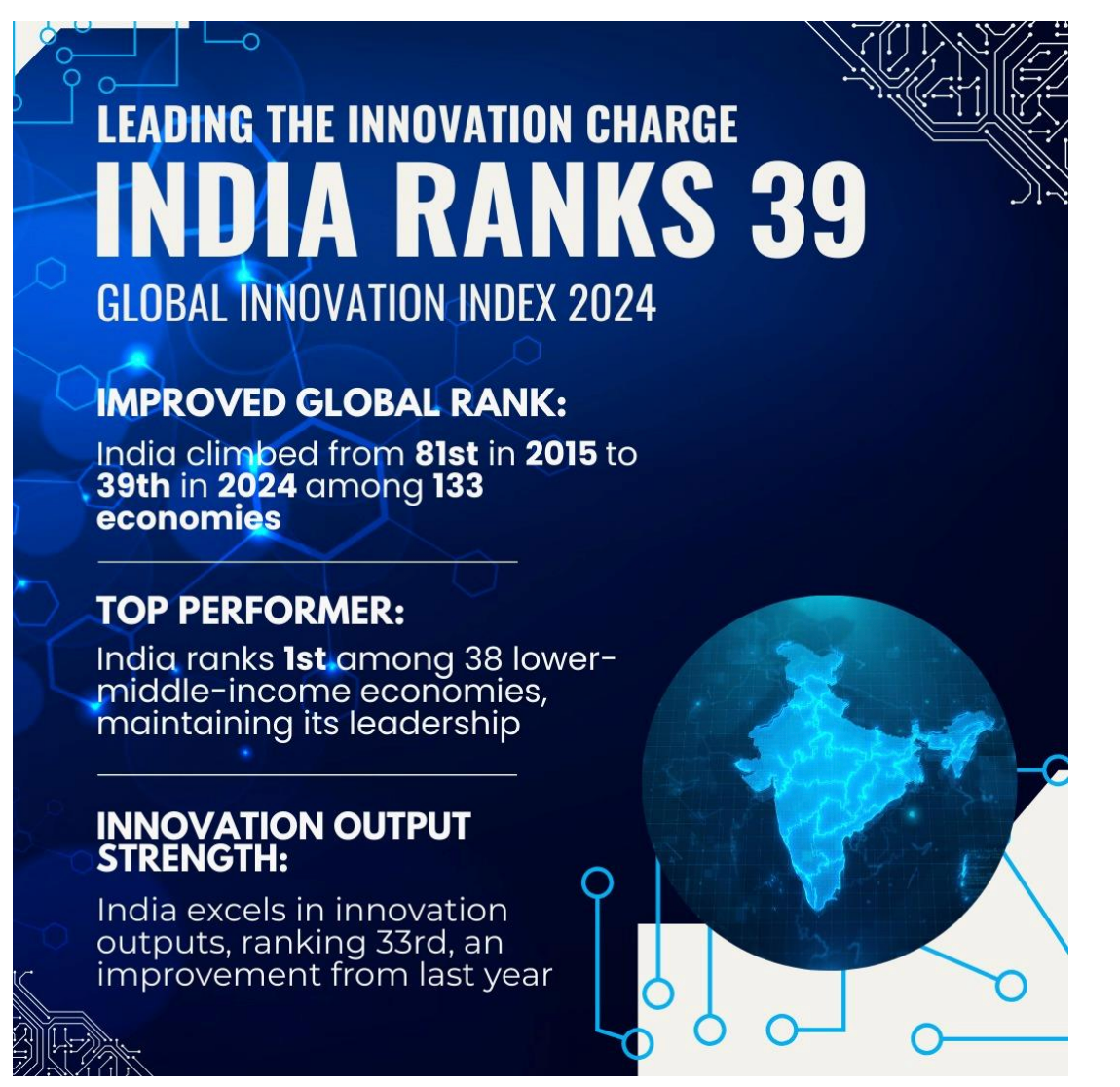
The country's ranking in the Global Innovation Index improved from 81st place in 2015 to 40th place in 2023. Patent grants have surged dramatically, crossing nearly one lakh annually. India has also climbed into the world's top ten nations for research output in several scientific disciplines.
So this is not a story about a country that lacks intellectual capability. Instead, it is a story about how that capability is funded.
And that's where things start to look unusual.
In most of the world's leading innovation economies, businesses are the primary engines of research spending.
Large technology companies invest billions of dollars every year to develop new products, improve manufacturing processes, create intellectual property, and stay ahead of competitors. Pharmaceutical firms fund drug discovery. Semiconductor companies spend heavily on advanced chip research. Automobile manufacturers invest in electric vehicles, batteries, and autonomous driving technologies.
Corporate R&D is often the backbone of national innovation.
India works differently.
Here, the government still funds the majority of research activity. Estimates suggest that roughly 60-65% of India's R&D expenditure comes from government institutions, public laboratories, higher education institutions, defence organisations, and state-supported research programs.
Private sector participation remains relatively limited.
This is one of the biggest reasons India's R&D intensity remains low despite rapid economic growth. The problem becomes clearer when you compare India with countries that dominate global innovation rankings.
Israel's R&D spending exceeds 6% of GDP because research is deeply embedded across its technology ecosystem. South Korea's spending crosses 5% because companies like Samsung, Hyundai, LG, and SK Group invest enormous sums into research every year.
India's corporate sector has certainly increased its research spending over time. But the overall scale remains small relative to the size of the economy.
Government data shows that gross expenditure on R&D has increased from roughly ₹60,000 crore in FY11 to over ₹1.27 lakh crore in FY21.
But GDP has grown rapidly too. As a result, R&D expenditure as a percentage of GDP has remained stuck around the 0.6%-0.7% range for years.
The economy expanded. But research spending did not expand fast enough.
Countries invest in research today because they want better medicines tomorrow. The smartphone, GPS, the internet, modern vaccines, advanced semiconductors, AI models, and countless industrial technologies all emerged from sustained investments in research.
The countries leading these industries today are often the countries that spent heavily on R&D years or even decades earlier.
This is why policymakers are increasingly paying attention to India's research spending gap.
Recent reports from NITI Aayog and the Economic Survey have highlighted concerns that India risks underinvesting in innovation relative to its ambitions. Because despite spending relatively little, the country has already delivered impressive outcomes.
Few nations have managed to produce India's scale of scientific talent while operating with such modest research budgets. In some ways, India has become remarkably efficient at extracting results from limited resources.
But India still has a long way to go and the real gap is investment. The question now is whether the country is willing to invest enough resources to fully unlock what those people can create.