
 Newsletter

Picture this.
You are in New York City, it is a random Tuesday night, and you have mentally committed to dal, rice and butter chicken. Maybe a dosa if life has been extra stressful. You walk into your usual Indian place, flip open the menu, and realise prices have quietly crept up.
Two, three, five dollars more here and there. Same food, same vibe, same tiny table where you once cried over an ex. But suddenly your comfort meal feels like a luxury. What changed?
Short answer: Washington did. Slightly longer answer: tariffs.
When the new US administration came in and decided to go hard on trade, India landed in the crosshairs. The government slapped fresh import taxes on almost everything coming in from India.
First about 25%, then bumped up to 50% on most exports. Officially it was framed as a penalty for India buying cheap Russian oil and as a way to “bring jobs and money back home.” On paper it sounds simple. Make foreign stuff expensive so people buy local instead. Politicians love that line.
But in the real world, these decisions travel very differently. They travel through sacks of basmati rice, tins of ghee, packets of chili powder, containers of mustard oil, cartons of coconut milk and boxes of single origin spices that define Indian food in America.
They travel through tiny restaurant kitchens in cramped basements and supermarket shelves in immigrant neighbourhoods. And eventually, they end up on your plate, in the form of higher prices or smaller portions or a restaurant that quietly shuts down.
To understand what is going on, you have to start with where Indian food stands in New York today. This is not the 90s “one generic curry buffet” scene. Indian restaurants in NYC are on a massive upswing.
The city has seen high end tasting menus, playful regional pop ups, grills that specialise in kebabs, biryani joints that pull crowds past midnight and chai spots that double up as community hangouts. Critics have been hyping these places. Awards have followed. Wall Street folks happily spend serious money on a long Indian tasting menu. Butter chicken, which people once mocked as “basic,” has become almost iconic in the city’s food culture.
It is not an exaggeration to say Indian food has been having its moment. But here is the catch. Even though demand is booming, the perception problem has not fully gone away. A lot of diners still think of Indian, Chinese, “Asian” in general as “cheap takeaway food.”
Twenty dollars for pasta feels normal. Twenty dollars for a main course with slow cooked gravy, imported spices, ghee, nuts and rice suddenly feels “pricey.” That mindset is exactly what makes tariffs so cruel for these restaurants.
Food businesses usually run on thin margins anyway. Rent in New York is insane, labour is expensive, delivery apps take their cut, and there are a hundred licences and inspections to deal with. When you add a sudden spike in ingredient costs on top of that, the math just stops working.
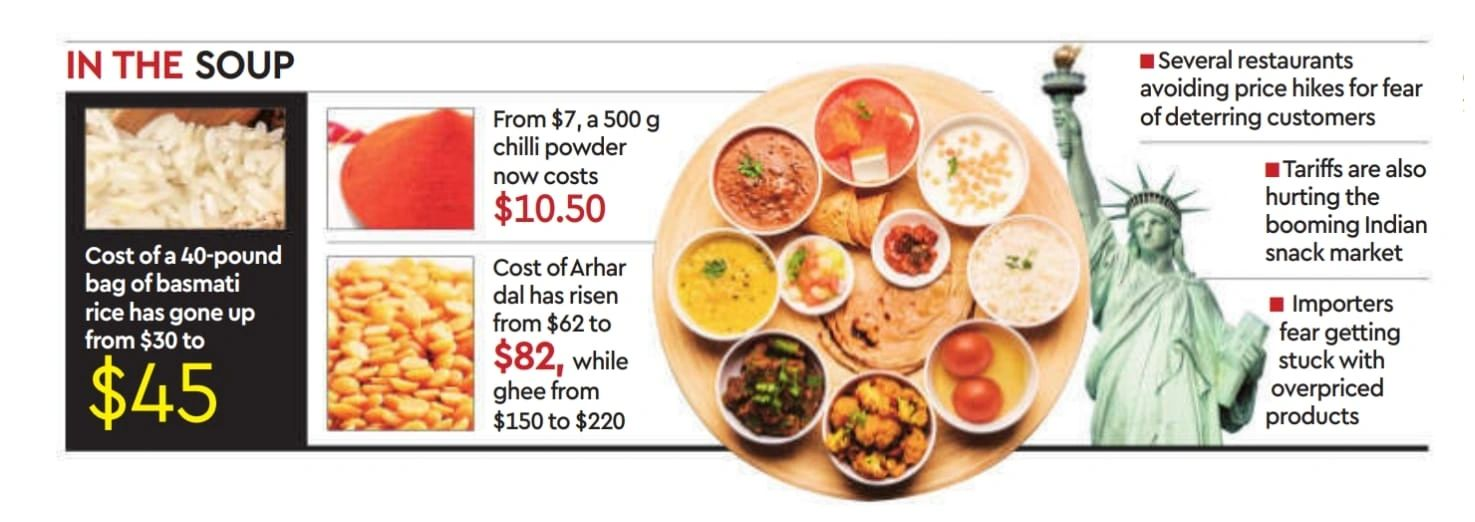
Take something as basic as rice. For many Indian kitchens, basmati is not optional. It is the backbone of biryani, pulao, thali plates, everything. After the tariffs kicked in, wholesale prices jumped sharply.
In some cases, a big bag of basmati that earlier cost around $30 moved to the mid 40s. In others, a 25 pound sack went from about $45 to almost 70. Rice alone can eat up a massive chunk of the food cost. Now layer on top the price of chili powder, which has gone from roughly $7 dollars a pack to above 10 in some kitchens. Coconut milk cases moving from the high 30s to high 40s. Lentils, pulses, ginger, garam masala, loose teas, cashews, ghee, ragi flour, wheat flour, all moving up by 20 to 50 % in a short span.
In one Indian snack brand’s case, a 200 pound shipment of spices by air came with a tariff freight bill of $1,700. Earlier, that part of the cost was almost negligible. Now it is the villain of the story.
Suddenly, every kitchen is forced into ugly decisions. Some restaurants have simply raised menu prices. Even then, owners say the new prices still do not fully cover the input shock. Margins are thinner than ever. The pressure shows up in the small things. That extra basket of papad? Maybe not.
Staff messing up an order? That is no longer a cute “haha it happens” moment. It is literally throwing away money. Other places are trying hard not to raise prices because their customer base is fragile. If your main crowd is students, office workers from the neighbourhood, taxi drivers and locals from the community, you cannot just slap a big price hike and expect everyone to smile.
One biryani focused spot has seen rice prices jump more than 50 % , lentils climb from around $3 a pound to $4.50, but it is still holding prices because it cannot risk losing loyal regulars. The trade off shows up elsewhere. Owners pull longer shifts themselves. They stop hiring extra hands. They squeeze labour costs by depending more on family members and friends who help out for lower pay.
Days off become a luxury. Then there is the “jugaad” side of this story. Some restaurants have switched certain ingredients from imported to domestic suppliers. If the flavour difference is small, they are moving to US based turmeric, black pepper, cashews or generic cooking oils.
For staples like basmati or specific spice blends where the difference is obvious, they either stock up in advance or just swallow the extra cost for as long as they can. One owner who usually bought three or four bags of rice at a time panicked when the tariffs were announced and loaded up on around sixty. That bought him some time, but stockpiling only works for a while.
You can only hoard so much in a cramped city kitchen. Supermarkets in immigrant hubs are playing their own balancing act. In a busy Queens neighbourhood like Jackson Heights, where a majority of residents are foreign born and a lot of them South Asian, Indian grocery chains are lifelines. They are the places you go to buy dal, rice, spices, pickles, flours, frozen snacks, all of it.
After the tariffs, wholesalers started hiking their rates on everything from ragi flour to chili powder. One store saw its wholesale price for a bag of ragi climb from about $3.75 to $5. They kept the retail price fixed at $5.99 even though their margin almost disappeared.
Shoppers have noticed the pattern. People have begun stocking up on basic staples, anticipating that the next round of increases is just around the corner. It is a weird kind of panic. Not quite as dramatic as pandemic hoarding, but the anxiety is there.
Out on the streets, small vendors are hammered even harder. A food stall that sells bhaji and snacks suddenly finds its mustard oil cost nearly doubling in a month. When your entire business is frying things in that oil, the shock is massive. You either make less money per plate, or you raise prices and hope your customers can take it.
For many, neither option feels good. The ripple effect runs into packaged snacks too. Think of a small brand that makes a very specific Indian inspired product. For example, a mix of boondi and chocolate with nuts, or potato chips with Bombay style spice blends. Their USP is that they use spices and ingredients sourced from India. After tariffs, it is not just that prices spike.
Importers and exporters themselves become jumpy. If they are worried that rates will keep changing, they start bringing in less stock. So even if you are willing to pay the high duty, you cannot be sure you will actually get the goods on time.
If importers are scared they will be stuck with overpriced stock no one will buy, they cut orders and suddenly there is a shortage all the way down the chain. The snack company has also had to explore new packaging suppliers inside the US instead of using their original Indian vendor.
What does this do to their business model? Money that could have gone into marketing, sampling or launching a new flavour is now going into tariff costs. Growth plans slow down. Risks go up. Remember, all of this is happening while the legal status of the tariffs is still messy. A federal court has already flagged them as illegal.
The country’s highest court has agreed to fast track a hearing. Till that final verdict comes, the tariffs stay. This in between zones is the worst of both worlds. Businesses cannot plan properly. Do they lock in new supply contracts at these higher prices, or do they wait in the hope that the duties will be rolled back in a few months? Do they reprint menus and reset expectations with customers, or do they treat this as a temporary storm to somehow ride out?
On the Indian side, the government has obviously called these duties unfair and unreasonable. On the US side, the political messaging is that these are necessary to punish bad behaviour and support American industry.
But here is the uncomfortable truth. Tariffs can make sense if there is a strong domestic alternative ready to take over. If you tax imported cars, and there is a big local auto industry waiting, maybe some production really shifts.
In the case of Indian food, there is no American equivalent for certain things. There is no local basmati that truly behaves like aged Indian basmati. There is no perfect domestic swap for some single origin Indian spices. You cannot simply replace them with generic blends and call it a day, at least not without compromising taste.
So the burden of tariffs does not magically fall on some “greedy foreign company.” It falls on small business owners in New York and New Jersey and Virginia, on their staff, and on customers who pay a little more for their comfort food or quietly cut visits.
Community leaders know this. But as of now, there are more promises than concrete solutions. And time is not a neutral player here. Bigger, well capitalised restaurant groups have more cushioning. They can absorb some of the shocks, renegotiate bulk contracts, maybe even use the crisis to grab market share.
They have marketing budgets, backup capital and high spending customers who are less sensitive to a $10 or $15 increase in the bill. For them, tariffs are painful but not necessarily fatal.
For a small family owned joint, they can be the last straw. That is what makes this story more than a “trade war” headline. People sometimes treat food as a soft culture, like it is just vibes and nostalgia. This moment shows you how tightly it is tied to hard economics and geopolitics.
Where does this go from here? As always, markets adjust. Some businesses will innovate like crazy, find new domestic suppliers, tweak menus to lean a little more on local produce and less on imported ingredients, and run even tighter operations. Others will get squeezed out. The phrase that owners keep coming back to is simple. This is going to be survival of the fittest.
If there’s a real word for what’s happening right now, it’s simple. Crossfire.
FAQs
Why are Indian restaurants in the US becoming more expensive?
Indian restaurants in the US are getting costlier mainly because the US administration doubled tariffs on most Indian imports to 50 percent. This pushed up the price of essential ingredients like basmati rice, spices, ghee and lentils, making it harder for restaurants to maintain old menu prices without hurting profits.
What items from India have become expensive due to US tariffs?
Key products like basmati rice, chili powder, lentils, coconut milk, mustard oil, wheat flour, ghee and many spice blends have seen price hikes. Many of these ingredients do not have easy American substitutes, so restaurants and grocery stores are forced to absorb the extra cost or raise prices.
How are New York restaurants coping with higher ingredient costs?
Restaurants are raising menu prices slightly, switching to US-based substitutes where possible, cutting back on hiring, buying supplies themselves instead of paying for delivery and working longer hours to save operational expenses. Some even stocked up ingredients in bulk when tariffs were first announced.
Why can’t restaurants simply raise their prices to match the tariff impact?
Indian food still suffers from the perception that it should be “cheap.” Restaurants worry that sharp price hikes will drive away customers. So most places only increase prices slightly, even though their costs have risen much faster, which results in thinner profit margins.
How are Indian grocery stores in the US affected by the tariffs?
Indian supermarkets are facing higher wholesale prices for essentials like flour, rice and spices. Many retailers are keeping retail prices low to avoid losing customers, which leaves them with shrinking margins. Shoppers have also started stocking up on essentials before further price hikes.
Are packaged Indian snacks in the US also impacted by tariffs?
Yes. Small snack brands that use Indian spices or ingredients are struggling with higher import duties and unpredictable supply. Some importers are hesitant to bring in large shipments due to tariff uncertainty, and brands are switching to US-based substitutes or paying higher costs to maintain production.
How do these tariffs affect Indian exporters?
India exports more than 80 billion dollars worth of goods to the US every year. When American importers face higher duties, they reduce or delay orders, which impacts Indian farmers, spice makers, mills, processors and packaging suppliers. The effects spread across multiple tiers of the supply chain.
Are these tariffs permanent?
Not yet. A federal court has already questioned the legality of the tariffs, and the Supreme Court is reviewing the issue. However, until a final ruling is delivered, the tariffs remain in place, leaving businesses in the US and India stuck in uncertainty.
Why can’t the US replace Indian ingredients with American alternatives?
Many Indian staples simply have no American equivalent. The US does not grow basmati rice like India, nor does it produce many of the regional spices used in Indian cooking. Substituting these ingredients changes the taste and authenticity of the food, making replacement difficult.
What does this tariff situation mean for Indian restaurants in the long run?
If tariffs continue, some restaurants may survive by adapting, finding new suppliers or restructuring menus. But smaller, family-run places with thin margins may not withstand prolonged cost pressure. The industry could see closures, reduced variety and slower expansion until trade conditions stabilise.