

 Newsletter

Every few weeks, another company announces a new factory in India.
Apple's suppliers are expanding. Foxconn keeps investing. Tata Electronics is building capacity. Global manufacturers looking to reduce their dependence on China are increasingly choosing India. Back home, the government has backed this ambition with Production Linked Incentive (PLI) schemes worth nearly ₹2 lakh crore, hoping manufacturing will become the country's next big growth engine.
For the first time in decades, India seems to have everything going for it. Global demand is shifting. Companies are willing to invest. New factories are coming up faster than ever.
So, what's stopping India from becoming the world's next factory?
Surprisingly, it isn't land. It isn't capital. It isn't even demand.
It's people.
Not because India doesn't have enough workers, but because companies are struggling to get them to stay.
A recent Mint investigation put this challenge under the spotlight by speaking to manufacturers, recruiters and workers across the country. The findings point to a problem that rarely makes headlines but could quietly determine whether India's manufacturing ambitions succeed or stall. Hiring workers is difficult. Keeping them is even harder.
This might sound surprising because India has one of the world's youngest populations. More than half its population is below the age of 30, and millions of young Indians enter the workforce every year. So why are factories struggling to build a stable workforce?
The answer is that India does not have a labour shortage. It has a labour retention problem.
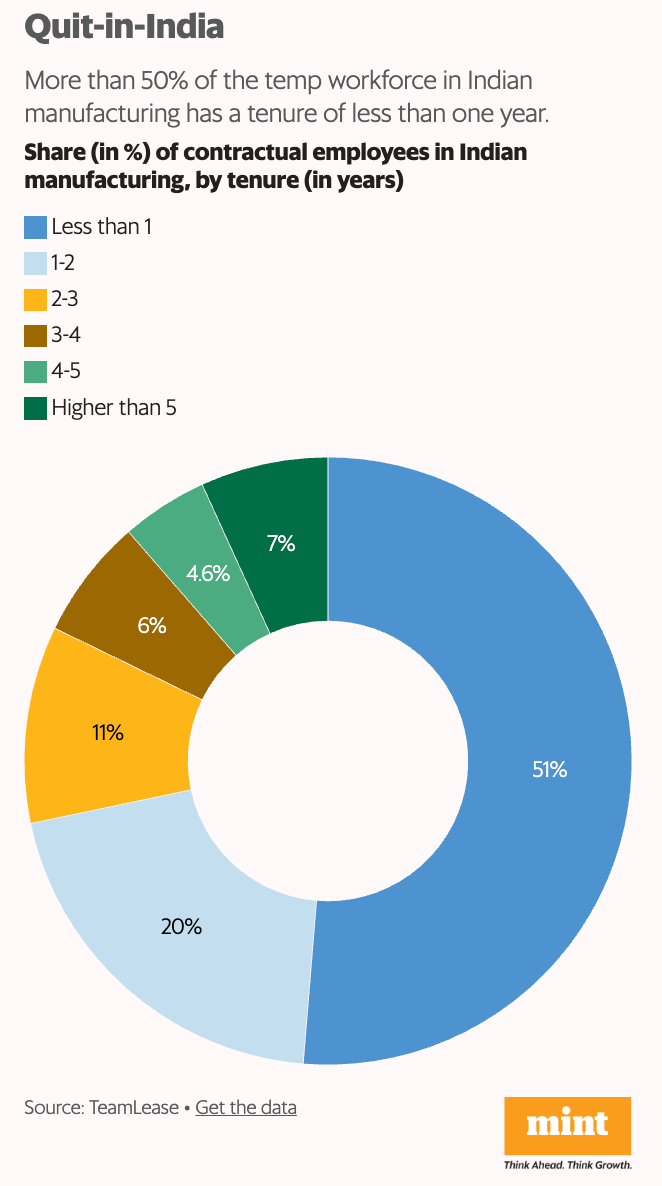
According to staffing firm TeamLease, more than 51% of contractual manufacturing workers leave within the first year of joining. Only 7% stay with the same employer for more than five years. Even more worrying, around one in ten workers quits within the first three months, precisely when companies are still training them. That means factories are constantly hiring replacements instead of building an experienced workforce.
Manufacturing is not like food delivery or retail, where a new employee can become productive within a day or two. Every worker who leaves represents weeks of training, supervision and lost productivity. Companies have to start the process all over again, increasing costs while reducing efficiency.
Many people assume the obvious solution is to simply pay more. But manufacturers say the problem runs much deeper than salary.
Imagine you're 19 years old and leaving your village for the first time. A recruiter tells you there's a factory job nearly 2,000 km away that pays around ₹20,000 a month. It sounds like the opportunity you've been waiting for. But when you arrive, everything feels unfamiliar. The language is different. The food tastes different. You're sharing a room with strangers on the outskirts of an industrial town. Every morning begins at the exact same time. There are production targets, safety protocols and strict factory routines.
A few weeks later, another company offers ₹1,000 more, or a delivery platform promises flexible working hours and quicker payouts. Suddenly, staying doesn't seem like the obvious choice anymore.
Factory jobs generally pay 30-40% more than agricultural work, according to an analysis of PLFS data by the Foundation for Economic Development. On paper, that should encourage workers to move from farms to factories. But migration involves much more than a higher salary.
Many workers leave their villages for the first time. They struggle with unfamiliar languages, different food habits, long factory shifts, shared accommodation and homesickness. Recruiters say some workers have left jobs because they could not adjust to local cuisine. Others return because parents are uncomfortable with them living far away. Some simply cannot afford to survive until their first salary arrives.
These might sound like personal problems, but together they become an economic challenge.
Manufacturers say the first 60-90 days are the toughest. That is when workers are adjusting not just to a new job, but to an entirely new way of living. Something as small as a ₹1,000 higher monthly salary elsewhere is often enough to convince them to switch because, for many families, that difference can cover groceries or transport for an entire month.
The problem starts even before workers enter a factory.
Despite years of discussions around Skill India and vocational education, fewer than 5% of Indians aged 15 to 29 have received formal vocational training, according to the latest Periodic Labour Force Survey.
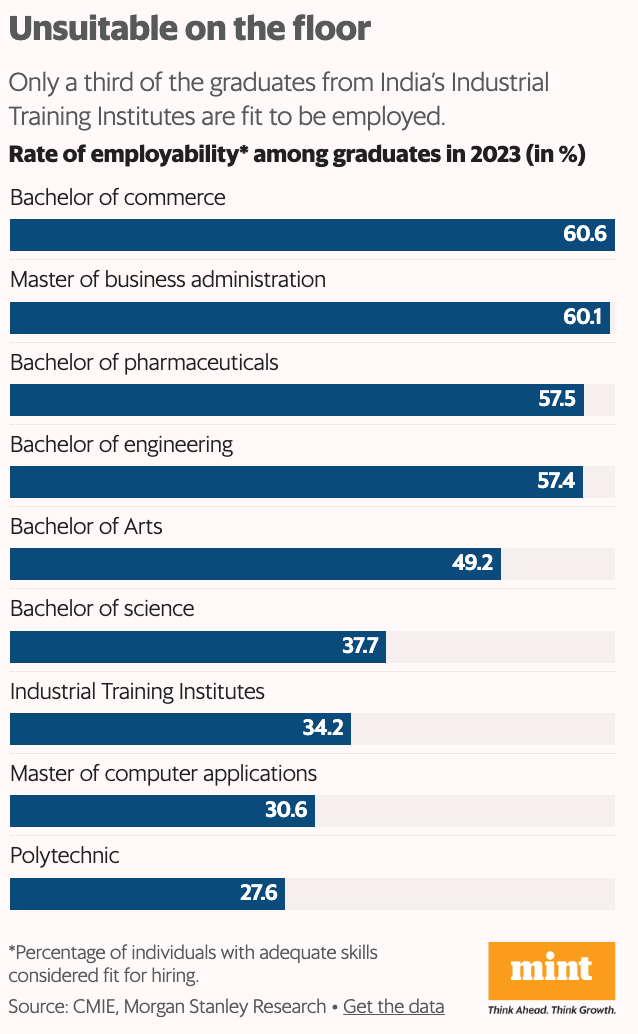
Even among students who complete technical education, companies often struggle to find job-ready candidates. Morgan Stanley estimates that only 34% of Industrial Training Institute graduates and just 28% of polytechnic graduates are considered employable. That means manufacturers are forced to spend time and money teaching workers skills that should ideally have been learnt before joining.
This is where India's manufacturing journey begins to look very different from China's.
In 1991, around 60% of China's workforce was employed in agriculture. By 2023, that figure had fallen to 22% as millions of people moved into factories during the country's industrial boom. India has certainly made progress, but much more slowly. Agricultural employment has declined from 63% in 1991 to 44% in 2023, according to the World Bank. Nearly half of India's workforce still depends on farming, which means the transition to manufacturing is far from complete.
Housing has emerged as another unexpected bottleneck. Most new factories are located on the outskirts of industrial clusters where land is cheaper, but affordable housing, schools, hospitals and public transport often fail to keep pace.
Several manufacturers have decided not to wait. Foxconn, Tata Electronics and Delta Electronics are building large dormitories near their facilities. Aerospace manufacturer Aequs has taken a different approach by setting up factories closer to labour-rich districts instead of expecting workers to migrate long distances.
Another challenge has emerged over the past few years, and it comes from an unexpected competitor.
The gig economy.
Young workers who once viewed factories as the obvious next step now have more options. Delivery platforms, ride-hailing services and quick commerce companies offer faster onboarding, flexible working hours and, in many cases, daily payouts. While these jobs may not always pay more over the long term, they offer something many factory jobs do not: flexibility and immediate income.
TeamLease says this shift is becoming particularly visible among workers aged 18 to 25, who form the backbone of India's manufacturing workforce. WorkIndia's hiring data also showed blue-collar gig hiring rising sharply during 2024, driven by ecommerce and logistics. For someone leaving a village for the first time, choosing between a factory with fixed shifts and a delivery job with flexible hours is no longer an obvious decision.
Manufacturers are responding in different ways. Some are linking attendance and skill development to performance incentives. Others have introduced festival bonuses to reduce absenteeism. Several are redesigning training programmes to help workers adjust during the first few months.
At the same time, automation is quietly becoming another response to the problem. Manufacturers are increasingly investing in automated assembly lines, not simply because machines reduce labour costs, but because machines don't resign after three weeks. Reliable labour availability is slowly becoming a competitive advantage. That creates a difficult policy dilemma. India wants manufacturing to generate millions of jobs, but persistent labour instability could push companies to automate faster, reducing the very employment opportunities the country hopes to create.
Last year, NITI Aayog acknowledged that India has had only "limited success" in capturing the China+1 opportunity. Capital is flowing in. Global companies are interested. Factory construction is accelerating. But factories do not run because machines are installed. They run because people show up every day.
India has already proved that it can attract global manufacturers. The next challenge is making factory jobs attractive enough for workers to build careers instead of treating them as temporary stops. Because if India's factories cannot hold on to their workers, the country's manufacturing dream may ultimately be limited not by investment or infrastructure, but by attrition.