

 Newsletter

India just rewired the fine print of its nuclear story. Quietly, through a new law with a long name and a short acronym: SHANTI, the government has changed who takes the blame if something ever goes wrong at a nuclear power plant. And that single tweak may end up deciding whether India’s nuclear dream finally takes off or keeps crawling along like it has for decades.
To understand why this matters, we need to rewind a bit.
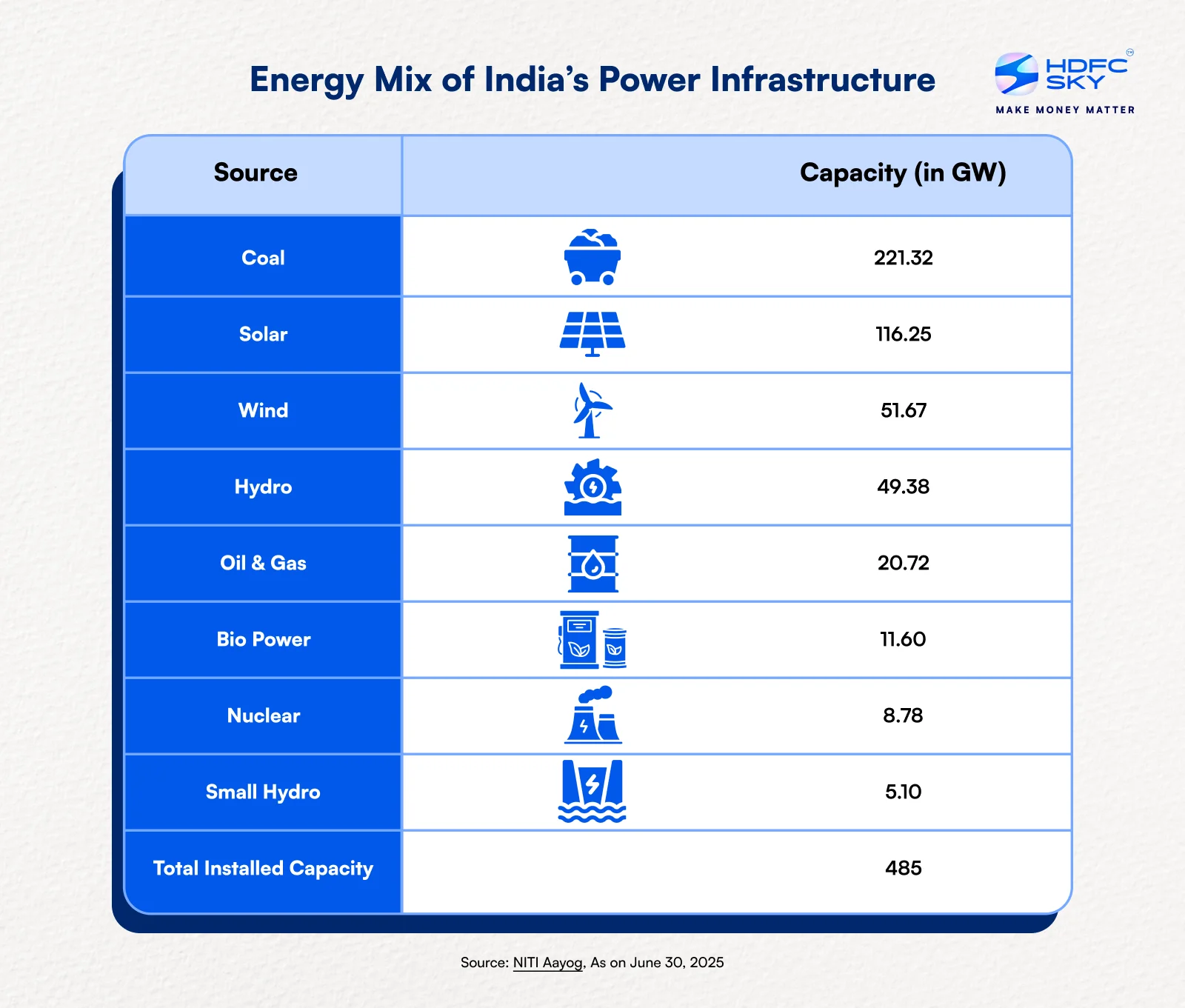
Nuclear power has always been the awkward middle child of India’s energy mix. Coal does the heavy lifting, supplying nearly 70% of electricity. Renewables like solar and wind get all the attention and investment buzz.
Nuclear, despite being clean, reliable and available 24/7, sits at under 9 gigawatts; less than 2% of total power capacity. That’s tiny for a country aiming to hit net zero by 2070 while powering data centres, electric vehicles, factories and cities that never sleep.
So why hasn’t nuclear scaled up? The usual answers are cost, safety fears and public resistance. But there’s a less obvious villain hiding in legal language: liability.
After the 1984 Bhopal gas tragedy, India went in the opposite direction of most countries. When it passed the Civil Liability for Nuclear Damage Act in 2010, it decided that not only the operator of a nuclear plant but also equipment suppliers could be dragged into court if an accident occurred. This made India almost unique globally. Everywhere else, suppliers are protected, and liability sits squarely with the operator, usually backed by insurance and government guarantees.
The logic behind India’s approach was moral. If a faulty reactor part causes damage, why should the supplier walk away? Fair point. But global nuclear suppliers didn’t see it that way. For companies like GE, Westinghouse or EDF, unlimited and uncertain liability in a foreign legal system was a deal-breaker. Projects stalled. MoUs gathered dust. And India’s nuclear capacity barely moved while countries like China raced ahead.
Fast forward to 2025, and the government has decided enough is enough.
The SHANTI Bill, short for Sustainable Harnessing and Advancement of Nuclear Energy for Transforming India; does something radical. It repeals both the Atomic Energy Act of 1962 and the 2010 liability law and replaces them with a single, modern framework. But its most controversial move is also its most important one: it removes supplier liability entirely.
Under the new law, if there’s a nuclear accident, only the operator of the plant is liable. Suppliers are off the hook unless there’s clear proof that an individual intentionally caused damage. Not faulty design. Not manufacturing defects. Intent. That’s a very high bar.
At the same time, the law caps how much an operator can be forced to pay. Liability now depends on reactor size. Small reactors of up to 150 megawatts face a maximum liability of ₹100 crore. Mid-sized plants face higher limits. And the biggest installations, those over 3,600 megawatts, top out at ₹3,000 crore, or about $330 million.
If damages exceed this amount, the central government steps in. A dedicated Nuclear Liability Fund is to be created to handle catastrophic scenarios. Operators must also carry insurance or financial security to cover their portion. In simple terms, the risk is now clearly priced, capped and shared — just like global norms.
This is exactly what suppliers and investors have been asking for.
And it’s not just about foreign companies anymore. For the first time since independence, private Indian companies can build, own and operate nuclear power plants. The state monopoly held by the Nuclear Power Corporation of India is effectively over. Private firms can also participate in fuel fabrication, reactor construction, and even importing nuclear technology, subject to regulation. Foreign direct investment of up to 49% is allowed in certain nuclear activities.
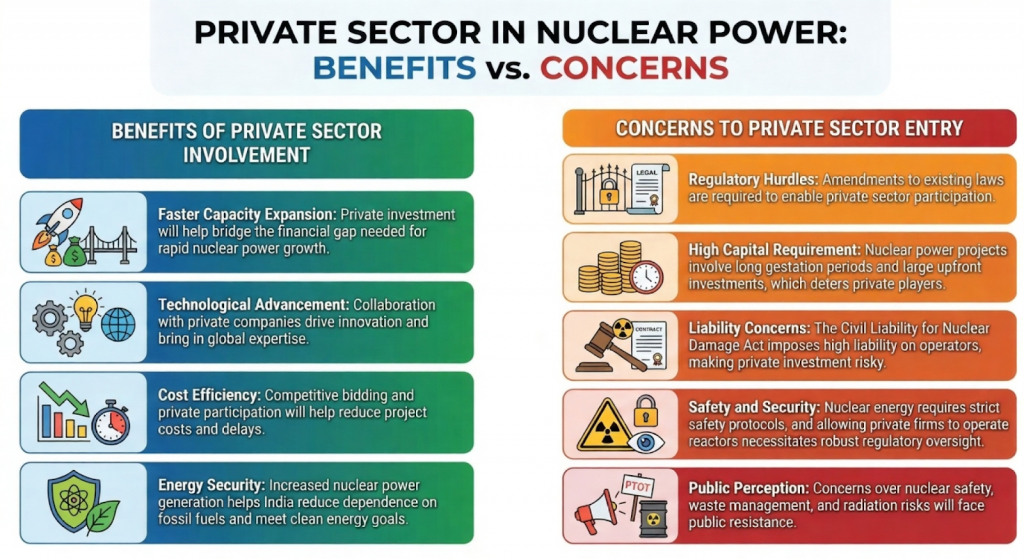
Why does this matter? Because the scale of India’s nuclear ambition is massive. The government wants 100 gigawatts of nuclear capacity by 2047. That’s more than an eleven-fold jump from today. The power ministry estimates it will cost about $213 billion. There’s no way the government can fund that alone. Private capital is rather essential.
Nuclear also solves a problem that renewables can’t fully crack. Solar doesn’t work at night. Wind is moody. Batteries are improving but still expensive at grid scale. Nuclear, on the other hand, provides clean baseload power; electricity that runs round the clock, rain or shine. That’s why countries reopening or expanding nuclear plants include Japan, the UK, South Korea and China, especially as AI and data centres drive up power demand.
India’s bill also leans into newer technology. Small Modular Reactors, or SMRs, get special attention. These are smaller, factory-built reactors that are cheaper, quicker to deploy and theoretically safer. The government has already announced a ₹20,000 crore mission to develop indigenous SMRs and aims to operationalise five of them by 2033. Lower liability caps for small reactors make them more commercially viable.
Of course, critics aren’t convinced. Environmental groups argue that removing supplier liability weakens accountability and shifts too much risk onto the public. After all, if the government steps in beyond the operator’s cap, taxpayers ultimately foot the bill. Others worry about land acquisition, radioactive waste and whether India’s regulatory institutions are strong enough to oversee a rapidly expanding nuclear sector.
The government’s counter is that safety regulation is being strengthened, not diluted. The Atomic Energy Regulatory Board gets statutory backing. A specialised Nuclear Damage Claims Commission and appellate mechanisms are being set up. Civil courts are kept out to ensure faster resolution. Penalties for violations go up. And the state retains control over sensitive areas like uranium mining and waste management.
But strip away the politics and ideology, and the economic logic becomes clear. Without fixing liability, nuclear was going nowhere. With this change, doors that have been shut for over a decade may finally open.
There’s also a bigger strategic angle. India wants to be part of the global nuclear supply chain, not just a buyer. A predictable legal regime helps Indian firms collaborate, learn and eventually export technology. It aligns India with international conventions and makes cross-border projects easier.
So yes, the SHANTI Bill does “spare suppliers”. But that’s kind of the point. It trades moral satisfaction for practical momentum. It chooses growth with guardrails over paralysis with principles.
Whether this gamble pays off will depend on execution: how well safety is enforced, how transparently accidents (if any) are handled, and whether private players actually show up with capital and confidence. But one thing is certain. India has finally decided that if nuclear power is going to be part of its clean energy future, it can’t be held hostage by laws written for a very different past.
Sometimes, to build something new, you don’t just need reactors and uranium. You need to rewrite the rules of blame.
FAQs
What is the SHANTI Bill 2025 and why is it important for India’s nuclear energy sector?
The SHANTI Bill 2025, short for Sustainable Harnessing and Advancement of Nuclear Energy for Transforming India, is a new law that replaces India’s older nuclear regulations from 1962 and 2010. It is important because it opens India’s nuclear power sector to private companies, removes supplier liability in case of accidents, introduces clear liability caps for operators, and creates a modern legal framework to accelerate nuclear capacity growth toward India’s 100 GW target by 2047.
Why did India remove supplier liability in its new nuclear energy law?
India removed supplier liability to align its nuclear liability framework with global norms and attract private and foreign investment. Earlier, suppliers faced unlimited legal risk, which discouraged companies like GE, Westinghouse and EDF from operating in India. By limiting liability to nuclear plant operators, the SHANTI Bill reduces uncertainty, lowers project risk, and makes nuclear investments more commercially viable.
Who is responsible if a nuclear accident happens under the SHANTI Bill?
Under the SHANTI Bill, the operator of the nuclear power plant is solely responsible for compensation in case of a nuclear accident. Equipment suppliers are not liable unless an individual is proven to have intentionally caused nuclear damage. This change creates a clear and predictable accountability structure for nuclear incidents in India.
What are the liability limits for nuclear operators under the new law?
The SHANTI Bill introduces capped liability based on reactor size. Small reactors of up to 150 megawatts face a maximum liability of ₹100 crore, while large reactors above 3,600 megawatts have a cap of ₹3,000 crore. If damages exceed the operator’s cap, the central government assumes responsibility through a nuclear liability fund.
How does the SHANTI Bill affect private companies and foreign investors?
The bill allows private Indian companies to build, own and operate nuclear power plants for the first time. It also permits up to 49% foreign direct investment in certain nuclear activities. By removing supplier liability and capping operator risk, the law significantly improves investor confidence and unlocks private and foreign capital for nuclear projects.
How will the SHANTI Bill help India achieve its clean energy and net zero goals?
Nuclear energy provides clean, round-the-clock baseload power, unlike solar and wind which are intermittent. By enabling rapid nuclear expansion, the SHANTI Bill supports India’s goal of achieving net zero emissions by 2070 while reducing dependence on coal, which currently supplies nearly 70% of India’s electricity.
What role do small modular reactors (SMRs) play in the new nuclear policy?
Small modular reactors are a key focus of the SHANTI Bill because they are cheaper, quicker to build, and potentially safer than traditional large reactors. Lower liability caps make SMRs more financially viable. India plans to deploy multiple indigenous SMRs, with five targeted to be operational by 2033.
Does the SHANTI Bill weaken nuclear safety and public accountability?
The government argues that safety is being strengthened, not weakened. The bill grants statutory authority to the Atomic Energy Regulatory Board, introduces dedicated nuclear claims mechanisms, mandates insurance coverage, and increases penalties for violations. While supplier liability is removed, regulatory oversight and operator accountability remain central to the framework.
Why was nuclear power underdeveloped in India before this bill?
India’s nuclear sector struggled due to strict liability laws, lack of private participation, funding constraints, and investor uncertainty. The 2010 liability law exposed suppliers to unlimited legal risk, deterring global nuclear companies and stalling large projects, which kept nuclear capacity below 2% of India’s energy mix.
Will taxpayers bear the cost of major nuclear accidents under the SHANTI Bill?
If damages exceed the operator’s capped liability, the central government will step in using a Nuclear Liability Fund. While this does mean public funds could be involved in extreme scenarios, the government believes this shared-risk model is necessary to enable nuclear growth while ensuring victims receive timely compensation.