
 Newsletter

Ravi Gupta once helped build a business around getting groceries delivered to your doorstep. Now, he's betting on something considerably more unpredictable: helping people find someone they actually want to date.
Gupta's journey into Silicon Valley wasn't particularly conventional. He started his career at McKinsey, spent a decade at investment firm KKR and then joined Instacart in 2015 as its first CFO. He eventually became its COO as well, helping the grocery-delivery startup expand its operations. By 2019, he had moved to Sequoia Capital, one of Silicon Valley's best-known venture capital firms, where he began backing other technology businesses.
But after years of helping companies grow and investing in startups, Gupta wanted to try something different. He teamed up with John Hegeman, a former Meta executive who had worked on recommendation systems and advertising technology, to build Ithaca Holdings.
Unlike a traditional venture capital firm looking for the next big startup, Ithaca wanted to acquire established businesses and improve them using advanced technology, particularly artificial intelligence. The founders spent six months examining hundreds of companies, trying to figure out which businesses could become more valuable as AI developed.
And the company they eventually settled on was Bumble, the dating app.
In a post on X on 13 October 2026, Gupta explained why Bumble stood out to him.
“As intelligence becomes more abundant, we believe connecting with the right person and forming meaningful relationships will become even more precious.”
He believes advanced technology can help people find and build those relationships, which is precisely why Ithaca sees an opportunity in Bumble.
Think about it. We already have AI assistants that can draft emails, answer questions and hold surprisingly convincing conversations. But finding someone you actually connect with remains a very human problem. Dating apps have spent years trying to solve it, often with little more than a photograph, a short bio and a swipe.
Gupta believes there's an opportunity to do better, and Bumble already has a recognised brand, an established community and years of experience connecting people. Rather than build another dating app from scratch, Ithaca wants to work with a business that already has those advantages.
And it's willing to put serious money behind that belief.
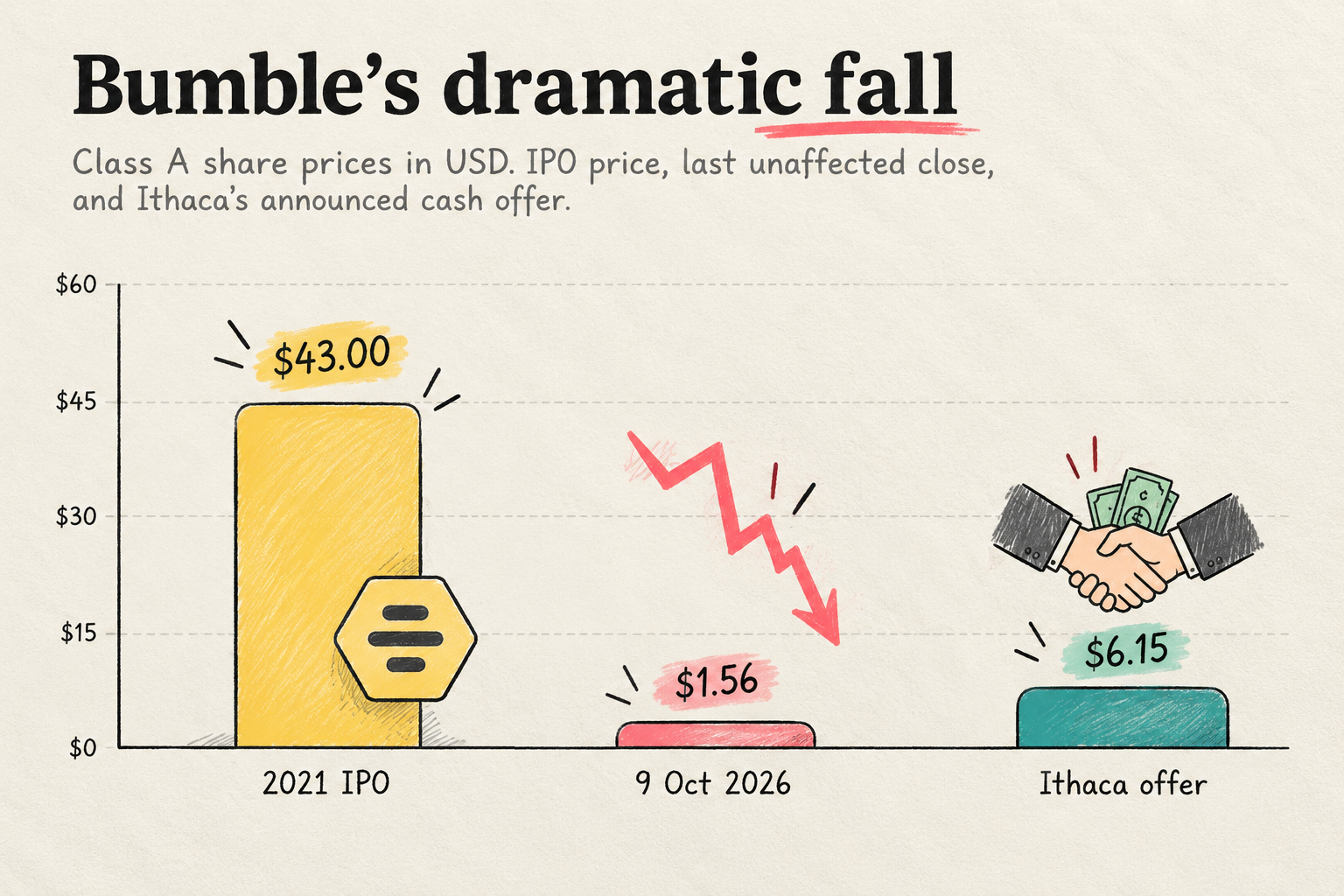
On 13 October, Bumble announced that it had agreed to be acquired by Ithaca in a $1.3 billion all-cash deal. Shareholders will receive $6.05 per Class A share, a 138% premium to Bumble's unaffected closing price on 9 October. Once the transaction is completed, Bumble will become a private company, with Gupta and Hegeman taking over as co-CEOs. Founder Whitney Wolfe Herd has supported the deal and said she will remain actively involved.
But here's some perspective. When Bumble went public in February 2021, its shares were priced at $43 each, and its market value briefly crossed $14 billion. Five years later, someone is offering $6.05 a share to take it off the stock market.
So how did a company that once had investors swiping right so enthusiastically end up here?
Bumble was founded in 2014 by Whitney Wolfe Herd, who had previously helped build Tinder. Back then, dating apps were becoming popular, but they also came with familiar frustrations. Unwanted messages, uncomfortable conversations and endless swiping were becoming part of the experience.
Bumble introduced a different approach. In heterosexual matches, women had to send the first message. The feature gave women more control over conversations and helped Bumble distinguish itself from competitors like Tinder. The brand grew, and in 2019, private equity giant Blackstone acquired a majority stake in its parent company at a valuation of around $3 billion.
Then came the pandemic, when dating apps benefited from people spending more time online. Bumble's 2021 IPO arrived during a period of tremendous enthusiasm for technology companies. Investors saw enormous potential in a business that could turn people's search for relationships into recurring subscription revenue.
But keeping users interested was proving harder than attracting them in the first place.
As social activities resumed, dating apps faced growing complaints about repetitive swiping, conversations going nowhere and matches that never became actual dates. Bumble also faced competition from platforms such as Hinge, which positioned itself around more intentional dating.
The company began making changes. Wolfe Herd stepped down as CEO in 2024 before returning in 2025. Bumble announced plans to cut approximately 350 jobs in 2024 and another 240 in 2025 as it tried to restructure the business.
Then, in August 2026, Bumble made perhaps its most symbolic change. It removed the rule that had helped define the app for more than a decade. Either person in a heterosexual match could now send the first message, and users had 72 hours to reply instead of 24. Bumble said its users wanted more flexibility and less pressure.
The company was effectively rethinking the feature that had helped make it famous.
And its financial performance explains why.
According to Bumble's annual results, revenue fell from $1.07 billion in 2024 to $966 million in 2025. Things hadn't improved much by the second quarter of 2026. Revenue dropped another 15.2% year-on-year to $210.5 million, while paying users declined 16.4% to approximately 3.2 million.
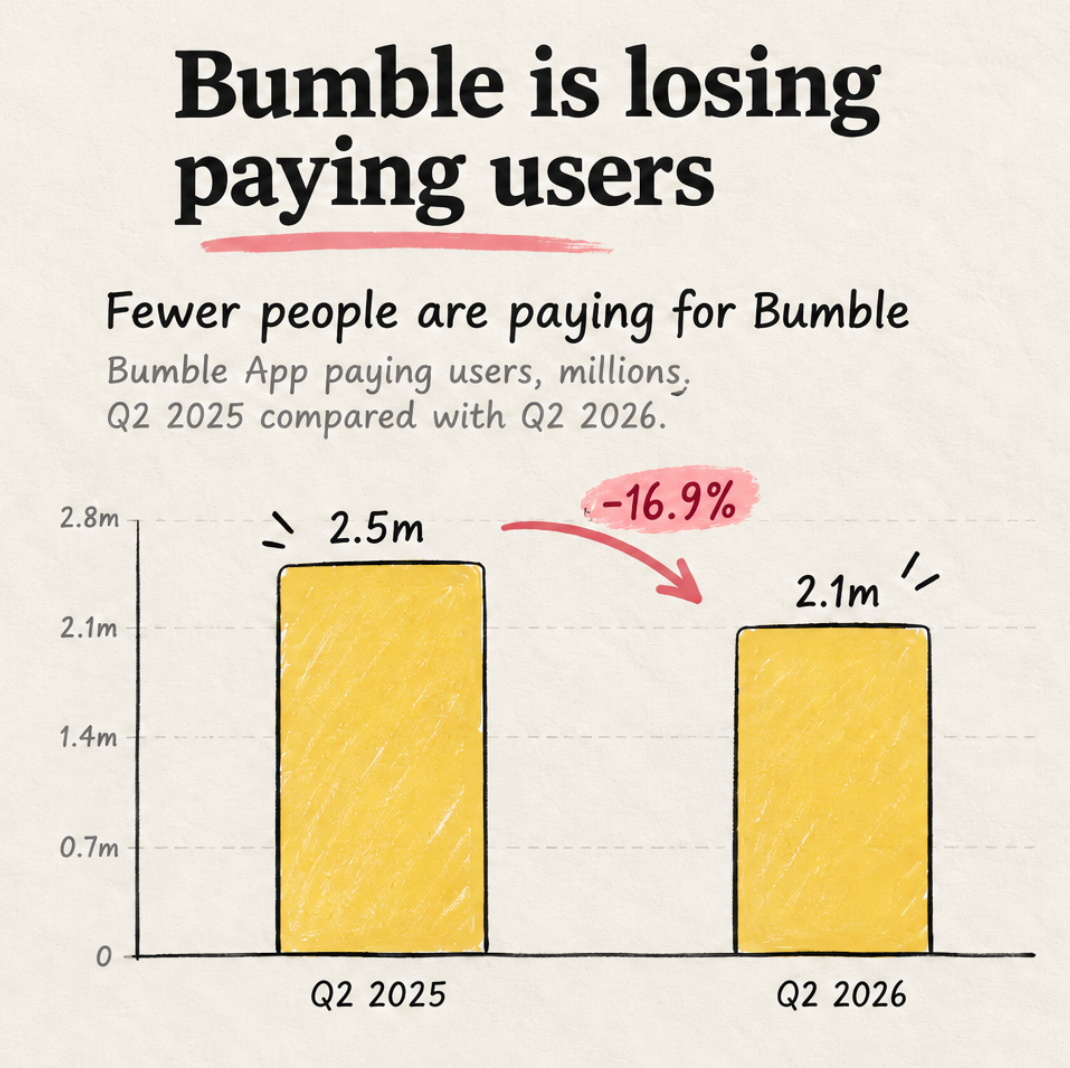
Interestingly, the average revenue Bumble earned from each paying user actually increased slightly. In other words, the people who stayed were spending a little more, but fewer people were willing to pay in the first place.
Still, Bumble isn't a business without value. It owns other platforms, including Badoo, has an established global brand and generated approximately $239 million in free cash flow during 2025. That's cash left after running the business and making capital investments. For Ithaca, the opportunity is to acquire an existing business with substantial revenues, rather than spend years trying to create an equally recognisable brand.
Bumble's problems also reflect wider changes in online dating, although some apps are performing considerably better than others. In the second quarter of 2026, Tinder's daily active users declined 4% year-on-year, while Hinge, owned by the same parent company, reported 22% revenue growth.
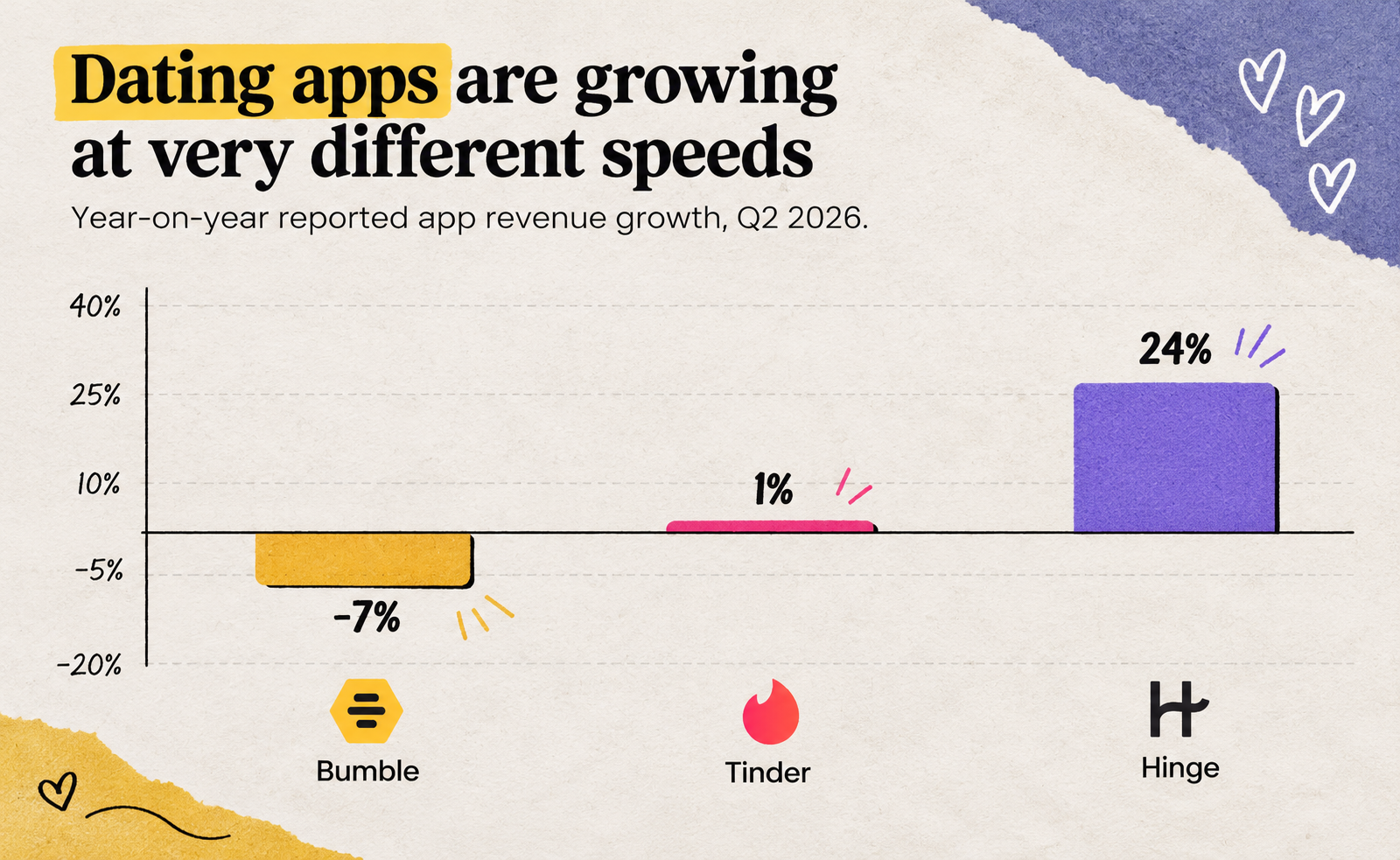
Clearly, people haven't given up on online dating altogether. But convincing them that a particular app is worth their time and money has become harder.
And that's where Ithaca's AI bet comes into the picture.
Hegeman's experience at Meta could be useful here. Social media platforms have spent years refining recommendation algorithms to understand what content people might enjoy. Dating platforms could benefit from more sophisticated recommendations too, although finding two people who genuinely like each other is rather different from predicting which reel someone will watch next.
Besides, Bumble was already experimenting with AI and rebuilding its matchmaking technology before Ithaca arrived. The prospective new owners are betting that their technical expertise and long-term investment approach can accelerate that work. Taking the company private could also give them greater flexibility to invest without having to explain every disappointing quarter to public-market investors.
Wolfe Herd has welcomed the acquisition, saying Ithaca shares Bumble's vision and believes in its women-first mission. But the new leadership will inherit a company that has spent years trying to convince users to return.
There's also a rather unusual business challenge here. Most subscription companies want customers to stay as long as possible. A dating app, meanwhile, should ideally help people find someone they like enough to stop using it. Better matches could improve Bumble's reputation and attract new users, but the company still needs a business model that makes those successful introductions financially worthwhile.
Gupta believes AI can help Bumble become exceptionally good at connecting people. Whether that translates into more paying users, stronger revenue and better relationships remains to be seen.
For a company built around helping people make the first move, getting people to come back for another one may be its toughest challenge yet.