

 Newsletter

Reliance Jio is testing an AI-powered astrology platform called JioAstro. Users can generate personalised kundalis, ask questions about their careers, relationships and finances, and receive readings through an AI chatbot. The platform currently supports English, Hindi, Marathi and Gujarati and is available on an invite-only basis.
Astrology might seem like an unusual business for India's largest telecom operator to enter. But an Indian startup has already built a ₹1,800 crore business around it.
Founded in 2017, Astrotalk connects users with astrologers through paid calls and chats. In FY26, the company reported operating revenue of ₹1,823 crore, up 55% from the previous year, and a net profit of ₹222 crore. Nearly 91% of its revenue came from consultations, with the rest coming from the sale of spiritual products such as gemstones and Rudraksha beads.
And demand continues to grow. Between January and September 2026, astrology apps recorded 150 million downloads in India, a 75% increase over the same period last year, according to Sensor Tower data.
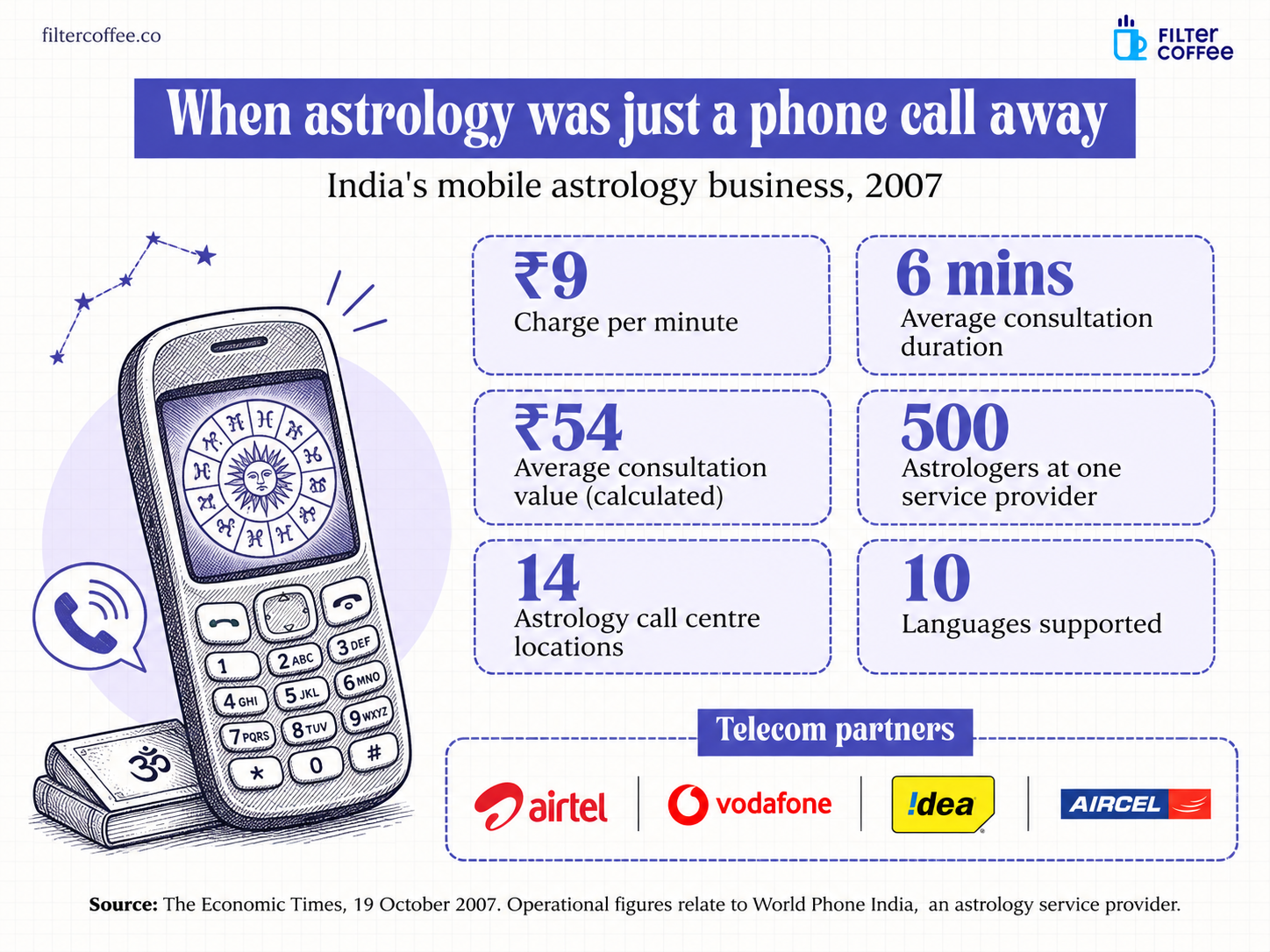
Interestingly, telecom companies were making money from astrology long before these apps existed.
Before JioAstro, there was R-World: Launched in 2003, R-World was Reliance Infocomm's mobile entertainment and information portal. Users could access news, cricket scores, games, ringtones, railway information and astrology directly on their phones By 2004, the platform was recording over 1 billion hits every month, offering 70 applications and 35 games. In 2005, its astrology services, including horoscopes, numerology and Vastu, were available for ₹25 a month or ₹3 a day.
In 2009, Airtel offered its customers a 24-hour astrology service, charging ₹7 per minute to speak to an astrologer. Operators such as Vodafone and Idea had also explored similar services. Telecom companies already had millions of customers, an established billing system and a network through which they could sell additional services.
Nearly two decades later, Jio has a similar distribution advantage, with one major difference: it can potentially deliver the service without employing an astrologer for every consultation.
Consider Astrotalk's expenses. In FY26, the company spent ₹823 crore on advertising and business promotion, equivalent to roughly 45% of its operating revenue. It also has to compensate astrologers for their time.
Jio, meanwhile, already has more than 542 million telecom customers and an established ecosystem of consumer apps. If it eventually integrates JioAstro into MyJio or bundles it with recharge plans, it could reach millions of potential customers without spending as heavily on acquiring them independently.
AI could also change the cost of delivering a consultation. While a human astrologer can attend to only one customer at a time, an AI system can handle thousands of conversations simultaneously, without a corresponding increase in human labour.
Jio isn't the first to explore this model either. AstroSage, one of India's older digital astrology platforms, introduced conversational AI astrologers in 2024.
At its 2026 AGM, the company outlined plans for AI-powered applications across education, agriculture and healthcare, with an emphasis on accessibility and Indian languages. Astrology offers another consumer category in which it can experiment with personalised AI services, recurring usage and potentially paid subscriptions.
The challenge, however, lies in understanding what customers are actually paying for.
Birth charts have been available online for free for years, yet people continue to spend money speaking to astrologers. For someone anxious about a relationship, a job interview or a family problem, the appeal may lie in having someone listen and offer reassurance. Whether customers will value an AI conversation enough to pay for it regularly remains untested.
JioAstro is still being tested, and Reliance hasn't announced its pricing or commercial plans. The success of the platform will ultimately depend on whether Jio can turn an established willingness to pay for human consultations into an affordable, scalable AI business.
Sources
- Business Standard: JioAstro
- JioAstro: Official terms and conditions
- Moneycontrol: Astrotalk FY26 financials
- Entrackr: Astrotalk revenue and expenses
- Times of India: Astrology app downloads, 2026
- Economic Times: Telecom companies and astrology, 2007
- Times of India: Airtel astrology service, 2009
- AstroSage: AI astrology launch, 2024
- Reliance: 49th AGM chairman's statement