

 Newsletter


On 19 October, the Indian government announced a tax relief for an unusual financial product called Maharajah INR Bonds. It decided that eligible investors holding these bonds, issued by the New Development Bank (NDB), would receive their interest without tax being deducted at source.
This came barely two months after India's insurance regulator allowed insurance companies to invest in these bonds. Behind both decisions is a plan by the NDB to raise ₹25,000 crore in India over the next five years.
But what exactly are Maharajah Bonds, and why is a bank backed by some of the world's largest emerging economies looking to borrow money from India?
Despite the rather royal name, a Maharajah Bond works much like an ordinary loan.
Suppose an international financial institution wants to raise money to build infrastructure in India. Instead of borrowing dollars from overseas investors, it can issue bonds in India's domestic market. Investors purchase these bonds, receive interest at an agreed rate and get their principal back according to the repayment terms.
The key difference is that the borrower is an international institution, while the money is raised and repaid in Indian rupees.
And in this particular case, the borrower is the New Development Bank.
Established in 2015 by Brazil, Russia, India, China and South Africa, the NDB is commonly called the BRICS Bank. Its purpose is to finance infrastructure and sustainable development in emerging economies. Think roads, renewable energy, public transport, water supply and other projects that require large investments and take years to generate returns.
To finance these projects, the bank needs money. It can raise funds internationally, borrow in different currencies or tap financial markets in the countries where it operates.
India's domestic bond market offers another way to do that.
Under its proposed Maharajah Bond programme, the NDB plans to raise ₹25,000 crore over five years. The money is intended for general corporate purposes, including financing and lending towards infrastructure, green and social projects in India.
Consider a hypothetical example. An insurance company buys ₹100 crore worth of NDB bonds offering an annual interest rate of 7%. The insurer would earn ₹7 crore in yearly interest, assuming annual payments, and receive the principal according to the agreed repayment schedule.
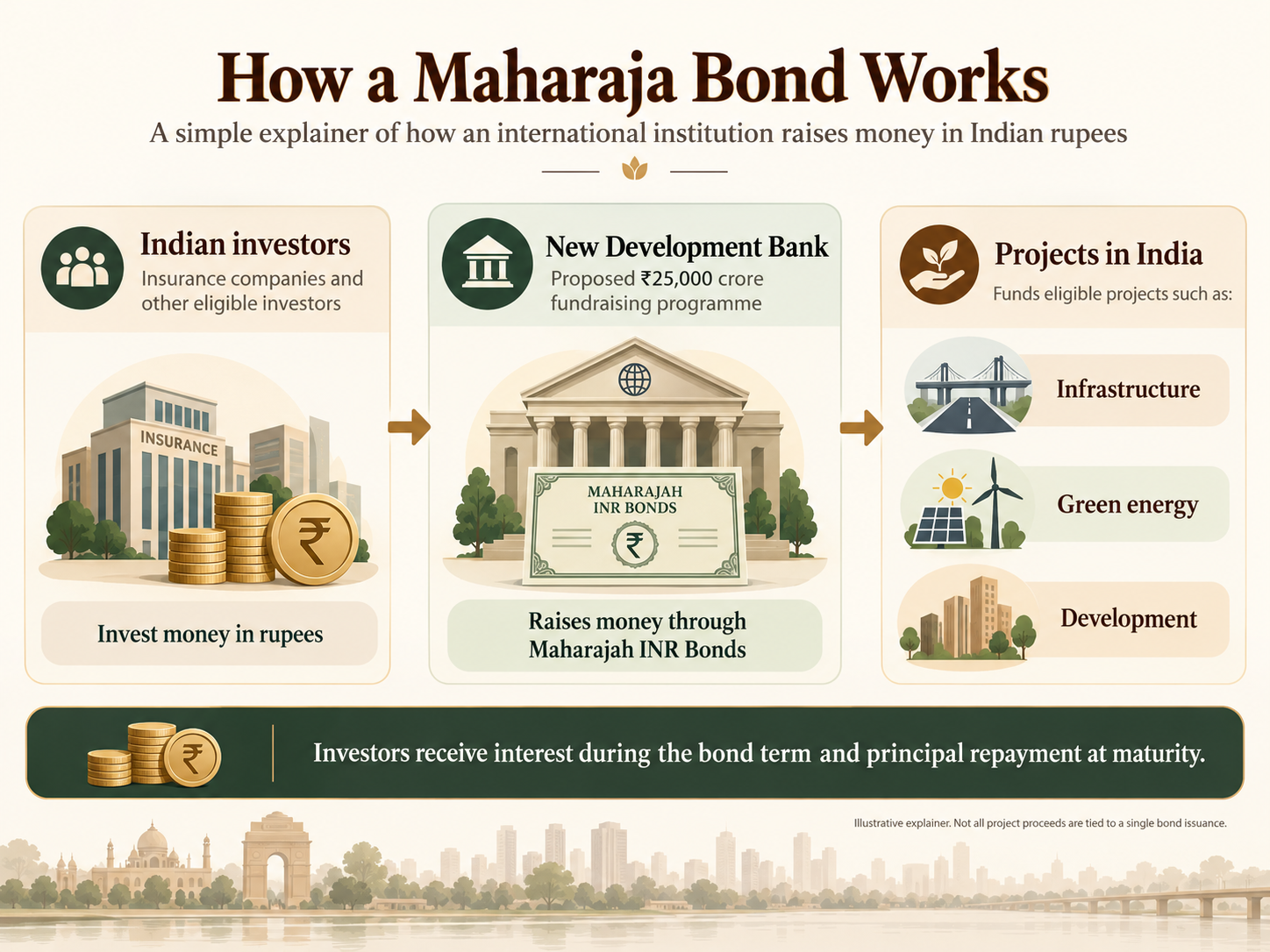
Meanwhile, the NDB gets ₹100 crore that it can deploy towards its financing activities. The actual interest rate and maturity will depend on the terms of each bond issuance.
But borrowing in rupees has another advantage.
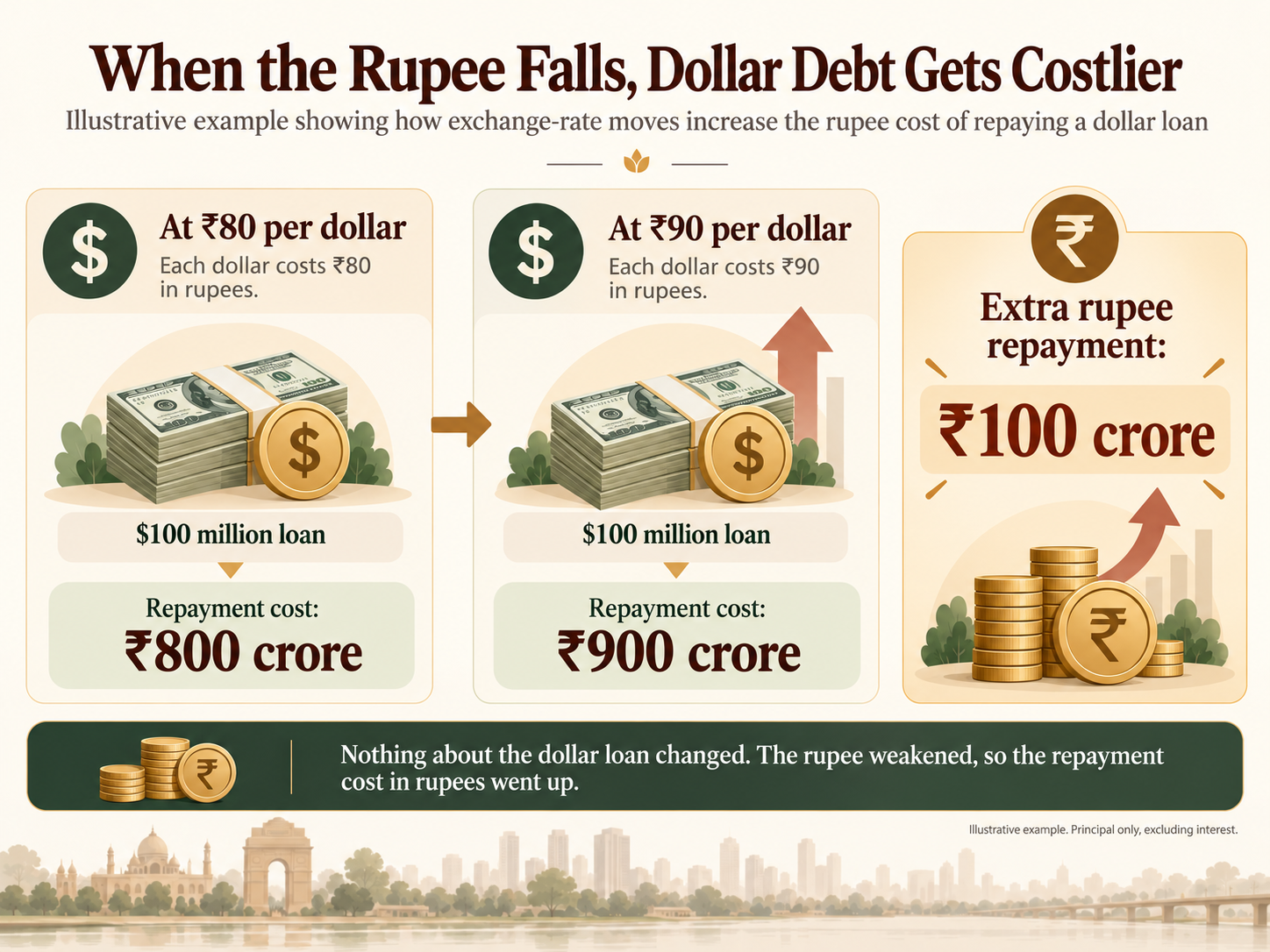
Imagine an Indian infrastructure company borrowing $100 million from a foreign lender when the exchange rate is ₹80 per dollar. That translates to ₹800 crore.
Now suppose the rupee weakens to ₹90 against the dollar. The company would suddenly need ₹900 crore to repay the same dollar principal, excluding interest.
Nothing about its original borrowing has changed. The exchange rate alone has increased its repayment burden by ₹100 crore. For businesses earning their revenues in rupees, foreign-currency loans can therefore become expensive when the rupee depreciates.
Borrowing directly in rupees reduces that particular risk. If the NDB raises rupees and lends those rupees to Indian projects, their repayment obligations remain in the same currency. It also helps the NDB match its borrowing with its lending, although the bank still needs to manage other financial risks.
Interestingly, Maharajah Bonds are not entirely new.
In September 2014, the International Finance Corporation (IFC), part of the World Bank Group, raised ₹600 crore through Maharajah Bonds from Indian and foreign institutional investors.
The bonds were listed on the National Stock Exchange and were designed to support infrastructure investments in India. The IFC's strong international credit rating also helped it attract investors at competitive borrowing rates.
Around the same period, another Indian-themed financial product was gaining attention: Masala Bonds.
Both allow investors to lend money linked to the Indian rupee, but there is one important difference. Maharajah Bonds are issued within India's domestic market, whereas Masala Bonds are rupee-denominated bonds issued overseas.
These two products reach different pools of investors. Maharajah Bonds can attract domestic institutions such as insurance companies, while Masala Bonds provide access to international capital markets.
The NDB's latest plan is particularly interested in India's institutional investors.
In August 2026, the Insurance Regulatory and Development Authority of India (IRDAI) allowed insurers to invest in qualifying NDB Maharajah Bonds as approved investments, subject to regulatory conditions.
Insurance companies are potentially valuable investors because they manage large amounts of policyholder money and have financial obligations extending many years into the future. Long-term bonds can help them earn income while matching some of those future payments.
The regulatory approval gives them another investment option and gives the NDB access to a potentially substantial source of long-term capital.
Then came the government's 19 October notification.
Under the new rule, eligible Indian resident investors and foreign institutional investors holding the specified NDB Maharajah Bonds will receive interest payments without tax deducted at source from tax year 2026-27 onwards.
Normally, tax deducted at source, or TDS, means part of an interest payment is withheld before the investor receives it. Removing that deduction improves the immediate cash flow for qualifying investors and reduces the need to claim refunds where applicable.
However, no TDS does not mean no tax. The interest income may still be taxable depending on the investor's circumstances and applicable law. The government has changed the deduction process, rather than declaring these bonds completely tax-free.
Together, the insurance regulator's approval and the government's tax relief could make it easier for the NDB to attract investors.
There are, however, a few catches.
The ₹25,000 crore is the bank's proposed fundraising amount over five years, not money it has already collected. The success of the programme will depend on how attractively the bonds are priced, their maturity periods and whether investors find the returns worthwhile.
The NDB carries strong international credit ratings, including an AA+ rating from S&P Global Ratings, but investors still face risks associated with interest-rate movements, liquidity and the issuer's ability to meet its obligations. Foreign investors also face currency risk when converting their rupee returns into their home currencies.
And while the programme is intended to support development financing, the announcement does not mean ₹25,000 crore has already been allocated to specific infrastructure projects.
India has long needed substantial amounts of patient capital for projects that take years to build and even longer to recover their costs. The Maharajah Bond programme offers one way to connect that demand with money held by domestic and international investors.
It also fits into a broader ambition shared by India and other emerging economies: financing more development in local currencies rather than depending entirely on dollar-denominated borrowing.
The regulatory groundwork is now in place. The real test will come when the NDB begins issuing these bonds, investors decide how much money to commit, and the funds start reaching projects that need them.
For India, the value of Maharajah Bonds will ultimately be measured by how effectively that borrowed money gets put to work.
Sources
- Ministry of Finance | 19 October 2026 tax notification
- The Economic Times | TDS exemption on Maharajah Bonds
- New Development Bank | ₹25,000 crore fundraising plan
- The Economic Times | IRDAI's approval for insurers
- Financial Express | Bond programme and investment conditions
- National Stock Exchange | IFC's first Maharaja Bond issuance in 2014
- New Development Bank | Credit ratings and financial credibility