
 Newsletter
India wants to be a $5 trillion economy.
But if we are being honest, the first place India hit ‘superpower’ status is not defence, not renewables, not space. It is your phone. The little thing that somehow runs your life and steals your screen time.
Because while the big national goals are still in progress, there is one race India has already won, and it is not even close. Social media.
Think about a normal day. You wake up and there is a WhatsApp ping before you have even sat up.
YouTube is on while you eat. Instagram reels sneak in ‘for five minutes’ and suddenly it is half an hour. Someone sends you a meme. Someone sends you a link. Someone forwards you a voice note you did not ask for.
Multiply that routine by hundreds of millions of people and you get the real story. India has become the world’s biggest demand engine for social media platforms.
According to the Annual Indian Startup Trends Report 2025, India now accounts for the largest user base across multiple global social media apps.
For years, platforms were built assuming their most valuable users lived in the West. Today, the fastest user growth and some of the highest engagement at scale is coming from India, not the US or Europe.
Let’s break it down.
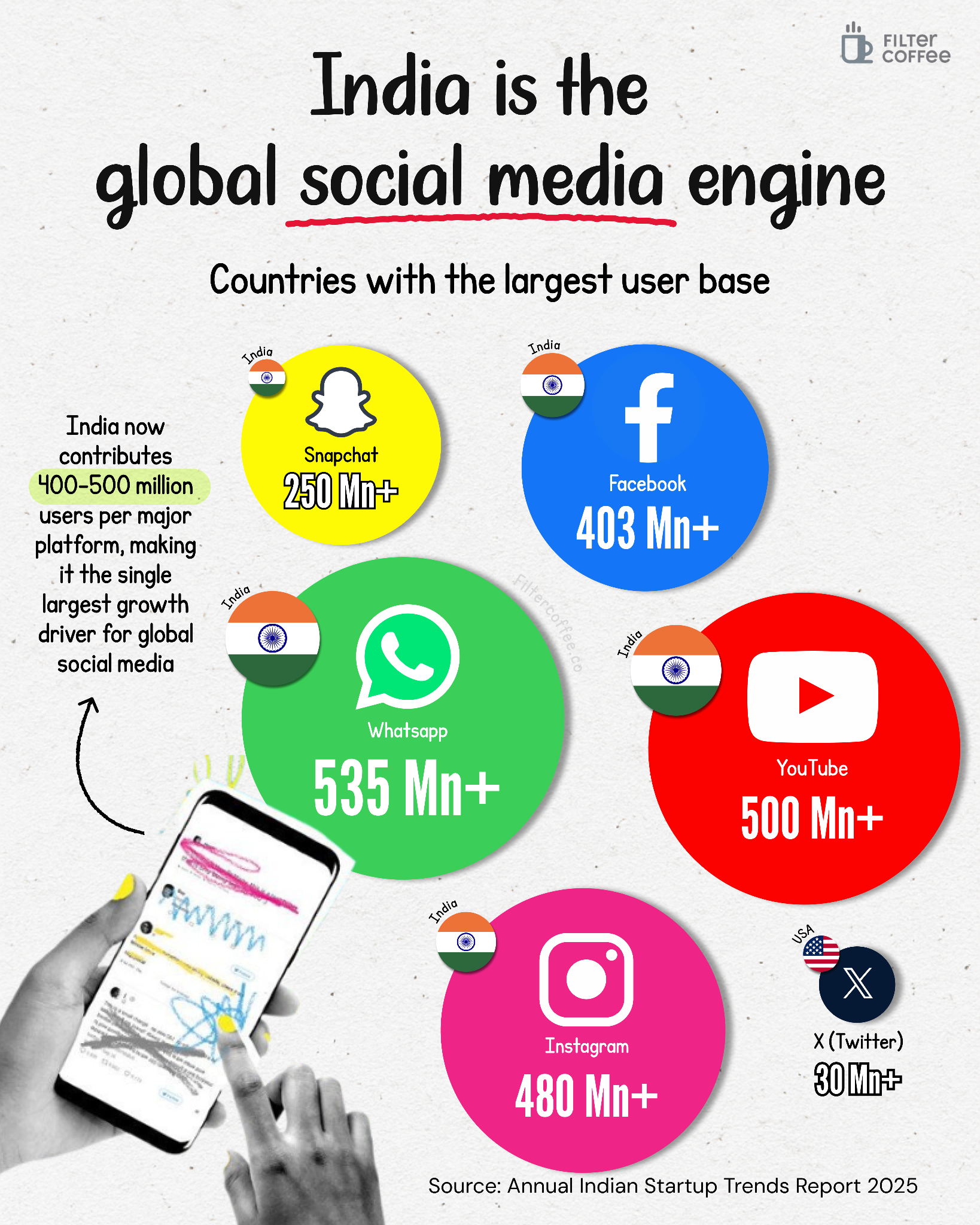
WhatsApp leads the pack with over 535 million users in India, making it the app’s single largest market worldwide.
YouTube follows closely with more than 500 million Indian users, showing how dominant India is in both long-form viewing and short-form scrolling. Instagram has crossed 480 million users in India. Facebook still has over 403 million users. Together, Meta’s platforms make one thing obvious. India is central to how global social media engagement looks now.
Even newer platforms have built huge bases here. Snapchat has over 250 million users in India, powered largely by younger audiences and the rise of regional content.
And then there is X, formerly Twitter, with around 30 million users. Smaller compared to the giants, yes, but still influential where news, politics, and public opinion collide.
So why is this happening?
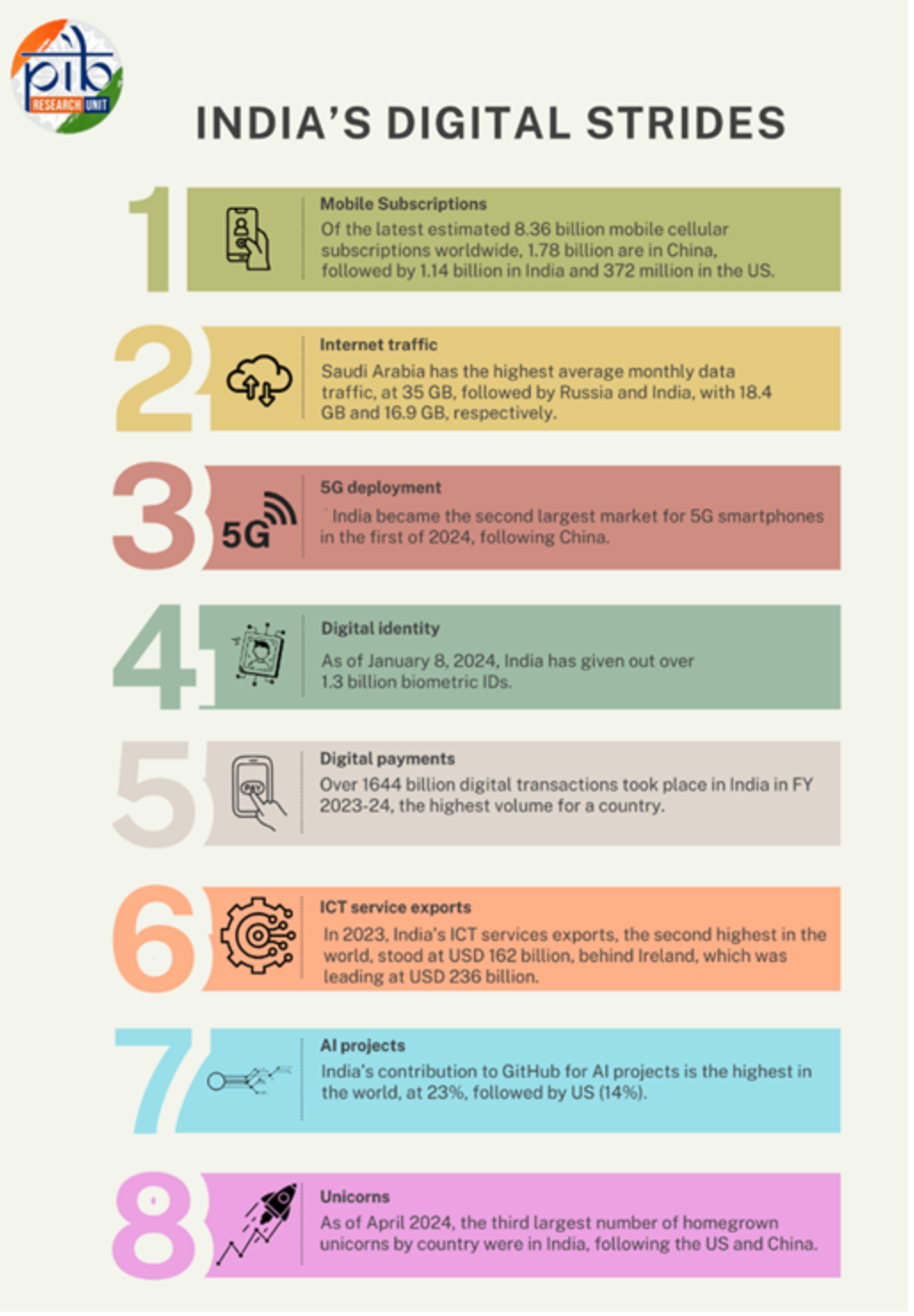
India is now one of the most digital countries on the planet, ranking third globally after China and the US. It also has the world’s second-largest base of mobile and internet users. Data is affordable, smartphones are everywhere, and that’s changed the scale of how people go online.
By September 2025, India had nearly 1.02 billion internet users, up from roughly 250 million in 2014. It is also the world’s second-biggest smartphone market, with around 750 million devices in use. And Indians burn through more data per phone than most countries. People here do not just use the internet, they practically live on it.
5G has added fuel too. India rolled out 5G faster than many countries, even if it started from a lower base. Add India’s strength in digital payments and its scale in Information and Communication Technology services, and you get a country that is structurally wired for mass digital behaviour.
By late 2025, India had around 500 million active social media user identities. Earlier growth was driven mostly by urban users who were already online and already comfortable with Facebook and Instagram. That phase is maturing.
The new phase is bigger, messier, and more interesting. New users are coming online from smaller towns and rural areas, many of them using social media seriously for the first time. Not as a novelty, but as an everyday tool.
With more than 1.03 billion internet users, access is no longer limited to tech-friendly audiences.
Earlier in 2025, around 806 million people were online, which already showed momentum. As access widened, social media stopped being something you checked and became something you lived with. People are not logging in briefly anymore.
They are spending hours scrolling short videos, watching YouTube like it is TV, replying on WhatsApp all day, and browsing Instagram whenever there is a spare minute.
And that explains something important.
India is not a one-app country. It is a many-app country. People happily use multiple platforms side by side because each app serves a different need. WhatsApp is useful.
YouTube is entertainment and learning. Instagram is discovery and aspiration. Facebook still runs communities. Snapchat is an expression and habit. X is conversation and news. The pie is huge, so many players can eat.
This is exactly why India’s role is bigger than just being a large market. Platforms cannot treat India as ‘growth later’ anymore.
They have to build for Indian price points, Indian languages, Indian content formats, and Indian behaviours. Creator ecosystems here are shaping what trends globally. Monetisation has to work at scale, not just at high spending per user. Even the way platforms launch products changes when your biggest audience is in India.
So yes, India is still chasing that $5 trillion headline. But in social media, it is not chasing anyone. It is setting the pace. And the next time an app changes its features, pricing, or creator strategy, there is a good chance the reason sits right here, in the world’s biggest scroll nation.