

 Newsletter

Tiger Global has finally exited The Viral Fever, or TVF, almost 10 years after first investing in the company behind Panchayat, Kota Factory, Aspirants and Gullak. And if you only looked at the exit price, you might think something went terribly wrong at TVF.
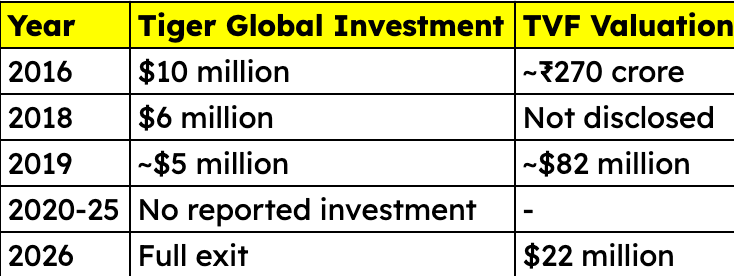
Tiger has sold its stake to investors including Lighthouse India Fund-I, Frontier Globecap Ventures and LC Nueva Advisors in a transaction that values TVF at just $22 million, according to Mint. Back in 2019, TVF was valued at around $82 million. So in seven years, roughly 73% of its peak valuation has disappeared.
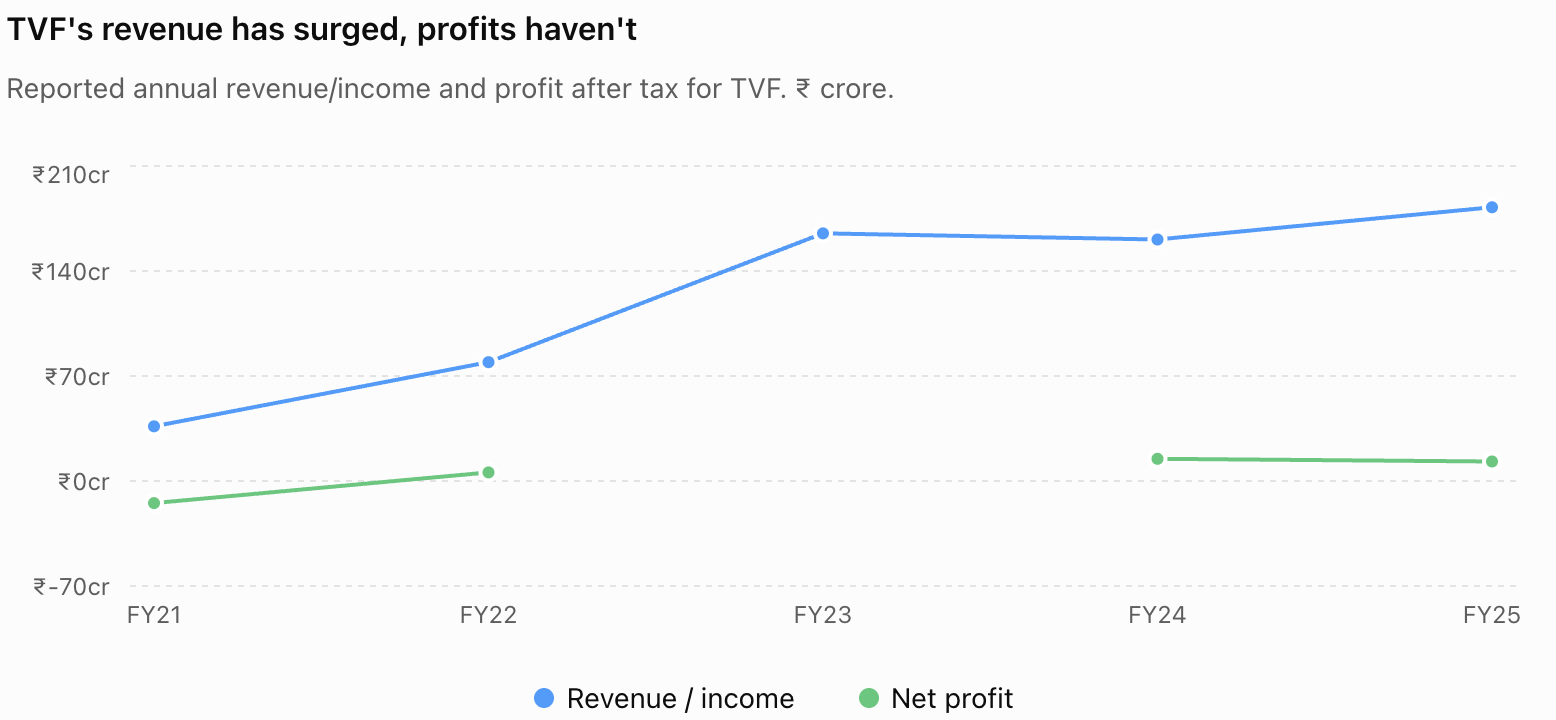
But, TVF hasn't exactly become a smaller company during this period. Its revenue has actually grown from ₹34.3 crore in FY21 to ₹182.4 crore in FY25, which is more than 5x growth in four years. It still produces some of India's most recognisable streaming shows, and Panchayat remains one of the country's biggest digital franchises.
So how does a company grow its revenue more than 5x, produce some of India's most successful web series and still end up being valued at barely a quarter of what it was worth seven years ago?

Well, to understand that, you need to go back to 2016.
That was when Tiger Global first backed TVF. It reportedly invested around $10 million, when TVF was valued at roughly $61 million, and continued investing in subsequent rounds until 2019. By then, TVF's valuation had climbed to approximately $82 million.
And at the time, paying that kind of money for a digital-content company didn't look unreasonable.
Netflix had entered India in 2016. Amazon Prime Video arrived the same year. Hotstar was expanding rapidly, while SonyLIV and several other platforms were trying to establish themselves. Everyone wanted Indians to develop a new habit: paying for and regularly watching entertainment over the internet.
But there was a small problem. You could build the slickest streaming app in the world, but people wouldn't keep opening it unless there was something worth watching.
So platforms went shopping for original content.
And TVF was almost perfectly positioned for this moment. It had already figured out how to make internet-native entertainment long before streaming became mainstream in India. Shows such as Permanent Roommates and Pitchers had demonstrated that young Indians were willing to watch long-form stories outside traditional television and Bollywood. Later came the Kota Factory, Aspirants, Gullak and Panchayat.
For investors, the logic was straightforward. If Netflix, Amazon, Hotstar, Sony and others were going to spend billions building India's streaming market, somebody had to make all those shows. TVF could become one of those companies.
Except the spending party didn't last forever.
The OTT industry has now moved from grabbing users to making money from them. Platforms have accumulated hundreds of millions of viewers, but investors increasingly want sustainable businesses rather than an endless stream of expensive originals. At the same time, consolidation has reduced the number of large buyers. JioCinema and Disney+ Hotstar, for instance, are no longer two separate platforms competing for shows after being combined under JioHotstar.
You can actually see this change in the number of shows being produced.
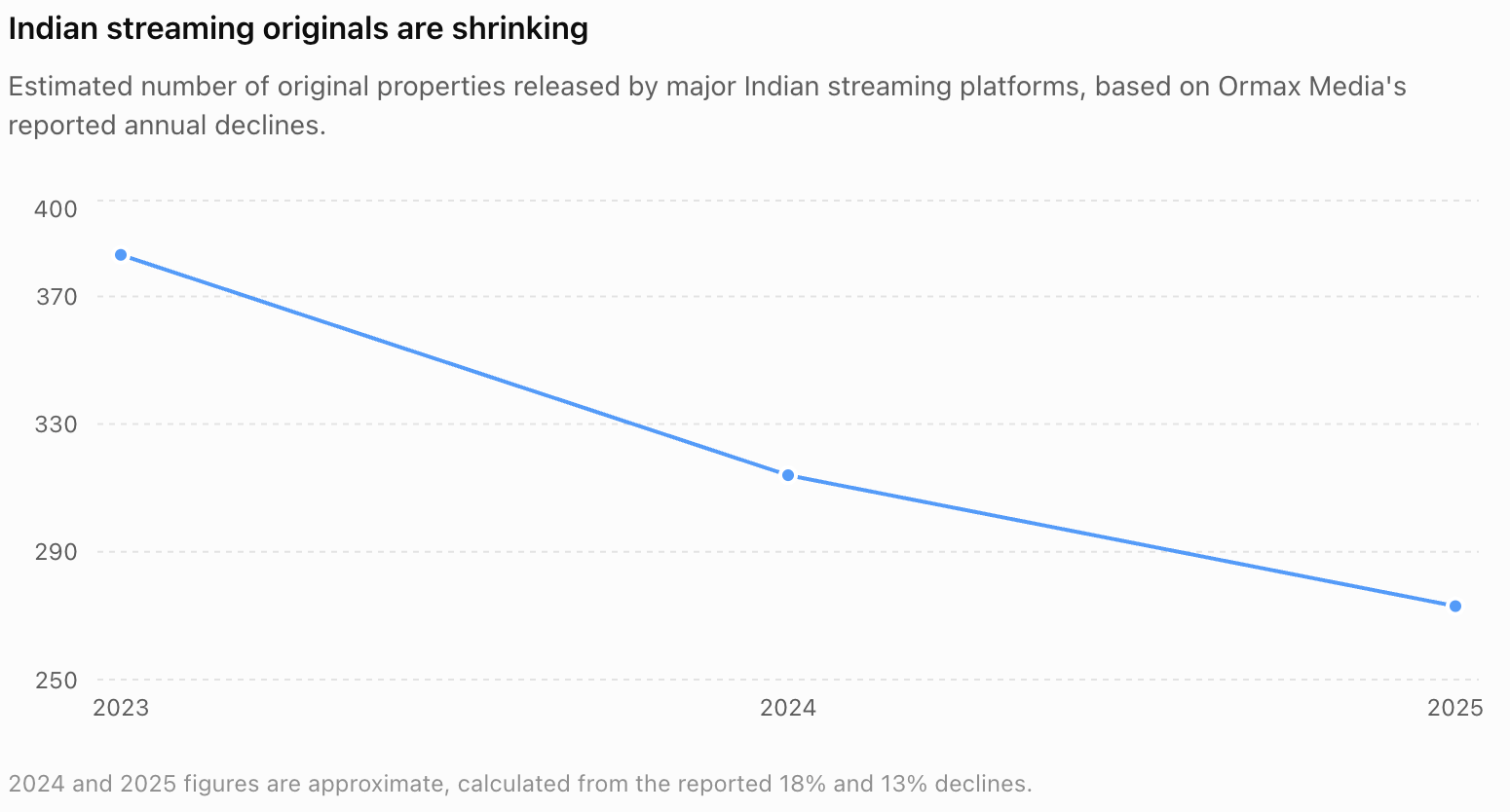
According to Ormax Media, major Indian streaming platforms released 383 original properties in 2023. The number fell 18% in 2024 and another 13% in 2025, taking annual streaming originals below 300 for the first time since 2020.
Fewer originals also mean fewer opportunities for production houses like TVF.
Earlier, several platforms were competing to find the next original series to pitch shows and negotiate deals. Today, those same studios are competing for a smaller pool of commissions because platforms can afford to be choosier.
TVFs revenue has grown spectacularly, but profits haven't kept pace. TVF recorded a net profit of ₹68.3 crore in FY22. By FY25, profit had fallen to roughly ₹13 crore, despite revenue reaching ₹182.4 crore.
That changes how an investor looks at the business.
Seven years ago, an investor could look at TVF and imagine how valuable it might become if India's streaming market exploded. Today, a buyer can look at the actual numbers and ask a much simpler question: how much profit can this company consistently generate?
And there's another twist here. Indians haven't stopped watching OTT. In fact, the opposite has happened.
Ormax estimates that India had about 601 million OTT users in 2025, up roughly 9.9% from the previous year. The country had around 148 million active paid OTT subscriptions, while the connected-TV audience jumped from 69.7 million to about 129.2 million in a single year.
The money moving into digital media is growing too. According to FICCI-EY, India's media and entertainment industry grew 9% to ₹2.78 trillion in 2025. Digital media crossed ₹1 trillion in revenue for the first time, while digital advertising grew 26% to ₹947 billion.
So OTT isn't dying. Far from it.
What's changing is where the money goes and what companies need to do to earn it.
During the first streaming boom, platforms needed lots of shows because they were fighting for subscribers. Now they need fewer, better-performing shows because the focus has shifted towards profitability. That is a much tougher environment for independent studios because producing a popular show doesn't automatically mean owning an enormously valuable business.
Take Panchayat. Its fourth season was estimated to have attracted around 23.8 million viewers in 2025, making it one of India's most-watched streaming originals. That's an enormous audience. But TVF doesn't own the platform where those viewers watch the show. Amazon Prime Video controls that customer relationship, collects the subscription revenue and decides how much content it wants to commission.
That means a studio can create valuable intellectual property and still have limited control over how much money ultimately flows back to it. Which is why TVF has gradually been trying to expand beyond simply producing shows for OTT platforms, including moving further into films and regional entertainment.
Now, what about Tiger Global?
After 10 years, waiting indefinitely for TVF to pursue an IPO or find a strategic buyer may not make sense for them. Selling the stake to another group of investors gives Tiger liquidity and gives the new investors a chance to bet on TVF's next phase.
India's first OTT phase rewarded companies for capturing attention and proving that internet-first entertainment could become mainstream.
TVF was one of the clearest winners of that period. The next phase is harder because attention alone isn't enough. Studios now need stronger margins, multiple ways to monetise their intellectual property and businesses that don't depend entirely on streaming platforms continuously increasing their content budgets.
TVF still has something valuable that many production companies would love to have: recognizable franchises, millions of viewers and more than a decade of experience understanding India's digital audience. But its journey of valuation dramatically shows that the rules have changed. India hasn't stopped watching streaming content. Investors have simply stopped assuming that everyone making popular streaming content deserves a blockbuster valuation.