

 Newsletter

On Wednesday night (31st December, 2o25), the finance ministry announced a fresh excise duty on cigarettes, charging tobacco companies a fixed tax per 1,000 sticks based on cigarette length, starting February 1. The move instantly raises the cost of making and selling cigarettes in India.
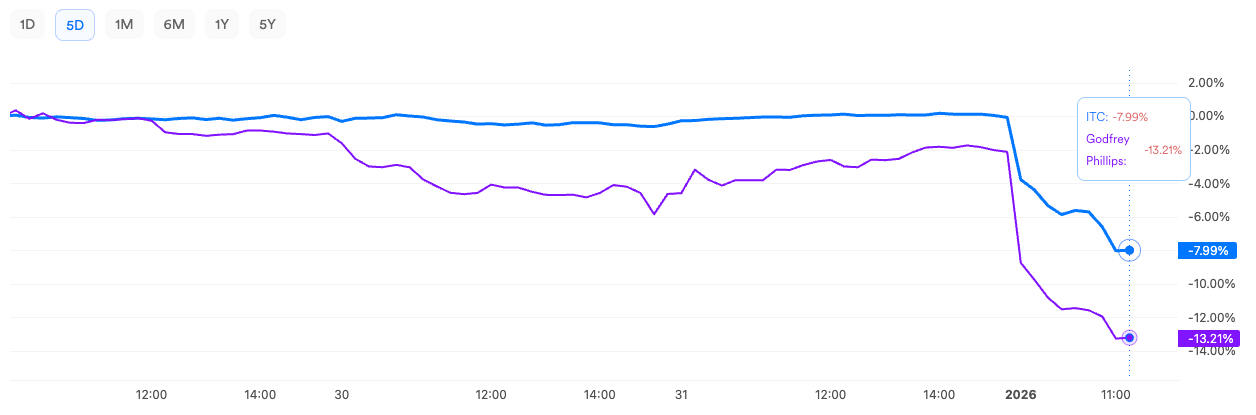
Shares of India’s biggest tobacco companies were sold off aggressively. ITC fell sharply and slipped to near two-year lows. Godfrey Phillips India saw its steepest single-day fall in months. By mid-morning, ITC had become the biggest loser on the Nifty 50, dragging the FMCG index down with it. One policy note was enough to wipe out thousands of crores in market value.
So what exactly spooked investors?
At the centre of it all is a new excise duty structure on cigarettes. The government has approved a permanent levy that replaces a temporary tax which had been running so far. Under the new rules, cigarette makers will pay an excise duty ranging from ₹2,050 to ₹8,500 per 1,000 sticks, depending on the length of the cigarette. And this is not a replacement for GST. It comes on top of the existing 40% GST that already applies to tobacco products.
Put simply, cigarettes are about to become structurally more expensive to make and sell.
For investors, this matters because tobacco is a volume-and-margin game. Companies like ITC and Godfrey Phillips earn a large chunk of their profits from cigarettes, even if they operate across hotels, FMCG, paperboards or other segments. When taxes rise, companies have only two choices. Either they raise prices and risk losing customers, or they absorb the cost and hurt their margins. Neither option is comfortable.
Early estimates suggest that the new duty could push up the overall cost of certain cigarette categories by 22–28%. In practical terms, that could mean a price increase of ₹2–3 per cigarette for longer sticks.
That may not sound much, but cigarettes are a highly price-sensitive product, especially in a market like India where consumers can easily down-trade to cheaper alternatives or reduce consumption altogether.
This is where the composition of sales becomes important.
Cigarettes longer than 75 mm account for a meaningful portion of industry volumes and an even larger share of profits because they sit in the premium segment. These are exactly the categories facing the steepest duty hikes. So even if volumes don’t collapse overnight, profit growth could slow sharply.
The market reaction reflects this fear. Godfrey Phillips, which has higher exposure to premium cigarette brands, saw a deeper cut in its stock price. ITC, despite its diversified business, was not spared either because cigarettes still contribute a disproportionate share of its profits. The sell-off was investors recalculating future cash flows under a heavier tax regime.
India already taxes cigarettes heavily, but total taxes still make up just over half of the retail price. Globally, health bodies argue that this should be much higher to discourage consumption. Over the years, the government has steadily nudged the system in that direction using larger warning labels, periodic duty hikes, and tighter compliance rules. This new excise duty looks like another step in that long game.
It signals a more permanent shift in how tobacco will be taxed going forward. And once policy direction becomes predictable, markets adjust fast.
There’s also an uncomfortable question investors are quietly asking. If this is the baseline now, what stops future governments from adding more cesses, health levies, or category-specific duties later? The uncertainty around future taxation is often more damaging than the tax itself.
For companies, figuring out the answers to these questions is an important step right now. Can they raise prices without losing volumes? Can they push premiumisation further to protect margins? Can non-tobacco businesses grow fast enough to reduce dependence on cigarettes? ITC, for example, has spent years building its FMCG portfolio precisely for moments like this. Whether that strategy pays off will now be watched more closely than ever.
For consumers, the outcome is simpler. Cigarettes are likely to get costlier. Some people may smoke less. Some may switch. And some may pay up anyway. That behavioural response will decide how painful this tax really is for companies.
In the end, this episode is a reminder of how quickly policy risk can reprice an entire sector. One notification changed investor sentiment overnight. Not because tobacco companies suddenly became bad businesses, but because the rules of the game just shifted.
And when the government tightens the screws on a product it has never liked to begin with, the market listens.
FAQs
Why did tobacco stocks fall sharply in India?
Tobacco stocks fell after the government announced a new excise duty on cigarettes that will significantly raise production costs. Investors reacted to the risk of lower margins and slower profit growth for tobacco companies.
What is the new excise duty on cigarettes announced by the government?
The new excise duty charges tobacco companies a fixed tax per 1,000 cigarette sticks, with rates ranging from ₹2,050 to ₹8,500 depending on cigarette length. It will take effect from February 1, 2026.
Does the new excise duty replace GST on cigarettes?
No. The excise duty is in addition to the existing 40% GST. This means cigarettes will face both GST and higher excise duty, increasing the overall tax burden.
Which stocks were most impacted by the excise duty announcement?
ITC and Godfrey Phillips India were the most impacted. ITC fell to near two-year lows and became the biggest loser on the Nifty 50, while Godfrey Phillips India recorded its steepest single-day fall in months.
Why are investors worried about higher cigarette taxes?
Higher taxes force companies to either raise prices and risk losing customers or absorb the cost and hurt margins. Both outcomes can reduce profits, which is why investors reacted negatively.
How much could cigarette prices increase due to the new duty?
Estimates suggest cigarette prices, especially for longer sticks, could rise by ₹2–3 per cigarette. Overall costs for some categories may increase by 22–28%.
Why are longer cigarettes more affected by the tax hike?
Cigarettes longer than 75 mm face the highest excise duty. These are premium products that contribute a large share of profits, so higher taxes on them can significantly impact earnings.
Why is cigarette demand considered price-sensitive in India?
Indian consumers can easily shift to cheaper cigarette options, reduce consumption, or switch to alternatives. Even small price increases can affect volumes, especially in a cost-conscious market.
Is this excise duty a temporary or permanent change?
This is a permanent structural change. The new duty replaces a temporary levy and signals a long-term shift in how tobacco products will be taxed in India.
What does this mean for the future of tobacco companies like ITC?
Tobacco companies will need to rely on pricing power, premiumisation, and diversification into non-tobacco businesses to protect profits. Policy risk will remain a key factor for investors tracking the sector.