
 Newsletter

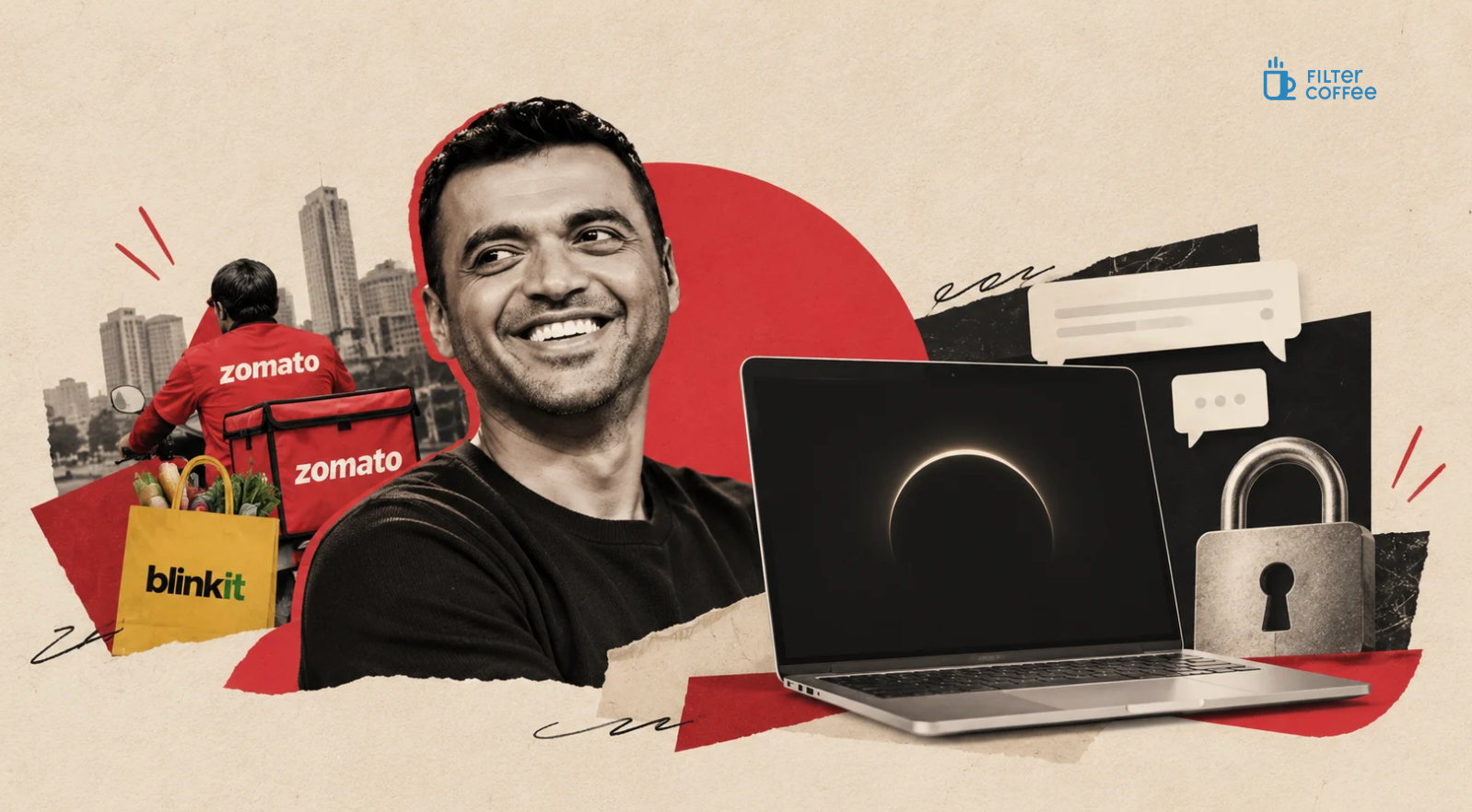
When Eternal announced its quarterly results on Wednesday, investors had plenty to discuss. Blinkit had added 308 stores, Zomato was spending more to attract customers, and quarterly revenue had climbed to ₹24,138 crore. Yet analysts also found themselves asking how much computing hardware the company might need for a new AI chatbot.
Yes, the parent company of Zomato and Blinkit is building a chatbot. It is called Dark.ai, and Deepinder Goyal hopes to launch it globally before the end of 2026. Its pitch is unusual for a company whose existing apps rely on understanding what customers browse and buy: Dark promises to keep its users’ conversations out of the company’s reach.
Goyal has a personal explanation. He wanted an AI assistant he could speak to freely, without wondering who might read the conversation later. Think about a founder discussing an unreleased product, a researcher exploring unpublished findings or an executive testing a sensitive business decision. An AI chatbot might help them think, but pasting confidential material into one also requires a fair amount of trust. Goyal believes that uncertainty is stopping people from using AI as fully as they otherwise would.
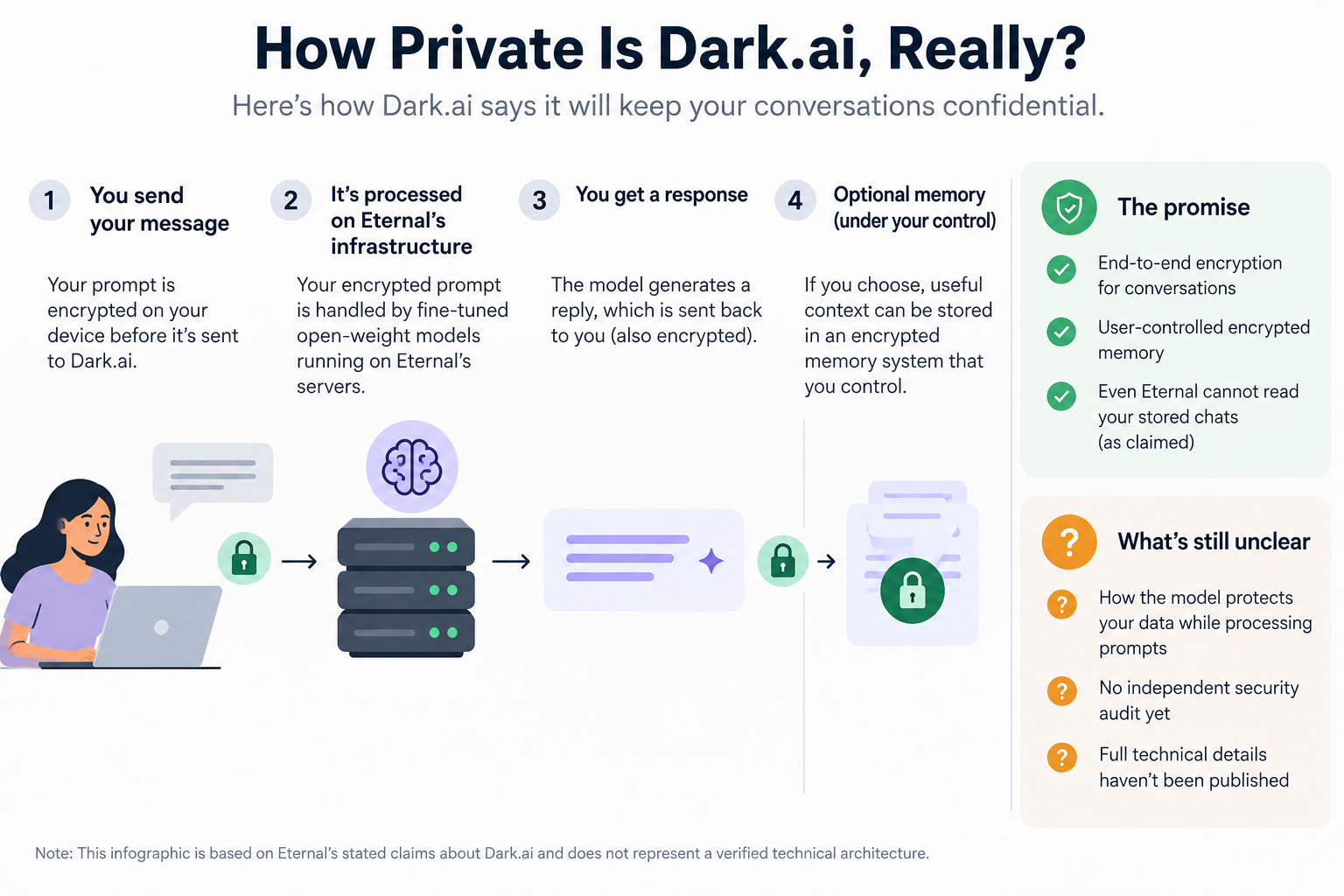
So Dark.ai is being built around that hesitation. According to Eternal, it will use end-to-end encryption and a user-controlled encrypted memory system, allowing the assistant to remember useful context between conversations without giving the company access to stored chats. Goyal claims even Eternal would be unable to read the conversations if compelled to do so.
There is a technical wrinkle here. Encrypting a saved chat is one thing; producing an AI answer is another. The model generally needs to process the words you type, which means the system has to protect what happens while those words are being processed, too. Eternal has not yet published an independent security audit or enough technical detail to verify the full extent of its promise. Until then, the privacy guarantee remains a company claim, rather than something users can check for themselves.
And Eternal is not starting from zero in AI. It previously developed Nugget, a customer-support platform initially used across its own businesses. For Dark.ai, however, it is taking a different route. Instead of spending enormous sums training a model from scratch, Eternal is taking existing open-weight models, fine-tuning them and building its own application on top. It plans to host them on its own infrastructure, which could give it greater control over how user conversations are handled.
That choice also shapes economics. Training a new frontier model would demand enormous investment, whereas adapting an existing one offers a cheaper starting point. Answering users still costs money: GPUs have to run the models each time someone sends a prompt. More customers would mean more computing capacity, even if demand is an excellent problem to have.
On the earnings call, Eternal CFO Akshant Goyal said Dark.ai had been in development for about a year, with costs still too small to materially affect the company's finances. He expects it could become a high-gross-margin business that largely pays for itself. But pricing is undecided, and he acknowledged that it may end up being a product for people willing to spend more, rather than a chatbot for everyone.
That is a very different proposition from delivering groceries in ten minutes. A successful software subscription can reach customers worldwide without setting up dark stores or recruiting delivery riders in every new city. Yet privacy alone will not guarantee paying customers. Proton already offers its privacy-focused Lumo assistant, while DuckDuckGo's Duck.ai offers private access to several AI models. Mainstream providers also offer data controls, including protections for business customers. Dark.ai will have to persuade users that its safeguards and answers are worth switching for.
Eternal has another claim to prove. Goyal says Dark's fine-tuned models offer unusually strong answers, but the company has not yet released the benchmarks behind that assertion. A chatbot that keeps your secrets safe but gives weak answers will struggle to become anybody's daily assistant.
For Eternal, this is a relatively small experiment inside a much larger business. Its September-quarter net profit rose 92% to ₹125 crore, driven by operations that still revolve around food, groceries and commerce. Management has been clear that Dark.ai could become a valuable global business, but could also be shut down if it fails to catch on.
The launch will therefore test two promises at once: whether Eternal can make its privacy claims independently credible, and whether enough people value that protection to pay for the computing behind it. Zomato made convenience something Indians happily pay for. Dark.ai is betting that confidentiality might deserve a bill of its own.
Sources: