

 Newsletter

The universe is built on movement.
Energy flows from hotter objects to colder ones. Rivers make their way from mountains to the sea. Air moves from high pressure regions to low pressure ones. Electrons travel through wires, planets orbit stars and even the atoms inside our bodies are constantly moving. Nature is never really still. Everything is always travelling from one place to another.
Money behaves in much the same way.We often think of money as something that sits in a bank account, a mutual fund or a stock portfolio. In reality, money is rarely stationary. It is constantly moving between people, businesses, sectors, countries and asset classes, always searching for the place where it believes it will earn the best return for the level of risk being taken.
Once you start looking at markets through this lens, investing begins to feel less like picking winning stocks and more like understanding the direction in which capital is travelling. Every major market move, whether it is a bull run, a correction or the birth of a new investment theme, starts with money deciding to leave one place and move somewhere else.
That idea may sound obvious, but economists have spent decades trying to find ways of measuring these invisible movements before they become visible in economic data.
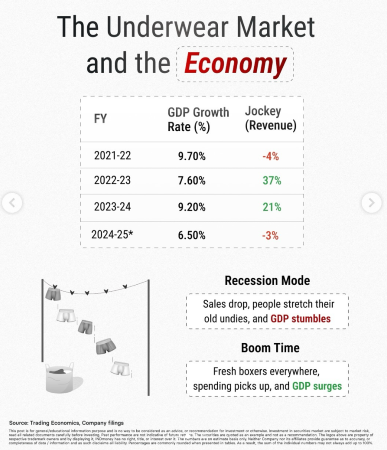
One of the most unusual examples came from former US Federal Reserve Chairman Alan Greenspan, who reportedly kept an eye on men's underwear sales. His logic was surprisingly simple. During difficult times, people postpone replacing things that nobody else can see. When underwear sales begin to recover, it may suggest that household finances are quietly improving before traditional economic indicators start showing the same story.
Another favourite among macro investors is the Baltic Dry Index. It tracks the cost of shipping raw materials such as iron ore, coal and grain across the world. If manufacturers are placing more orders for these materials, shipping demand rises. Since factories need raw materials long before they produce finished goods, many investors see the index as an early glimpse into the direction of global economic activity.
On the surface, one indicator sounds almost ridiculous while the other sounds highly technical. Yet both are trying to answer exactly the same question. Where is money beginning to move before everyone else notices?
Several researchers have started viewing financial markets through a similar lens. In a 2008 paper, Information Flow Between Stock Indices, Okyu Kwon and Jae Suk Yang used transfer entropy to study how information travels across global markets. They found that markets behave less like isolated exchanges and more like interconnected networks where information flows from one market to another.
More recent studies have extended this idea to sectors, countries and asset classes, suggesting that financial markets are linked by measurable flows rather than independent events.Once you begin thinking about capital as something that flows instead of something that sits still, many events that appear unrelated suddenly become connected.

Imagine a government announcing a massive infrastructure programme. The first beneficiaries may be engineering companies, but the story rarely ends there. Cement producers receive larger orders. Steel manufacturers increase production. Equipment suppliers see demand rise. Banks extend more credit. Logistics companies move more material and power producers generate more electricity. One decision causes money to spread through an entire chain of industries.
The same thing happens when a completely new investment theme emerges. Artificial intelligence, renewable energy, defence manufacturing or pharmaceuticals may become the destination attracting fresh capital, but the movement never stays confined to one company. It spreads through suppliers, customers, financiers and supporting industries before eventually reaching parts of the economy that appeared unrelated at the beginning.
Capital does not stop at sectors either. It moves across borders every single day.
If global investors believe India offers stronger long term opportunities than another emerging economy, money gradually shifts towards Indian equities and away from competing markets. If interest rates in the United States rise sharply, some of that capital may flow back into dollar assets. A slowdown in China can reduce demand for commodities, affecting exporters in Australia, Brazil and Africa almost immediately. Markets may be separated by geography, but capital treats the world as one connected system.Today, several tools attempt to track these movements in real time. Fund flow data, ETF flows, sector rotation models and Relative Rotation Graphs all help map where capital is entering and where it is leaving. One cannot predict the future, but they offer a useful way of understanding how money is moving before those shifts become visible in prices.This brings us to one of the biggest myths in investing.
Most people assume that prices rise first and money follows. In practice, the sequence is often reversed.
Large institutions begin accumulating positions over weeks or even months. Ownership changes gradually, trading volumes begin to increase and liquidity improves. Only after enough capital has already entered does the price start moving in a way that attracts wider attention. By the time headlines declare that a sector is booming, the journey has usually been underway for quite some time.That is why price should be seen as evidence rather than the cause. It tells us where money has already been, not necessarily where it is going next.
The best investors are not simply looking at charts or searching for the next exciting story. They are trying to answer a much deeper question. Where is capital moving today that everyone else will only notice tomorrow?
Markets become much easier to understand once you realise they are not just collections of companies moving independently. They are living networks connected by the continuous movement of capital. Just as physicists study the flow of energy to understand the natural world, investors who learn to study the flow of money begin to understand something far more valuable than price itself.