
 Newsletter

Google invested $36 million in hyperspectral imaging startup Pixxel in its Series B round back in 2023. Three years later, the startup has raised a whopping $100 million in Series C funding, co-led by Temasek and Seraphim Space.
Pixxel started out building hyperspectral imaging satellites but has since expanded into Earth intelligence software, satellite systems and manufacturing.
The deets: the latest round takes Pixxel’s total funding to $195 million and will help the company scale its satellite network, software business and manufacturing capabilities.
What has Pixxel built so far: last year, Pixxel deployed its first six Firefly satellites into low Earth orbit. These satellites capture images across 135 spectral bands, allowing them to detect details that regular satellite cameras may miss.
Now, Pixxel is working on its next-generation Honeybee satellites, which will be larger and capable of capturing even more detailed data across around 250 spectral bands.
The company plans to deploy six more Firefly satellites next year before gradually moving to Honeybee. The first Honeybee satellite is expected to launch in the first quarter of 2027, followed by five more by early 2028.
Who needs all this data: Pixxel is targeting both governments and businesses across industries such as oil and gas, mining and agriculture.
Closer home, the company has won multiple challenges under the Ministry of Defence’s iDEX programme. It has also been selected to lead the development of India’s first public-private Earth observation constellation, comprising 12 satellites under IN-SPACe.
And Pixxel isn't stopping at satellites. The company plans to open its Gigapixxel factory in India within months. The facility could increase its annual satellite production capacity from 25 to 100 satellites, founder and CEO Awais Ahmed told SpaceNews.
The big picture: Pixxel’s expansion comes as India’s private space industry picks up pace.
India wants to grow its space economy from $8.4 billion in 2022 to $44 billion by 2033, capturing around 8% of the global space market.
Government spending has also increased. India’s space budget has risen from ₹5,615 crore in FY14 to ₹13,416 crore in FY26.
The Centre has also committed ₹211 crore under the Fund of Funds for Startups scheme for space-tech innovation and set up a dedicated ₹1,000 crore venture capital fund for the sector.
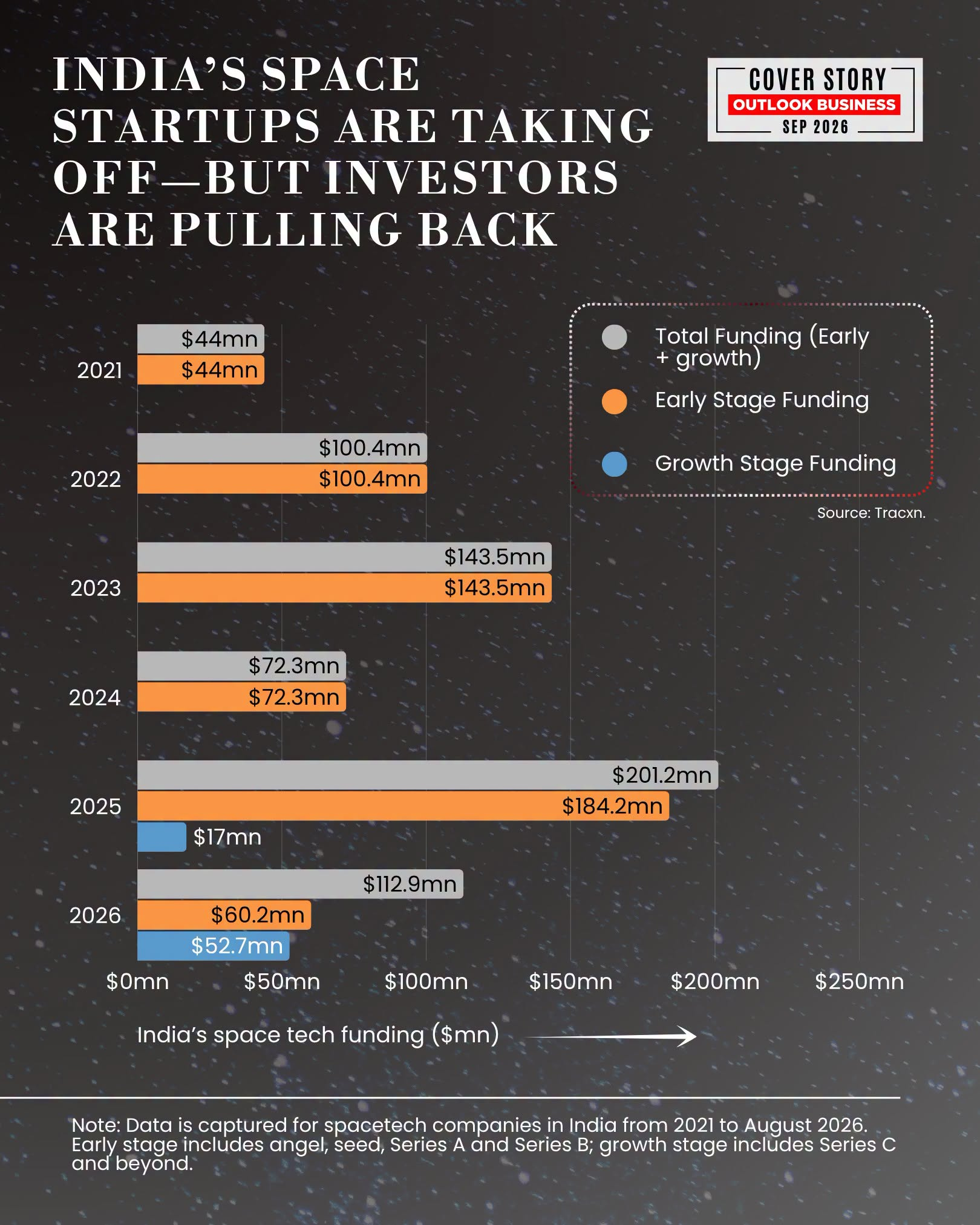
But while more money is flowing into Indian space startups, one challenge remains: scaling up.
Early-stage funding has grown, but securing enough capital to move from promising technology to large-scale commercial operations remains difficult. Pixxel’s $100 million raise shows that some Indian space startups are now beginning to cross that gap.