

 Newsletter


The chipmaker’s shares rose as much as 6% in extended trading after it reported strong third-quarter numbers and offered a confident outlook for the months ahead.
First, the record numbers: the AI giant’s revenue more than doubled year-on-year to $115.8 billion in Q3 FY27.
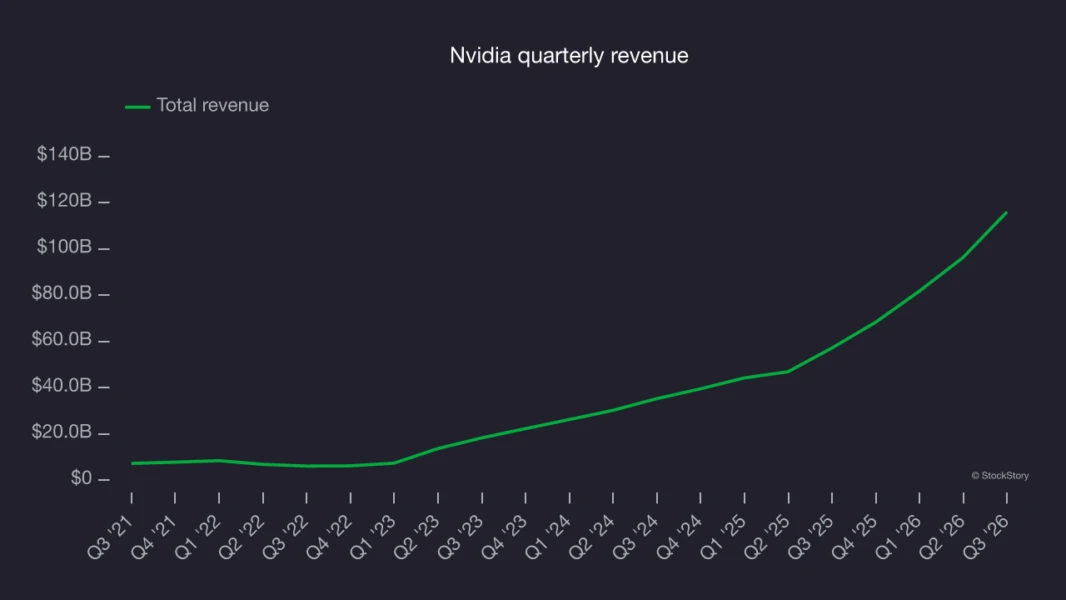
By the numbers:
- Net income up 105% YoY at $65.3 billion
- Operating income up 115% YoY at $77.5 billion
- Gross margin at 74.8% up from 73.4% last year
- Earnings per share: $2.70, up 108% YoY
The AI engine: Nvidia’s data-centre business remained the star of the quarter.
Revenue from this segment reached a record $107.6 billion, up 110% from last year. It now contributes more than 90% of Nvidia’s overall revenue.
Data centres buy Nvidia’s powerful processors to train and run AI models. Demand from cloud companies, AI laboratories and other technology businesses therefore continues to drive most of the company’s growth.
Nvidia also began shipping its new Vera Rubin systems during the quarter. The company described it as the fastest product rollout in its history.
Beyond data centres: Nvidia’s edge-computing business generated $8.2 billion, up 42% YoY.
This segment includes chips and technology used in personal computers, autonomous vehicles, robotics and other devices that run AI locally instead of depending entirely on a distant data centre.
What comes next: Nvidia expects Q4 revenue of around $130 billion, plus or minus 3%.
However, gross margin is expected to fall to between 71% and 72%. Management indicated that Q4 could mark the low point, with margins expected to improve afterwards.
For FY28, Nvidia raised its revenue growth outlook to approximately 75%, from its earlier projection of 70%. Gross margins are expected to recover to between 72% and 73%. investor.
China remains the problem: Nvidia has not included any revenue from selling data-centre computing products to China in its Q4 forecast.
New US restrictions seek to prevent Chinese companies from accessing advanced American AI chips, including through data centres located in other countries.
Leaving China out of the forecast makes Nvidia’s guidance more cautious. But it also shows how much potential business remains at risk if restrictions become tighter.
No Jensen comeback: Nvidia board chair Harvey Jones began the earnings call by addressing the leadership question directly.
He said the board had unanimously accepted Jensen Huang’s resignation and did not intend to reinstate him as CEO.
Colette Kress will continue serving as interim CEO while Nvidia searches for a permanent replacement. During the call, she said operations were continuing as usual despite the leadership change.