
 Newsletter
Industrial output grows, defence locks in, and HUL dampens mood.
🗓️ Morning, folks! ☀️
Every year, nearly 65 million two-wheelers are sold around the world. But when we think of performance motorcycles, we usually think of brands from Italy, Germany or Japan, not India, and definitely not electric.
Ultraviolette is trying to change that.
The company started by building one of the hardest products in EVs: a performance electric motorcycle. Its bikes have raced a mini fighter jet, been lowered into the world’s deepest diving pool, and are being built out of Bengaluru.
Tanvi Raut Dessai visited Ultraviolette in Bengaluru to understand what it takes to build a high-performance electric motorcycle brand from India, for the world.
Full story here 👇🏻
Moving on,
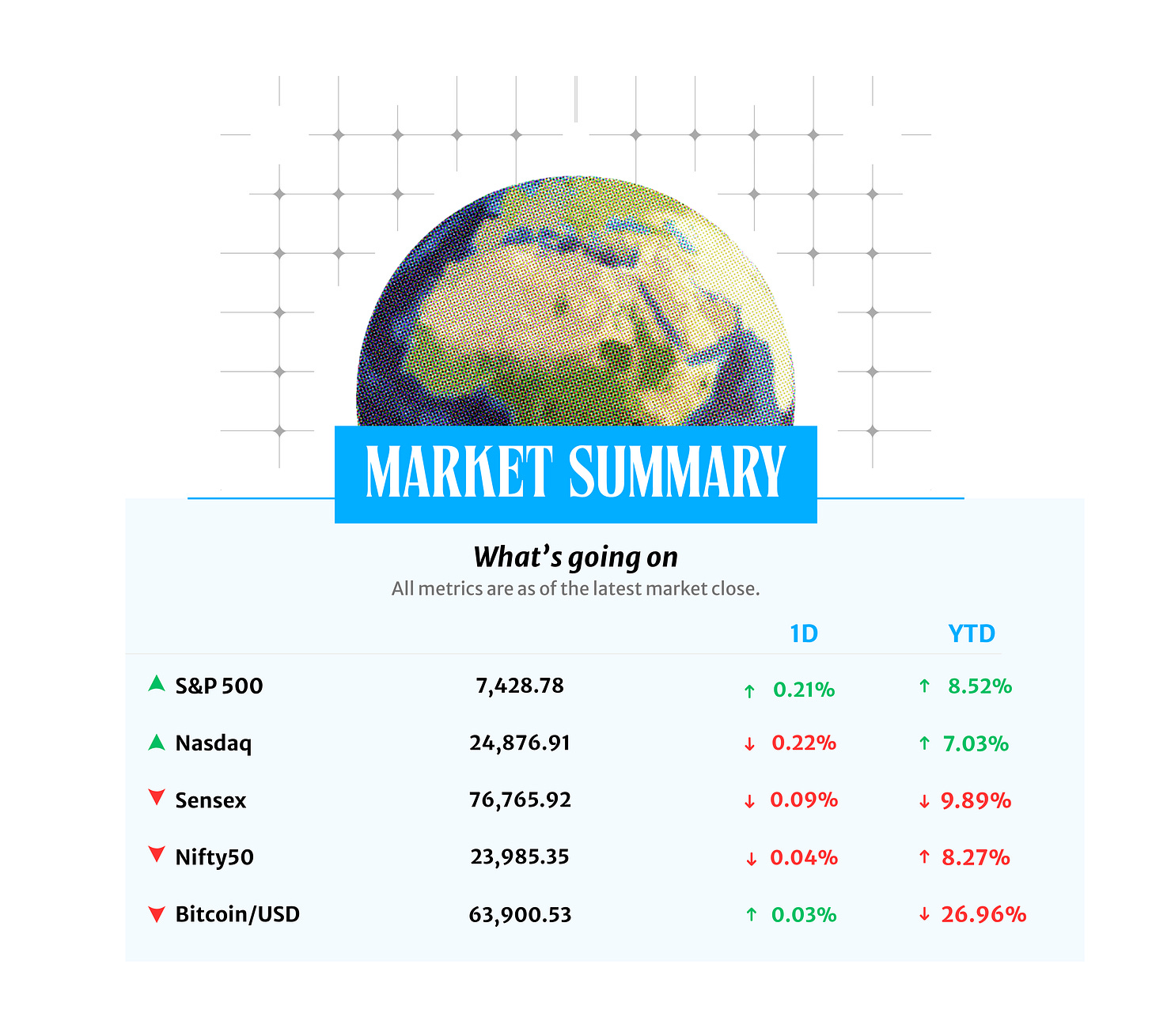
A quiet Tuesday for Dalal Street. The Sensex and Nifty ended with marginal losses as investors stayed cautious.
IT stocks continued to outperform, with Tata Consultancy Services (TCS) and Tech Mahindra among the top gainers.
Looking ahead, all eyes will be on the US Federal Reserve’s policy decision for clues on interest rates.
Back home, the Q1 earnings season will continue to drive stock-specific moves.
💡 Spotlight: India's factories are back in top gear 📈
India’s industrial activity picked up pace in June 2026, with output growing 7.3% year-on-year, up sharply from 5.1% in May.
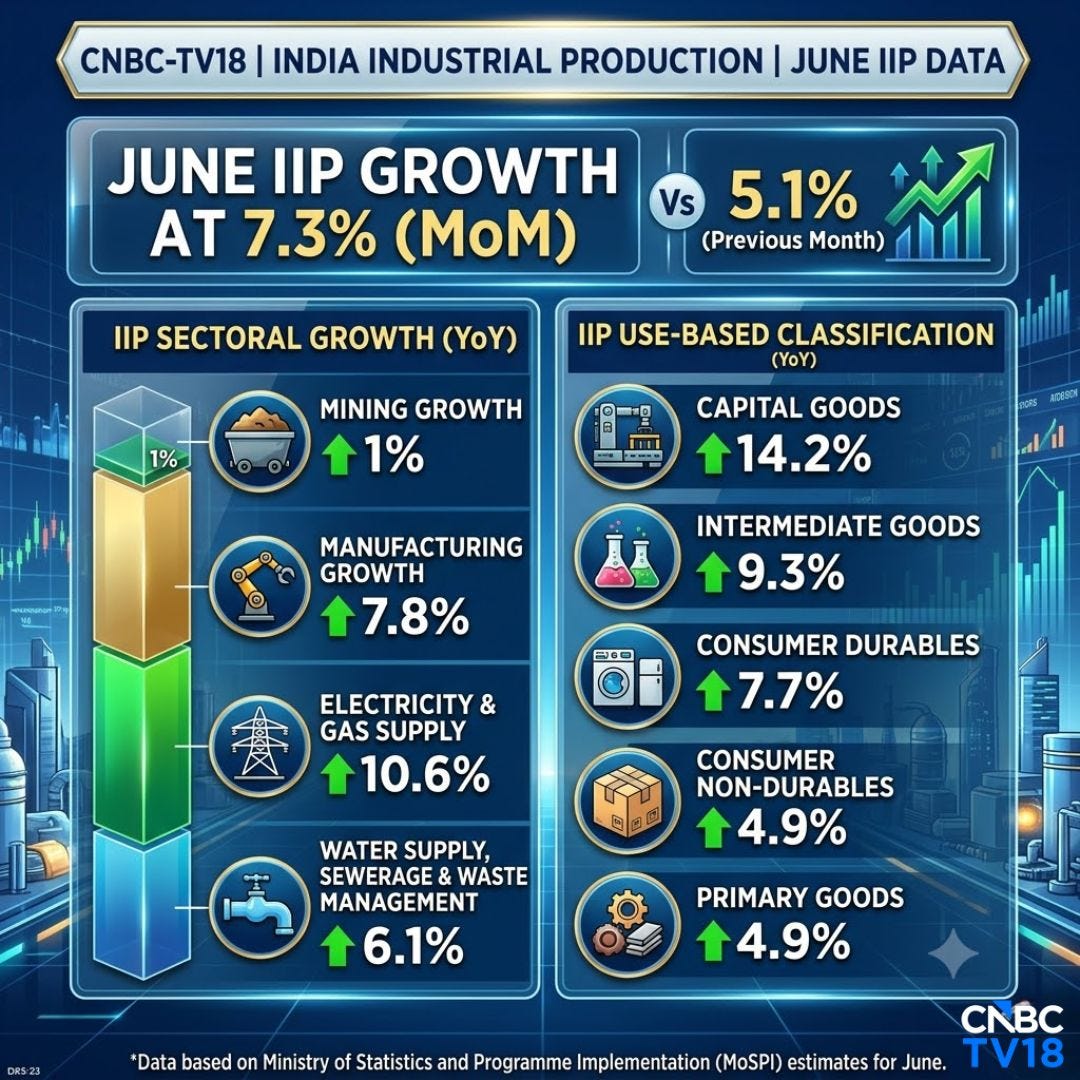
The biggest winners: manufacturing, the largest part of India’s industrial economy, grew 7.8%, with 19 of the 23 manufacturing industries posting positive growth.
The biggest stars were electrical equipment (34%), followed by automobiles and auto components (17.5%), and food products (10.8%).
Consumer demand also remained healthy. Output of consumer durables, such as cars and home appliances, grew 7.7% during the month.
Meanwhile, production of primary goods and consumer non-durables, including everyday essentials like food and household items, rose 4.9%, suggesting that spending remained steady across the economy.
In an interesting insight,
Deepinder Goyal’s healthtech startup Temple doubled its valuation to $375 million, up from around $190 million, following a secondary share sale.
At the same time, the company has launched its first ESOP liquidity programme, allowing employees to cash out part of their stock options before an IPO or acquisition.
Temple is building a forehead-worn wearable that tracks metabolism in real time to help users better understand their health.
Let’s hit it! 💪🏻
1 Big Thing: HUL disappoints in Q1 👎🏻
Hindustan Unilever shares fell as much as 6% intraday after the FMCG giant reported Q1 results that missed expectations.
By the numbers:
- Net profit: down 3% YoY to ₹2,673 crore vs ₹2,756 crore
- Revenue: up 10% YoY to ₹17,341 crore vs ₹15,757 crore
- EBITDA: up 8.4% YoY to ₹3,947 crore vs ₹3,640 crore
- EBITDA margin: remained flat at 23%
The why: the quarter remained challenging as volatile crude oil prices, driven by the ongoing US-Iran conflict, kept input costs elevated.
Net profit also declined due to the absence of the one-off tax credit recognised in the year-ago quarter.
HUL’s Personal care business posted 4% underlying sales growth (USG), supported by price hikes taken to offset a second consecutive year of palm oil inflation.
The Beauty & Wellbeing segment recorded 11% underlying sales growth to ₹3,721 crore, driven by strong volume growth.
Management’s take: expects inflation to remain in the 3-5% range in the coming quarter and plans to gradually raise prices to protect margins without hurting demand.
More on earnings 💸,
It wasn’t a great June quarter for Varun Beverages either. Shares fell over 7% after the company’s India volume growth came in below what the street was expecting.
The numbers 📊:
- Net profit: up 15.5% YoY to ₹1,521 crore vs ₹1,317 crore
- Revenue: up 21% YoY to ₹8,650.5 crore vs ₹7,163 crore
- EBITDA: up 17% YoY to ₹2,344 crore vs ₹1,999 crore
- EBITDA margin: 27.1% vs 28% a year ago
What’s next: Varun Beverages will continue to expand its manufacturing capacity and distribution network to meet rising demand and strengthen its position as one of PepsiCo’s biggest bottling partners in international markets.
2. Apollo enters smart bombs race 🎯
Apollo Micro Systems has been shortlisted by the Indian Air Force (IAF) to develop a key part of India’s next-generation precision bombs under the Make-II programme.
The deets: the company has been empanelled as a Prime Development Agency (DA) for the Indigenous Precision Range Extension Kit (IPREK) programme.
In simple words, the IAF has officially selected Apollo as one of the companies allowed to design and build this technology.
Being empanelled doesn't guarantee an order. It simply allows Apollo to develop a prototype for the IAF.
What is Make-II: under the Defence Acquisition Procedure (DAP) 2020, the Make-II category asks Indian companies to fund the research and development of military equipment using their own money.
The idea is to encourage private companies to build advanced defence technologies in India instead of relying on imports.
Big theme: India has significantly increased defence spending over the past decade, including a 15.2% hike in FY27.
As the armed forces modernise, Indian defence companies are seeing a steady pipeline of new orders.
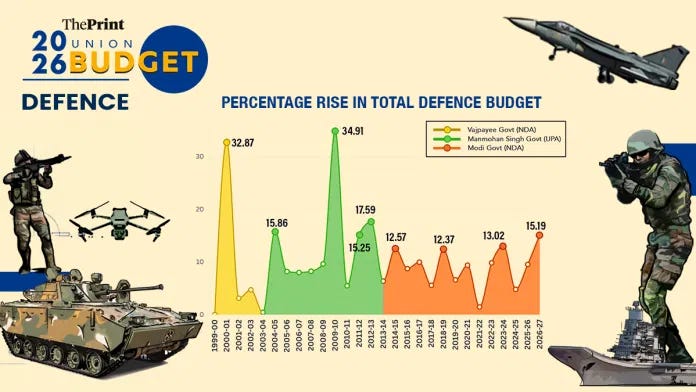
3. How India became America’s pharmacy 💊
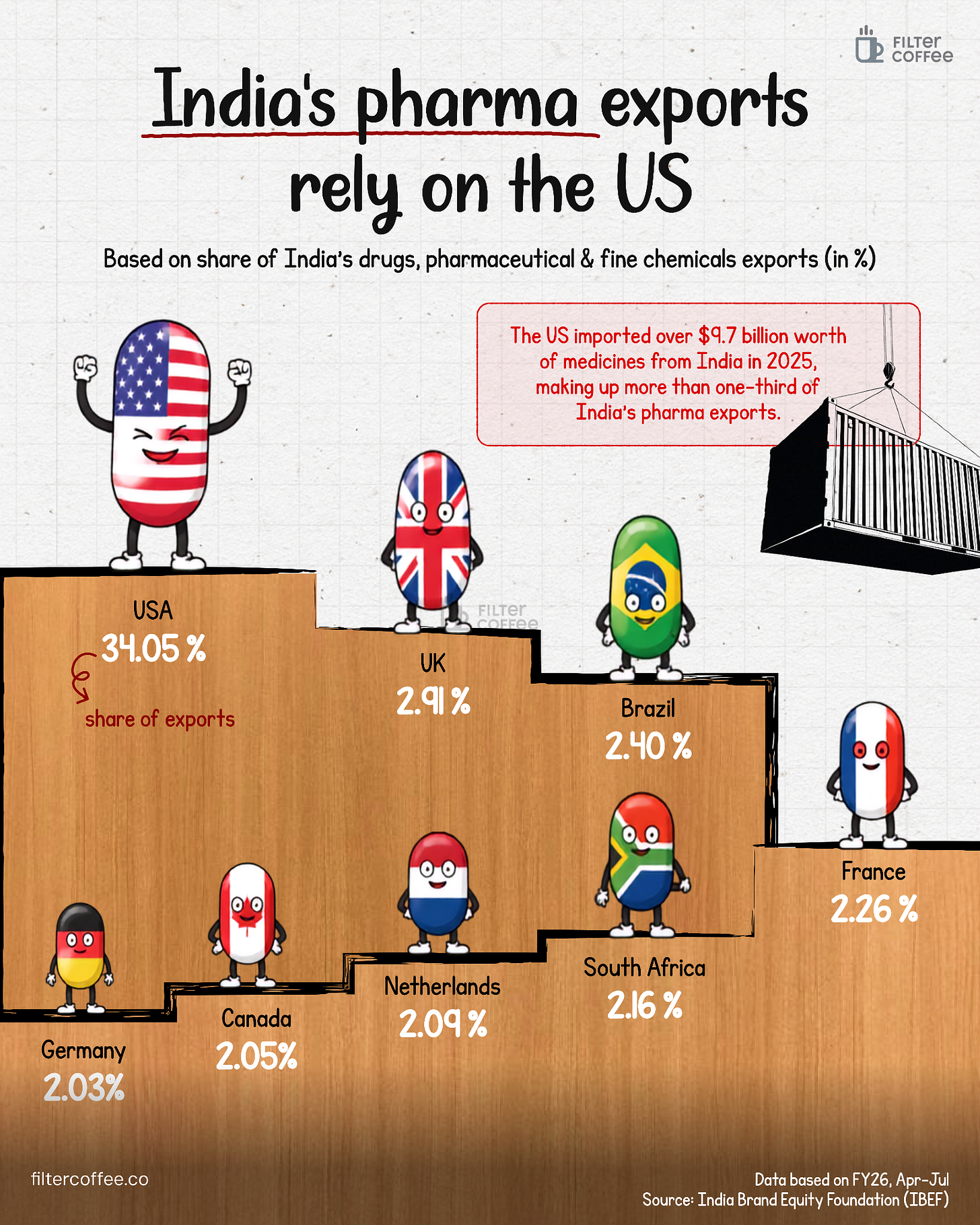
India’s pharma export basket looks like a risky portfolio: one country accounts for more than one-third of it.
The US bought more than $10.5 billion worth of medicines from India in FY25, making it the industry’s biggest overseas customer by a huge margin.
The relationship runs both ways. Over 90% of prescriptions filled in the US are generics, and more than 95% of India’s pharma shipments there are estimated to be generic drugs.
India keeps American medicines affordable, while the US keeps Indian pharma factories busy.
4. The Chakravyuha of investing 💸
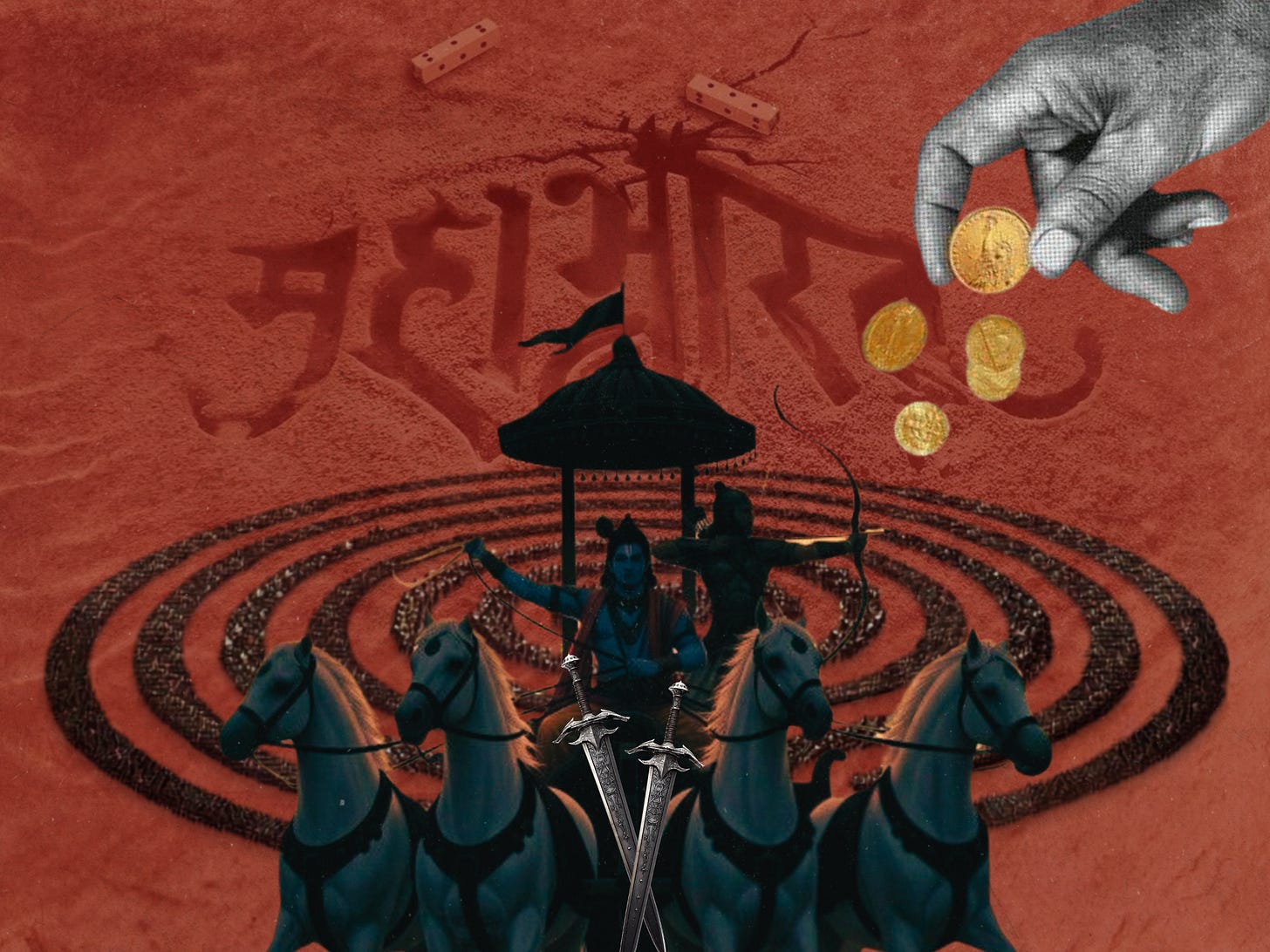
Every investor has a framework for buying a stock.
Far fewer have a framework for selling one. That imbalance has shaped investment decisions for decades, reinforced by psychology, industry practices and even the way markets are taught.
But what if the biggest edge in investing doesn’t come from discovering the next multibagger, but from knowing exactly when an existing investment no longer deserves your capital.
5. Stocks that kept us interested 🚀
What went up ⬆️
💻 Coforge jumped over 10% after it reported 1.1% organic Q1 growth and announced a China expansion plan.
🍳 TTK Prestige gained more than 5% as Q1 net profit more than doubled, driven by consumers shifting to induction cooktops.
📈 Hexaware Tech and Radico Khaitan rose up to 5% after reporting strong Q1 earnings.
What went down ⬇️
🤖 AI anxiety triggered tech rout, with Hitachi Energy, CG Power, Black Box other AI-related stocks falling up to 6%.
🛡️ Coal India, Bharat Electronics and Avenue Supermarts slipped up to 6% following their Q1 earnings.
⚡Suzlon Energy ended 10% lower as margins narrowed despite 22% revenue growth.
What else are we snackin’ 🍿
💵 Polymer notes: the government has approved field trials of ₹10 and ₹20 polymer banknotes, with no plans to replace paper currency for now.
📊 Earnings snapshot: L&T shares gained after it reported a 14% rise in Q1FY27 profit, with revenue and earnings beating street estimates.
✅ Green signal: Cipla received USFDA approval for its generic Advair Diskus inhaler, targeting a US market worth about $908 million.
🌊 Wind deal: L&T and Hitachi Energy have secured a TenneT contract to deliver offshore wind transmission projects in the Netherlands and Germany, supporting Europe’s 2 GW clean energy push.
🚛 Fleet deal: Zaggle signed a 3-year agreement with Daimler India Commercial Vehicles to provide fleet management and corporate payment solutions for its fleet partners.
That’s a wrap! Don’t let the weekday blues get to you.

And if you’d like to place your brand on this newsletter, let us know.
Hit that 💚 if you liked this issue.