
 Newsletter


Solar overtakes nuclear, cinema on a generational-run, and industrial production slows.
🗓️ Morning, folks! ☀️
Climate hasn’t exactly been serving hopecore lately. But a new BBC report might just give us a reason to look on the sunnier side.
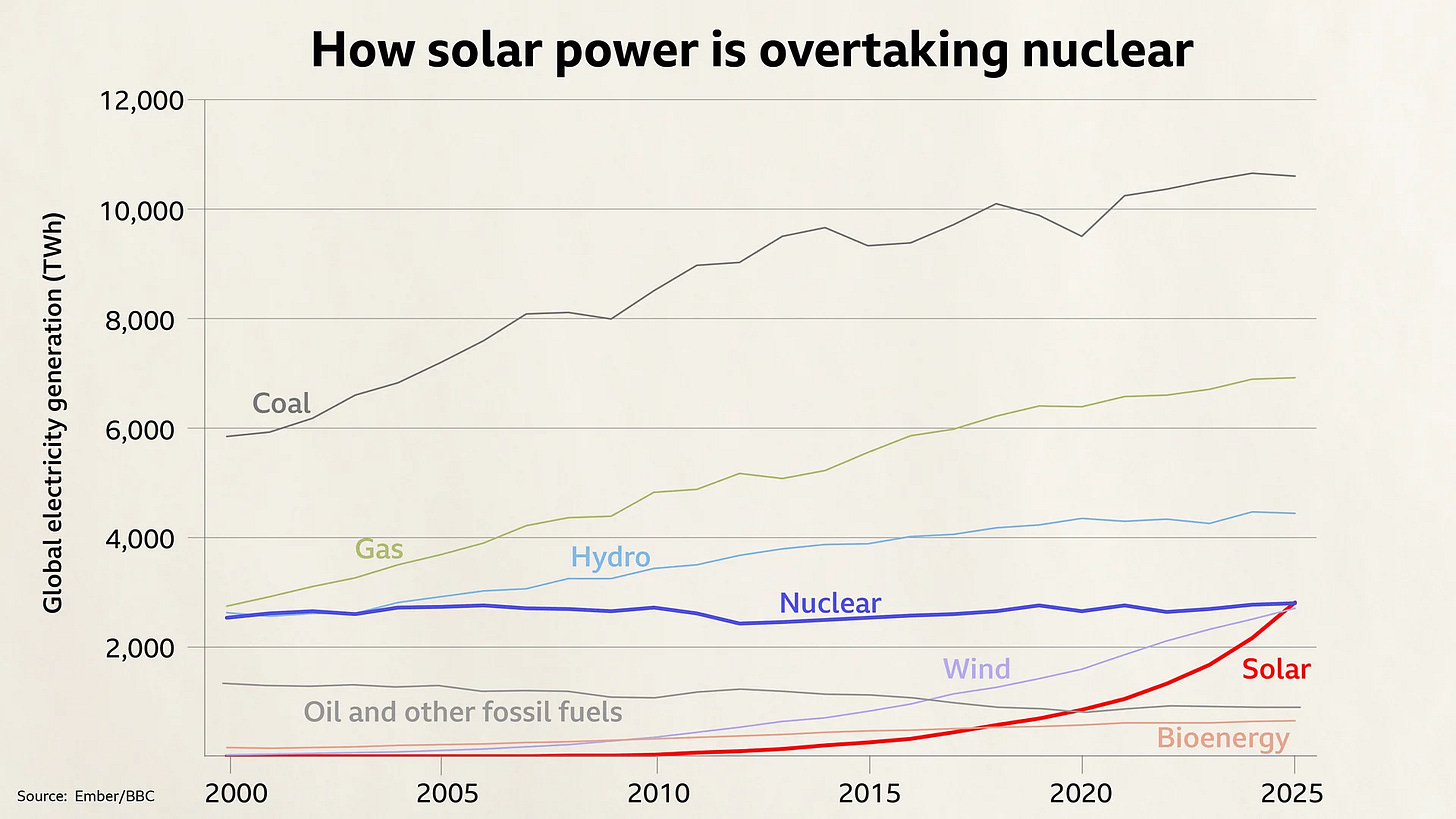
Solar panels are now producing so much power that they’re leaving nuclear plants in the dust. And the numbers back it up.
Solar is on track to generate 10% of the world’s electricity in 2026. Over the 12 months to September 2026, it produced 13% more electricity than nuclear.
The secret sauce? Cheap panels, China’s massive manufacturing capacity, rising oil prices and the hunt for more reliable energy. Solar generation has grown roughly 2,700-fold since 2000, while nuclear output has stayed largely flat.
The next challenge? Building better batteries and upgrading power grids so the lights stay on even when the sun clocks out.
Moving on to markets,
Dalal Street ended in the red on Wednesday, with the Sensex and Nifty both slipping. However, midcap stocks held up better, while Bank Nifty also gained.
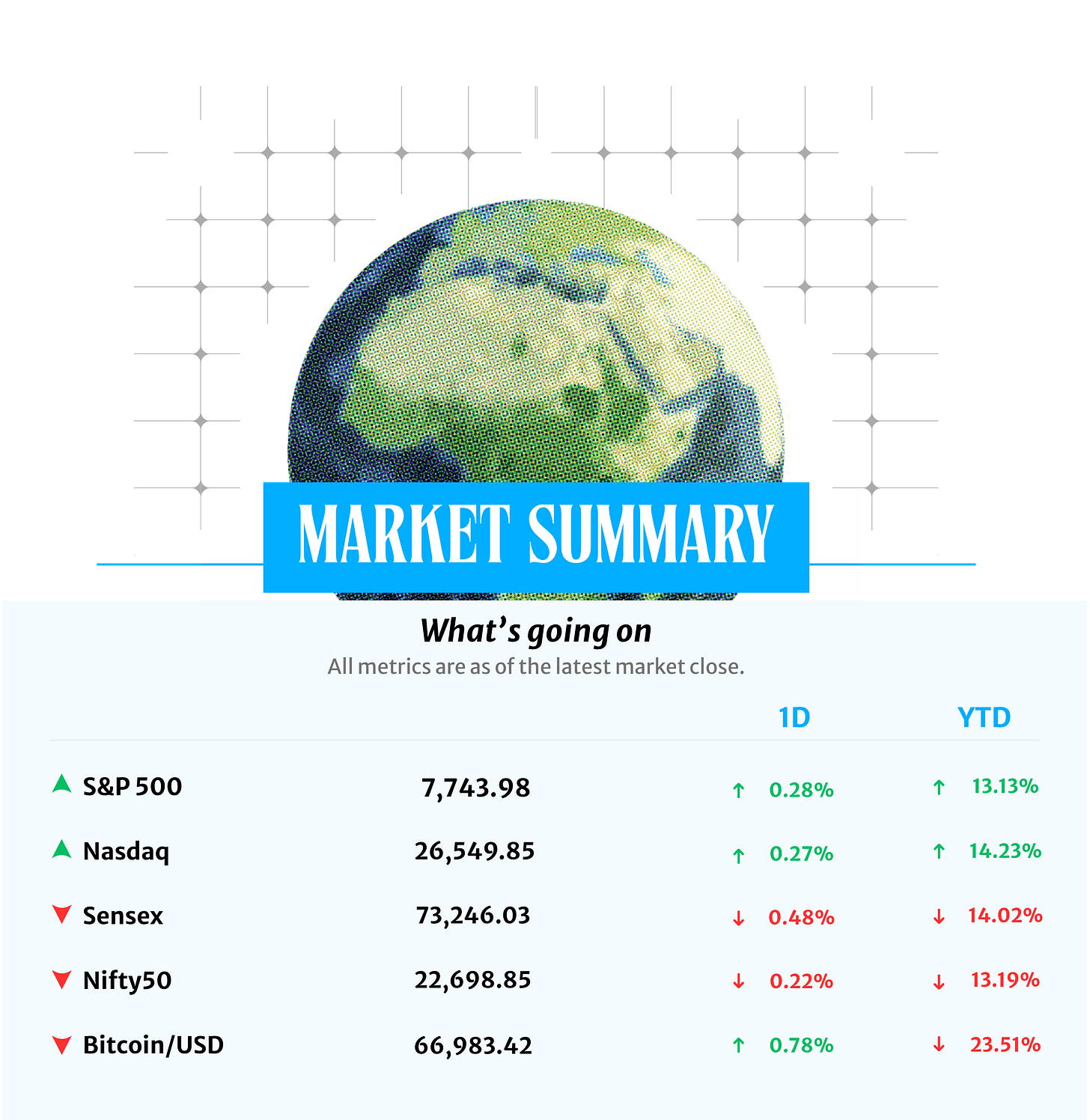
IT stocks took a hit, with the Nifty IT index falling over 2% amid concerns around global AI earnings.
Meanwhile, the US Federal Reserve kept interest rates unchanged on Wednesday, choosing to wait and watch as inflation remains difficult to control.
As expected, the Federal Open Market Committee kept the overnight funds rate in a range between 3.75-4%.
💡 Spotlight: Jio makes a blockbuster market debut 📱
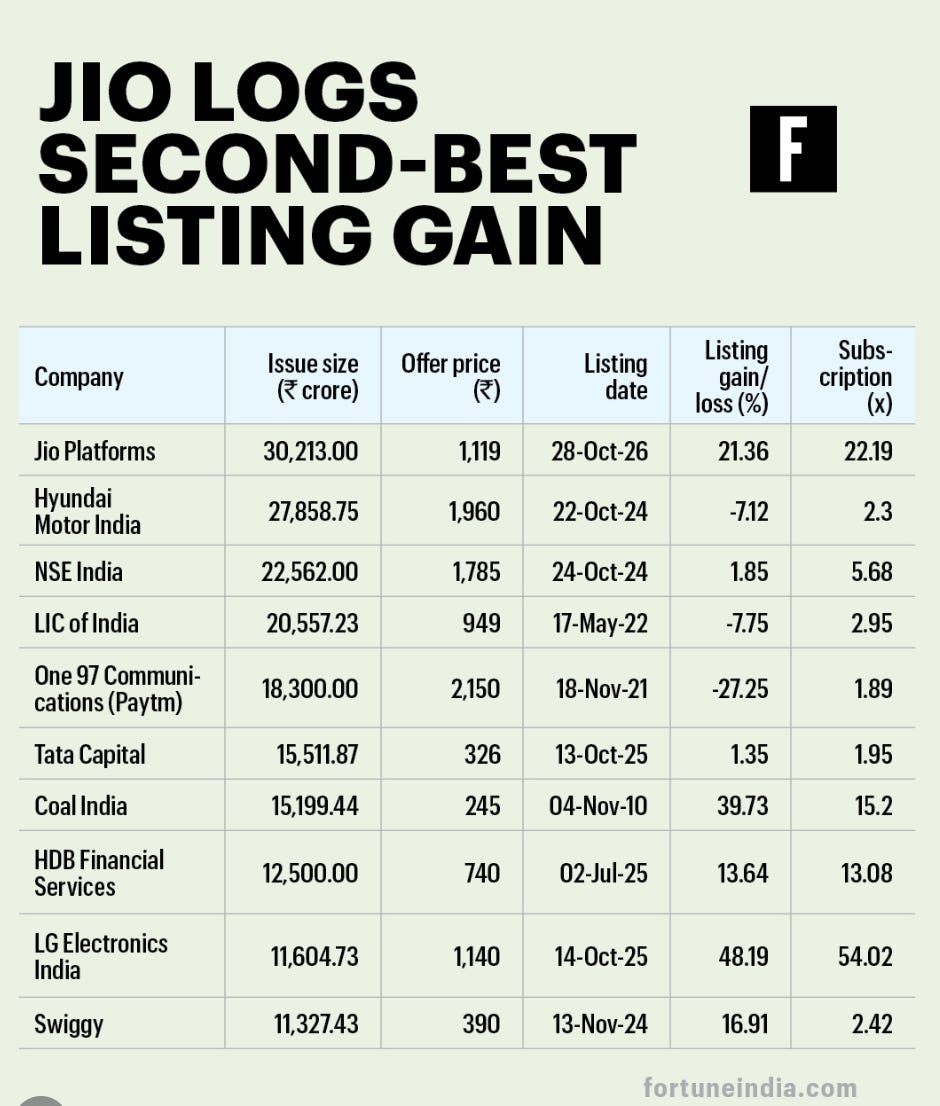
Jio Platforms made a blockbuster stock-market debut. The shares listed at ₹1,358, compared with the IPO price of ₹1,119.
That is a gain of ₹239 per share, or 21.36%, on the first day. Jio offered shares worth ₹30,213 crore, but investors placed bids for more than 22 times the shares available.
The IPO received around 1.38 crore applications, becoming the first Indian public issue to cross the one-crore mark. It was also fully subscribed within around 100 minutes of opening.
Jio’s valuation: at the IPO price, Jio was valued at around ₹10.3 lakh crore.
At its listing price, that jumped to approximately ₹12.5-12.6 lakh crore, making Jio India’s second-most valuable listed company.
The listing has also placed Jio in a small global club of founder-led companies including Meta, Alibaba and SpaceX that were valued above $100 billion at the time of their IPOs.
We also broke this down on video, check out here 💸
Let’s hit it! 💪🏻
1 Big Thing: HUL brews a good Q2 ☕
Hindustan Unilever reported a resilient Q2, with revenue and profit rising. Meanwhile, its shares are at a 52-week low.
By the numbers 📊:
- Net profit: up 4% at ₹2,790 cr vs ₹2,685 cr (YoY)
- Revenue: up 14.4% at ₹18,226 cr vs ₹15,919 cr (YoY)
- EBITDA: up 8% at ₹4,089 cr vs ₹3,785 cr (YoY)
- Margin: at 22.43% vs 23.7% (YoY)
The maker of Taaza and Kissan jam reported underlying sales growth of 15%, its highest in 14 quarters.
How its businesses performed:
- Home care: revenue grew 21.4%, beating expectations of 14–17%, helped by higher sales of liquid products and price increases. Brands include Surf Excel and Rin.
- Beauty & Wellbeing: revenue grew 15.7%, above expectations of 10-13%.
- Personal care: revenue grew 8%, within expectations of 5-11%, led by skin-cleansing and premium products.
- Foods & Refreshment, excluding ice cream: Revenue grew 8.5%, at the upper end of expectations of 6-8.5%.
What management said: demand remains resilient, but rising raw-material costs are expected to persist in the short term. HUL expects to keep ₹22-24 from every ₹100 in sales after day-to-day operating costs, but before taxes, loan interest and certain accounting expenses.
While we are on earnings 💰,
PVR Inox’s second-quarter profit more than doubled as hit films brought more business to its cinemas.

The numbers:
- Net profit: at ₹263 cr vs ₹106 cr (YoY)
- Revenue: up 17% at ₹2,105 cr vs ₹1,799.6 cr (YoY)
- EBITDA: up 25.2% at ₹769 cr vs ₹615 cr (YoY)
- Margin: at 36.5% vs 34% (YoY)
Hits such as ‘The Odyssey’ and ‘Spider-Man: Brand New Day’ helped drive a 23% rise in gross ticket sales.
However, earnings depend heavily on the film release calendar, while streaming platforms like Netflix and Amazon Prime Video remain strong competitors.
2. Noel Tata steps back, but stays at the top 🔄
Noel Tata will step down from the boards of six major Tata Group companies on November 12.
He will leave his position as non-executive chairman of Trent, Voltas, Tata International and Tata Investment Corporation. He will also step down as non-executive vice-chairman of Tata Steel and Titan Company.
Tata will continue as chairman of Tata Trusts, the charitable organisations that collectively own around 66% of Tata Sons. He will also retain his position on the board of Tata Sons, the holding company sitting at the top of the conglomerate.
The why: Noel Tata is stepping down under the Tata Group’s retirement policy, which requires non-executive directors to leave company boards at 70.
The larger picture: Noel Tata is leaving the boards of individual Tata businesses but retaining his most influential positions at the top.
Tata Trusts and Tata Sons reportedly disagree over two major decisions. Noel Tata opposed granting Tata Sons chairman N. Chandrasekaran another five-year term from February 2027.
He has questioned whether the proper selection process and voting rules under Tata Sons’ Articles of Association, its internal rulebook were followed.
Noel Tata has also opposed a possible stock-market listing of Tata Sons, arguing that other regulatory options should be explored first.
3. How did Nykaa ace the content business? 👀

Nykaa has built a network of over 1.7 lakh creators and affiliates, up from just 28,000 in May 2025.
Together, they generate around 23 lakh pieces of beauty content annually, turning Instagram reels, skincare tutorials and product reviews into a new sales channel.
Creators earn commissions when shoppers buy through their links, while Nykaa gets to influence purchasing decisions before customers even open its app. Meanwhile, its Korean beauty portfolio grew 58% in FY26.
4. Stocks that kept us interested 🚀
What went up ⬆️
📈 JSW Energy rose nearly 3% as Q2 profit jumped 49.8%, beating estimates, while revenue grew 23% to ₹6,368.5 crore.
💸 TVS Motor gained 4% after its Q2 FY27 profit jumped 52% YoY to ₹1,377 crore.
⚡️ KPIT Technologies went up nearly 4% as quarterly EBIT rose 4.2% QoQ to ₹197 crore and margins expanded to 11.65%.
🙇🏼♀️ Apollo Hospitals led Nifty gains, rising over 4%, while Piramal Pharma surged over 17% after reporting strong Q2 results.
😮💨 Larsen & Toubro went up nearly 4% after strong quarterly results and order book growth boosted investor confidence in infrastructure spending.
What went down ⬇️
❌ CarTrade declined over 12%, marking its biggest-ever intraday fall, as weak second-quarter results raised concerns about the company’s performance.
🔻 Info Edge fell over 2% as Hitesh Oberoi announced his exit as CEO, with Sanjeev Bikhchandani taking over.
😐 Adani Group stocks mostly closed lower, while Adani Ports bucked the trend, ending with modest gains after raising its guidance.
What else are we snackin’ 🍿
🏭 Factory slowdown: India’s industrial output growth slowed to 6.7% in September from 8% in August, as mining contracted despite steady manufacturing and electricity growth.
♻️ Metal recovery: MIDHANI partnered with BARC and the Heavy Water Board to develop methods to recover nickel and cobalt from manufacturing waste, reducing reliance on newly mined minerals.
🏭 Manufacturing boost: The Cabinet approved a ₹10,000 crore container manufacturing scheme and a ₹1,856 crore sports goods scheme to support domestic production.
That’s a wrap! Don’t let the weekday blues get to you.

And if you’d like to place your brand on this newsletter, let us know.
Hit that 💚 if you liked this issue.
Disclaimer: this newsletter is for informational and research purposes only. Nothing here should be considered financial, investment, legal, or professional advice.