
 Newsletter

A year ago, people were queuing outside toy shops, paying inflated resale prices and hanging a toothy little monster from handbags that sometimes cost more than a month's rent. Today, the company behind Labubu is facing an altogether less adorable situation.
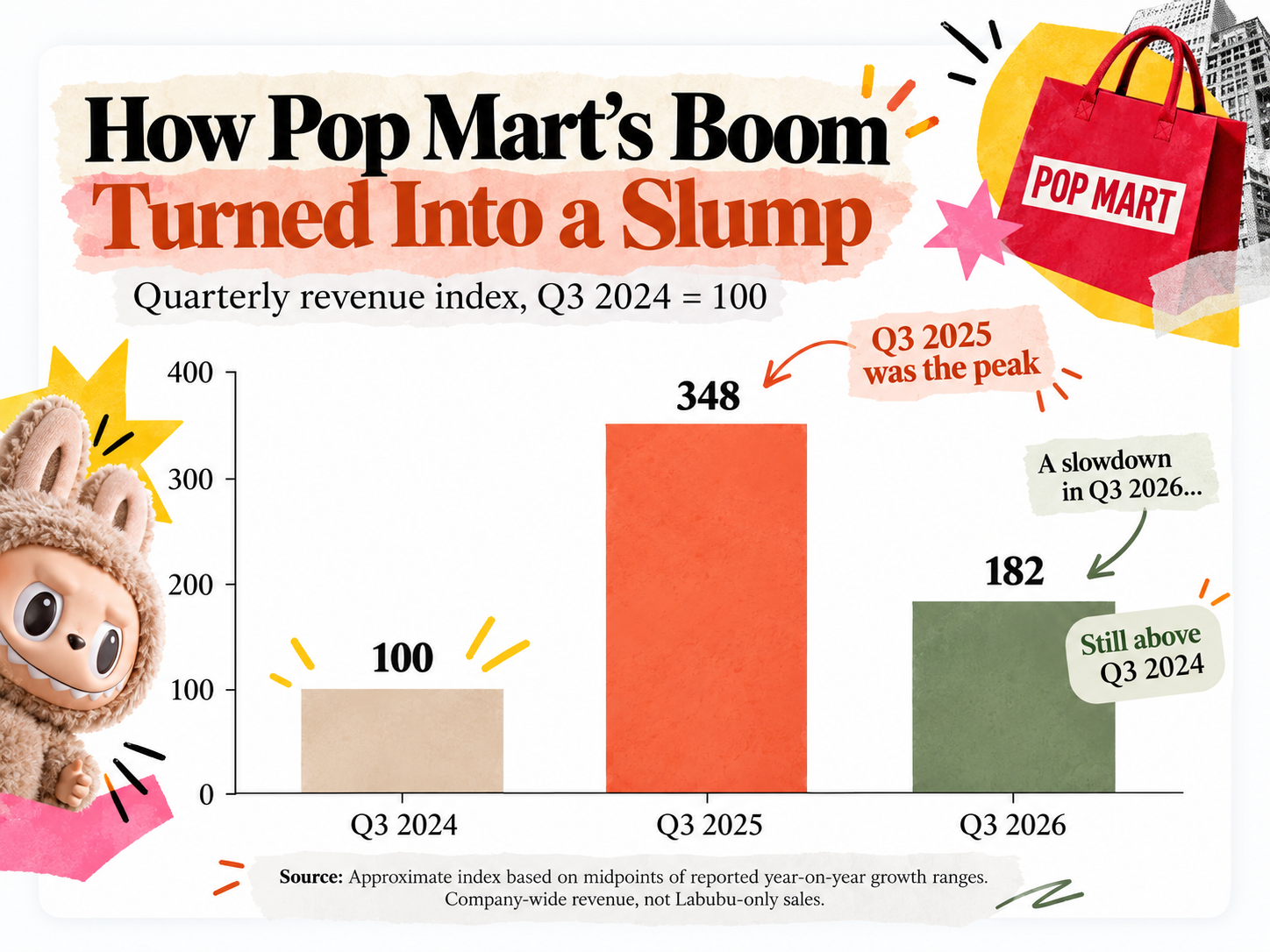
On Tuesday, China's Pop Mart reported that its revenue fell 45% to 50% in the July-September quarter of 2026. Sales in the Americas plunged 70% to 75%. During the same quarter last year, the company's revenue had grown by roughly 250%.
Its shares have lost about 60% from their peak, wiping out approximately $35 billion in market value. These are Pop Mart's company-wide figures, rather than sales of Labubu alone, but the fading frenzy around its best-known character is central to the story.
It's tempting to treat this as another case of the internet finding a new obsession and promptly getting bored. Except people have been doing something remarkably similar since long before Instagram or TikTok existed. Every few years, a toy or an ordinary household object becomes a must-have collectible. The prices climb, people begin buying for reasons other than enjoyment, and someone eventually discovers that a cupboard full of merchandise isn't quite the retirement plan they imagined.
Labubu itself wasn't designed for this kind of madness. Hong Kong-born artist Kasing Lung created the elf-like character in 2015 as part of The Monsters, a picture-book world inspired by Nordic folklore. Chinese retailer Pop Mart began selling the characters in 2019.
The breakthrough came in 2023, when Labubu appeared as a furry keychain with a vinyl face. The toy could now travel on somebody's handbag rather than spend its life on a shelf. After BLACKPINK's Lisa shared her enthusiasm in 2024, celebrity sightings and social-media videos helped push it into global fashion culture.
Pop Mart also had an extremely effective way to keep customers buying: the blind box. Instead of choosing a particular Labubu, you purchased a sealed box without knowing which design was inside. Perhaps you'd get the colour you wanted. Perhaps you'd get a duplicate. Perhaps you'd be lucky enough to find a rare secret edition. For collectors, the purchase included the thrill of a reveal, and for the company, it created a reason to return for another box.
Scarcity gave that experience a second life online. Sold-out editions began fetching premiums on resale platforms, drawing in people who weren't interested in keeping the toys at all. A reseller could buy at retail and sell to someone who wanted to skip the queue. And as resale prices climbed, the toys attracted even more attention. A Labubu was becoming a fashion accessory, a collectible and, for some buyers, a tiny speculative investment.
By 2025, Pop Mart was enjoying the results. Its annual revenue surged nearly 185% to 37.1 billion yuan, with The Monsters franchise contributing 14.2 billion yuan. At the height of the frenzy, a human-sized Labubu even sold at a Beijing auction for over 1 million yuan, although that extraordinary collector's purchase was hardly the going price for an ordinary keychain.
The earliest warning came from people trying to flip the toys. Reuters reported in October 2025 that a Labubu variant called Luck, which had traded for more than 500 yuan in June, was down to about 108 yuan. Pop Mart had expanded its supply of plush toys, including Labubu, tenfold, and was producing around 30 million plush units a month across its range. Buyers had more chances to purchase through official channels, so resellers could no longer charge quite so much for access.
Falling resale prices didn't automatically mean people had stopped liking Labubu. More supply can bring prices down even when real demand remains healthy. But by 2026, Pop Mart's financial results were also beginning to show pressure. First-half revenue from The Monsters fell from 4.81 billion yuan a year earlier to 4.45 billion yuan. The latest quarter has made the cooling considerably harder to dismiss.
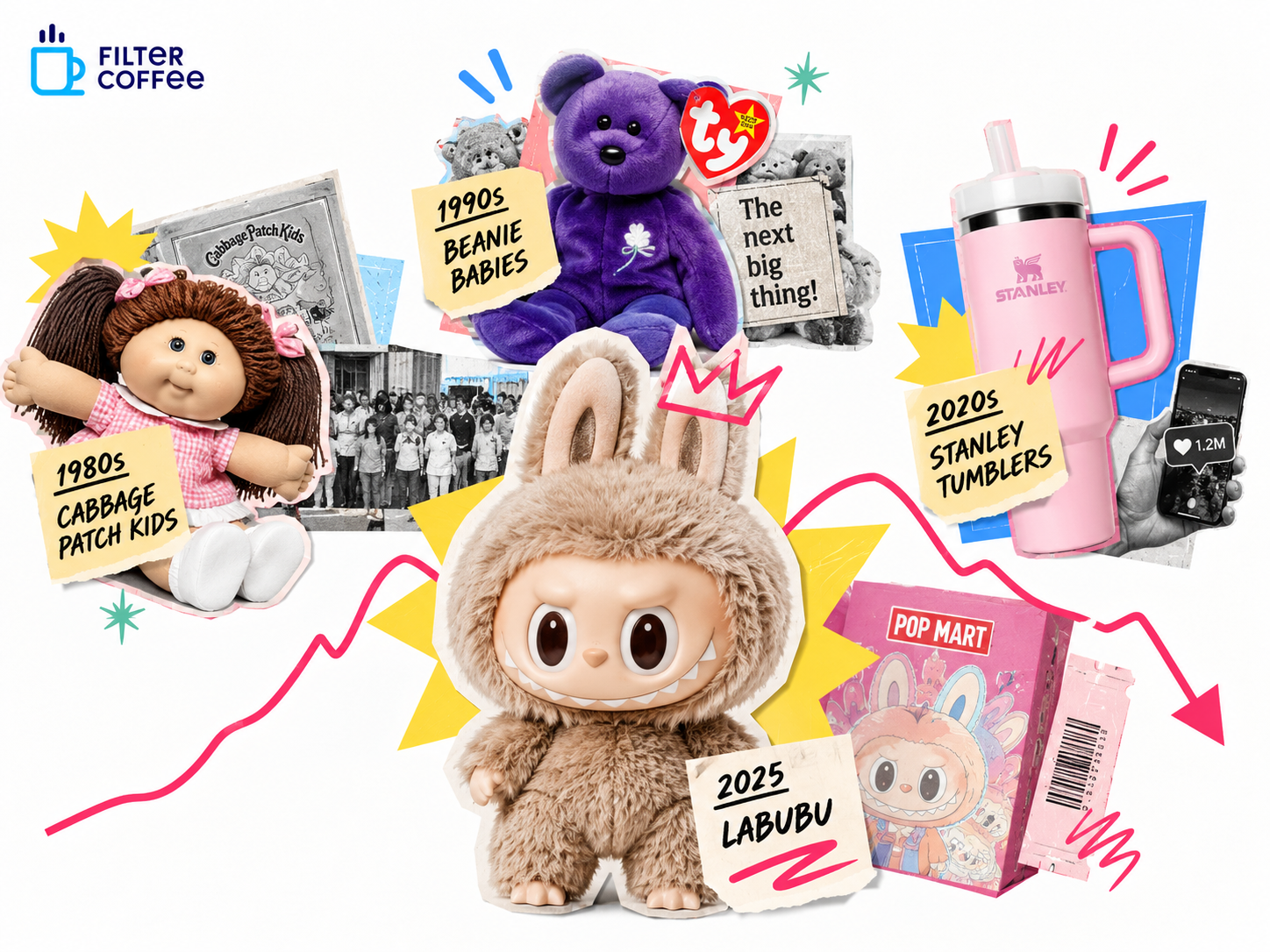
The history is oddly familiar. In the 1990s, Americans became obsessed with Beanie Babies, little stuffed animals that usually retailed for around $5. Their maker, Ty, kept releasing new characters and retiring others, making some designs seem increasingly difficult to find. Collectors preserved their tags, traded them online and paid hundreds or thousands of dollars for examples they believed would grow more valuable. Some families even treated their collections as savings for college or retirement.
Beanie Babies found an ideal home on the early internet. eBay gave enthusiasts a place to meet, compare prices and sell to one another. The prices themselves became part of the excitement: if a $5 toy could fetch $500, perhaps the next one would too. But there was no guarantee another buyer would appear at that higher price. The mania broke around the end of the decade, and most Beanie Babies never recovered their extraordinary resale valuations. Today's Labubu collectors have TikTok unboxings and resale apps instead of 1990s auction listings, but the incentives are strikingly similar.
Indian millennials may remember a smaller, less financially dramatic version of the collecting instinct. Tazos tucked inside Lay's packets and the hunt for different Beyblades made the surprise, the trade and the possibility of completing a set as exciting as the object itself. Those childhood crazes weren't equivalent to a multibillion-dollar listed company's boom, but they show that the urge to collect is older than the algorithm.
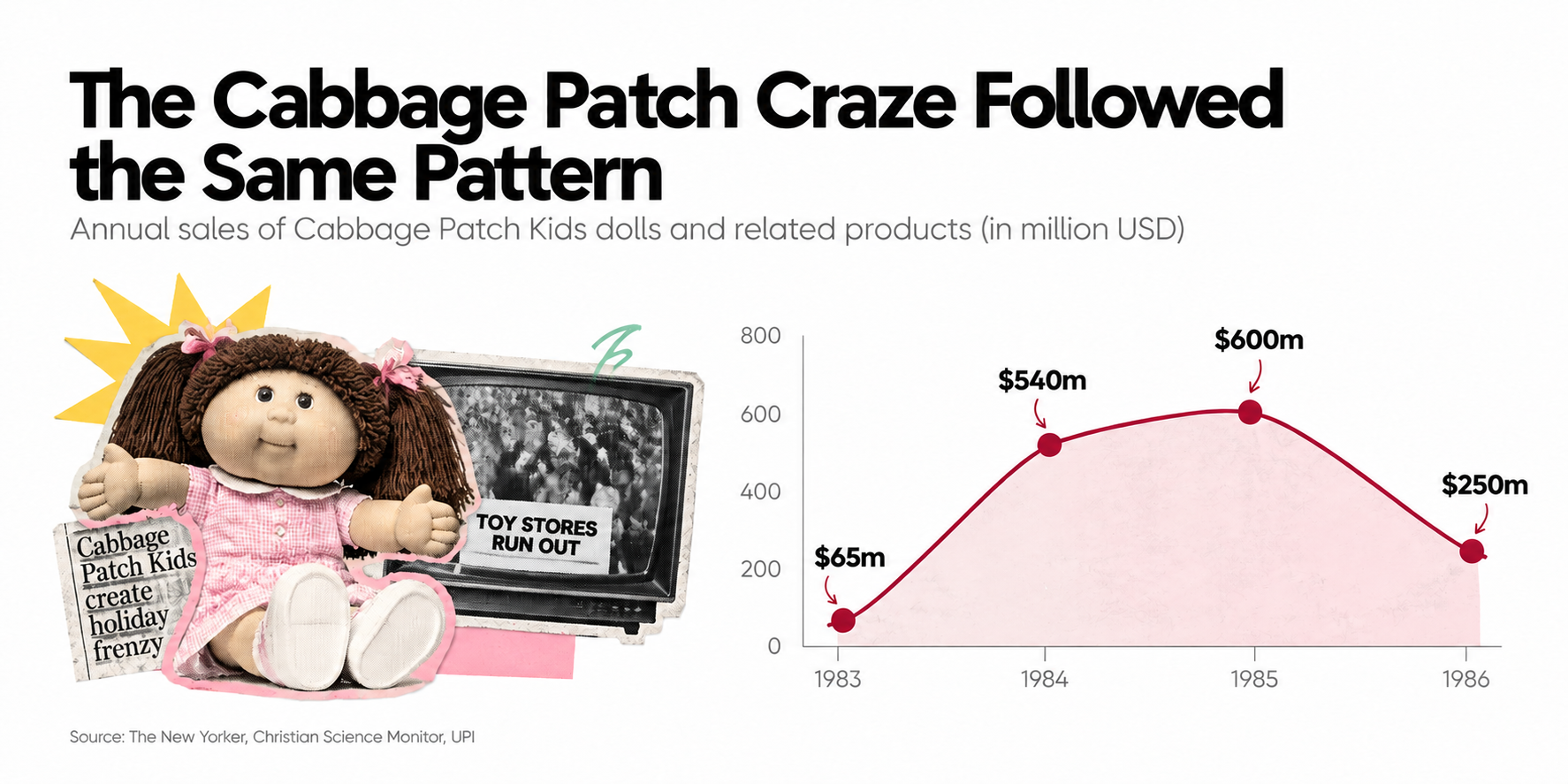
Toy makers have also paid a price for misreading how long the excitement would last. Cabbage Patch Kids caused such a frenzy during the 1983 Christmas season in America that shoppers scrambled to find them. Sales of the dolls and related products reached roughly $600 million in 1985, before falling to about $250 million the following year. Manufacturer Coleco had expanded heavily during its good years and eventually filed for bankruptcy protection in 1988. The dolls weren't its only problem, but weakening sales made its debt burden far harder to manage.
Even adults who have never bought a collectible toy have participated in similar behaviour. Stanley's Quencher tumblers became an unlikely social-media status symbol, helped by new colours and enthusiastic online communities. Stanley's annual revenue rose from about $73 million in 2019 to an estimated $750 million in 2023. The wider insulated-bottle market later cooled, although Stanley still sells a useful product and remains a substantial brand. A water bottle can survive the end of its moment in fashion. A toy franchise must work harder to convince people to keep coming back.
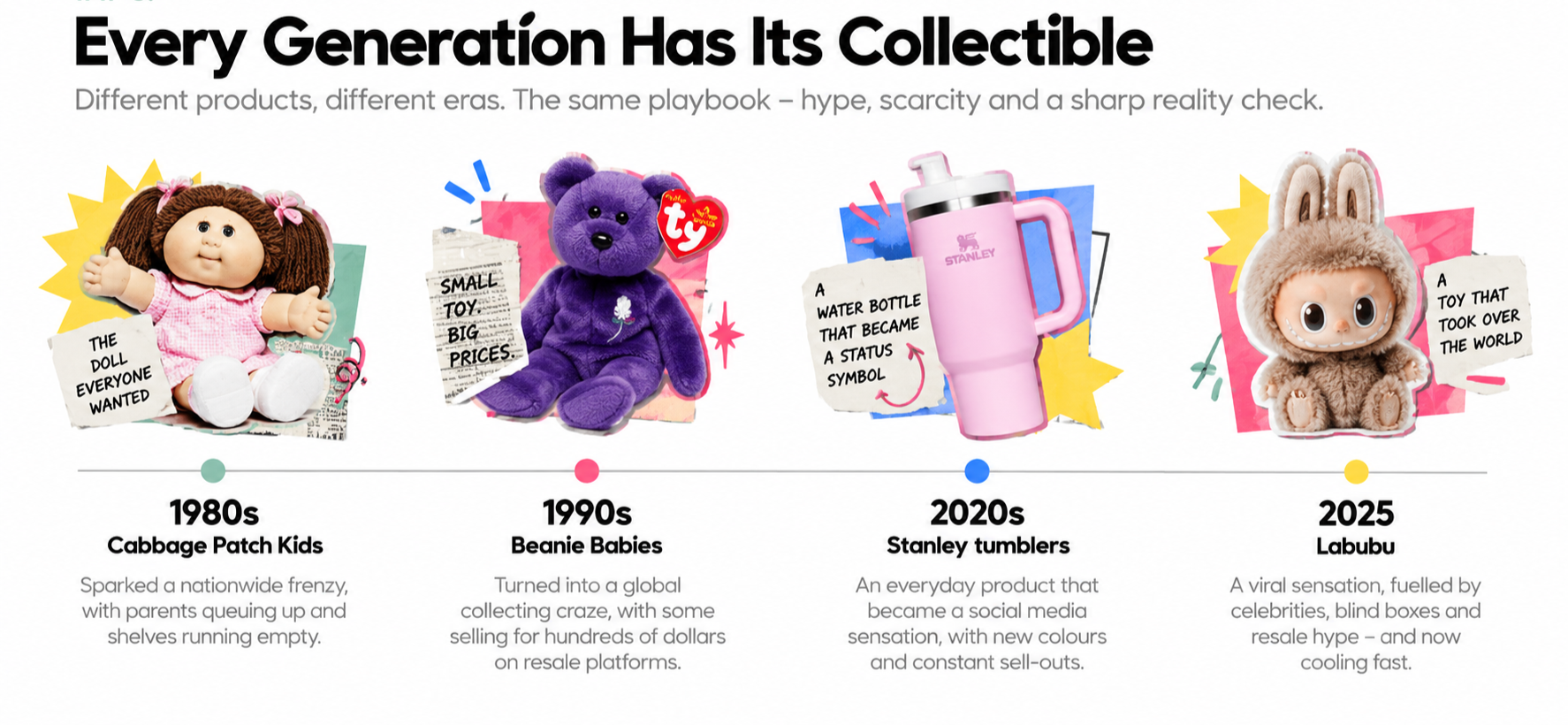
All these crazes run on a familiar combination of belonging and scarcity. People want the product because others want it; limited availability makes owning one feel special; and rising resale prices give that desire an apparent financial justification. Manufacturers then face a difficult choice. Keep supply tight and frustrate customers, or produce enough to meet demand and risk removing the very scarcity that encouraged the frenzy. Meanwhile, speculators can disappear as quickly as they arrived.
Pop Mart isn't necessarily heading for the Beanie Babies ending. Its first-half 2026 results show that another character, Twinkle Twinkle, generated 2.65 billion yuan in revenue, growing more than sixfold from a year earlier. Even after the latest collapse, Pop Mart's third-quarter sales remain well above the level recorded two years ago. The company has an international retail network and several franchises, although opening more stores while sales are falling will test how much lasting demand exists.
Labubu may continue to be loved, collected and worn long after its resale premium has vanished. What Pop Mart needs to prove is that customers will keep buying its characters when there are no extraordinary queues, no easy profits for resellers and no celebrity endorsement driving the next purchase. Beanie Babies, Cabbage Patch Kids and Stanley all offer versions of the same lesson: a craze can introduce millions of people to a product, but it cannot guarantee those people will still want another one next year.
Sources
- Bloomberg: Pop Mart's Q3 2026 sales decline and stock performance.
- Pop Mart Annual Results 2025: Revenue growth and The Monsters franchise sales.
- Pop Mart Interim Report 2026: Labubu's slowdown and Twinkle Twinkle's growth.
- Associated Press: Labubu's origins, Kasing Lung and celebrity-driven popularity.
- Reuters: Labubu's falling resale prices and increasing production.
- History: The rise and collapse of the Beanie Babies craze.
- The New Yorker: Historical sales figures for Cabbage Patch Kids.
- The Christian Science Monitor: Coleco's financial troubles and declining doll sales.
- Fast Company: Stanley tumblers' revenue boom and subsequent market slowdown.