

 Newsletter

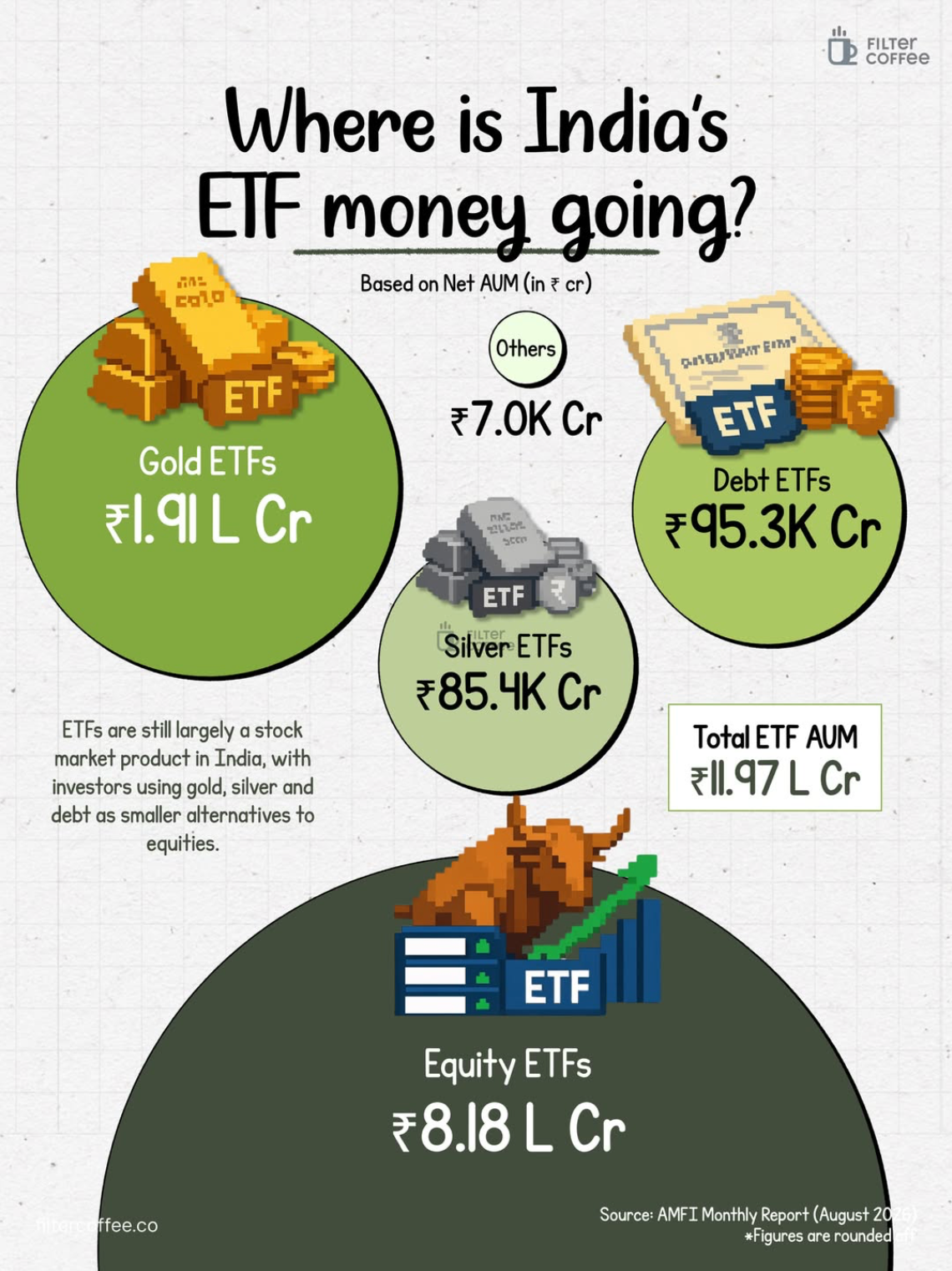
Gold doesn't need a demat account full of jewellery, and investing in the Nifty doesn't mean buying 50 different stocks. ETFs have made both possible with a single investment. Now, India's ETF market holds ₹11.97 lakh crore, with money spread across equities, gold, silver and debt.
Look at the numbers and stocks are still way ahead. According to AMFI’s August 2026 data, equity ETFs hold ₹8.18 lakh crore. Gold ETFs come next at ₹1.91 lakh crore, followed by debt ETFs at ₹95,300 crore and silver ETFs at ₹85,400 crore.
People buy these funds for different reasons. Someone who wants to invest in the Nifty without picking individual stocks can buy an equity ETF. Someone who wants exposure to gold without worrying about storage can look at a gold ETF. Silver ETFs offer a similar route into silver, while debt ETFs give investors access to bonds and other fixed-income securities.
Gold is worth looking at because people often turn to it when markets are uncertain. But it doesn't always rise when stocks fall. Silver has its own set of drivers, including industrial demand, so its price can move quite differently from gold.
There's a detail that's easy to miss when looking at these numbers. A bigger ETF doesn't necessarily mean more people have invested in it. If gold prices rise, the value of the gold held by its ETFs rises too. The fund's assets can grow even if the amount of fresh money coming in hasn't changed much. To see where investors are actually putting new money, we need to look at inflows as well.
And ETFs aren't risk-free just because they're easy to buy. Equity ETFs can fall with the market, precious metals can be volatile, and debt ETFs can lose value when interest rates or credit conditions change. Costs and liquidity matter too.
For now, equities hold the biggest share of India's ETF market. But investors don't have to stick to individual stocks or keep all their money in one asset. ETFs offer a way to spread investments across stocks, metals and debt. It'll be worth watching whether fresh money continues to go mainly into equities or whether gold, silver and debt attract a larger share.


