

 Newsletter

Foreign investors had finally started buying Indian stocks again in July and August. Then, almost as quickly, they changed their minds.
They bought ₹20,200 crore worth of shares in July and another ₹29,631 crore in August. In September, they sold ₹35,861 crore. And by 11 October, they had already pulled out another ₹44,166 crore. That brought their net withdrawals for 2026 to ₹3.04 lakh crore, compared with ₹1.66 lakh crore during all of 2025.
So, what's making India such an easy market to leave?
High oil prices, a stronger dollar and US government bonds offering yields above 5% have hurt the appetite for Indian stocks. Meanwhile, a very different opportunity has been competing for global investors' money: the companies making the hardware behind AI.
Imagine you're running a global fund and have ₹100 to invest in emerging markets. That's the label investors use for stock markets such as India, Taiwan, South Korea and China. You could buy Indian banks, retailers and software companies. Or you could buy TSMC in Taiwan, which manufactures advanced chips, and Samsung Electronics and SK Hynix in South Korea, which make memory used in AI servers.
Over the past two years, the second option has become awfully tempting. And you can see the change in something called the MSCI Emerging Markets Index. Think of it as a ready-made basket of major companies across developing stock markets. Plenty of international funds use it to decide where their money should go or how their performance compares with the market.
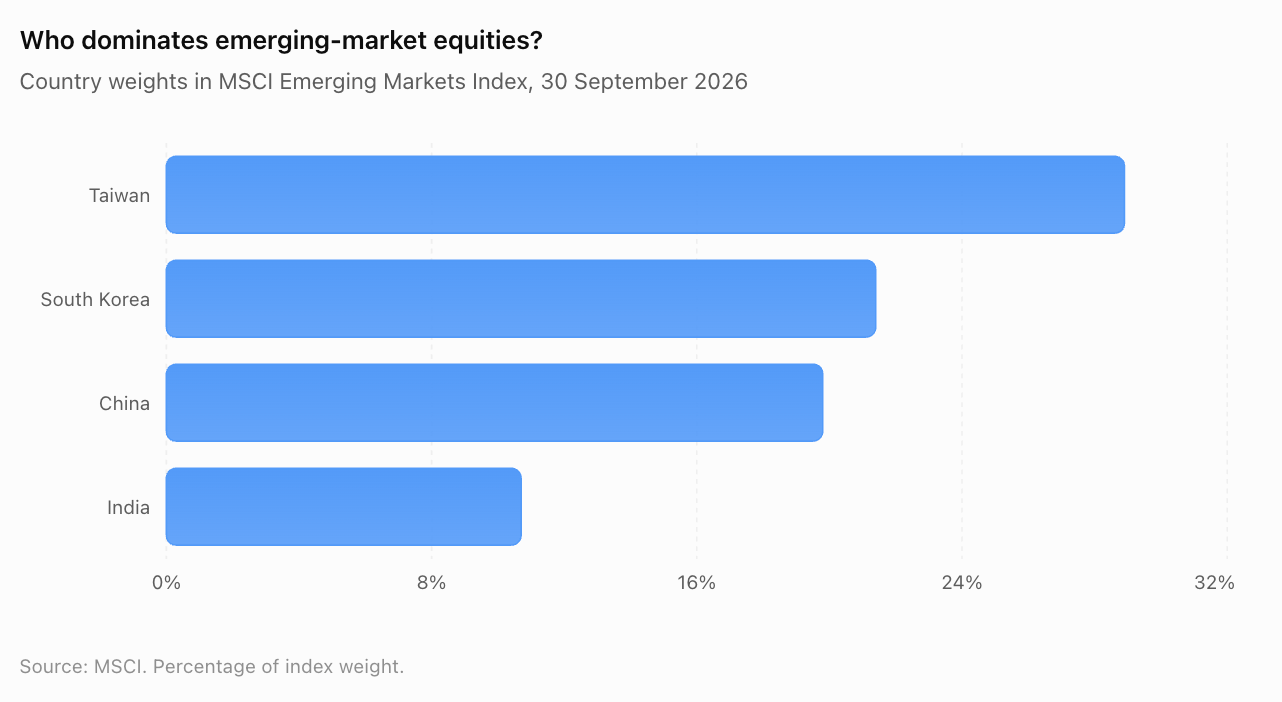
Back in mid-2024, India accounted for roughly ₹20 of every ₹100 in that basket. By 30 September 2026, it was down to ₹10.65. Taiwan had climbed to ₹28.94 and South Korea to ₹21.40. Together, the two North Asian markets now make up more than half of the index.
Now, these weights move partly because share prices move. So India losing weight doesn't prove that investors took an identical amount of cash from Mumbai and sent it to Taipei. But it does show where stock-market value has been growing.
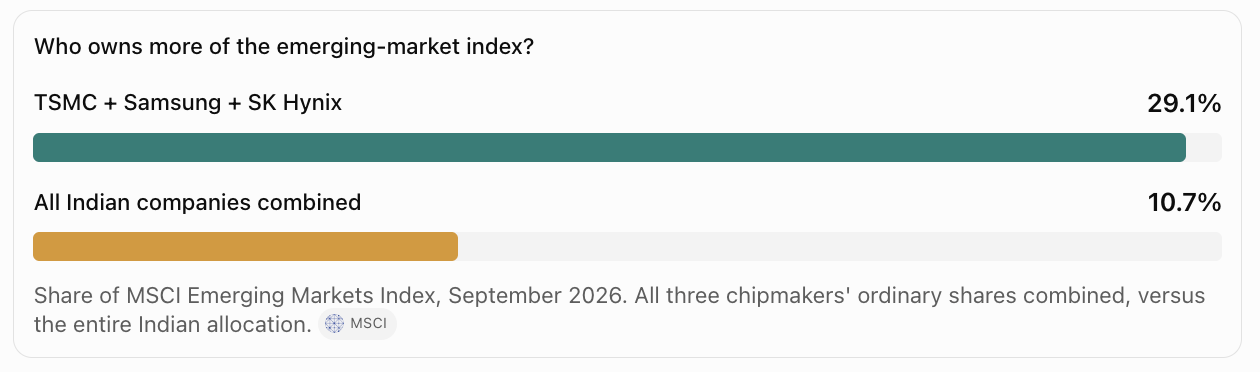
And consider this. Just three companies, TSMC, Samsung Electronics and SK Hynix, account for about 29% of the entire index. That's almost ₹30 of every ₹100 tied to three chipmakers.
The appeal is fairly easy to understand once you look at how AI works.
Whenever you type a prompt into ChatGPT or use another AI tool, there's a physical infrastructure making that response possible. Data centres need powerful processors and enormous amounts of memory. Nvidia designs many of those specialised processors, TSMC manufactures advanced chips, and Samsung and SK Hynix supply memory that helps these systems handle huge amounts of data.
As technology companies spend billions building bigger AI data centres, the companies supplying this hardware stand to benefit.
And demand for advanced chips is already showing up in sales. TSMC reported revenue of NT$511.9 billion in September 2026, up 54.6% from a year earlier. Investors can look at figures like that and see the AI boom turning into actual business.
India's stock market offers something different.
Its biggest listed companies are largely in banking, energy, consumer goods and IT services. India is building a semiconductor industry, with 12 projects approved across six states and three facilities already in commercial production. But it doesn't yet have a publicly listed company comparable to TSMC in leading-edge AI chip manufacturing. Building chip factories takes years, and becoming a global stock-market giant takes even longer.
Even India's IT companies have a complicated relationship with AI. They can earn money helping customers use it, but those same customers may eventually need fewer billable hours for work that AI can automate.
Take TCS. In October, the company said its annualised AI revenue had reached $3.1 billion, more than 10% of total revenue. Yet its overall revenue grew just 0.5% from the previous quarter in constant currency, meaning after adjusting for exchange-rate changes.
So AI is already bringing in meaningful business for TCS, but it hasn't yet translated into much faster overall growth.
Which brings us to the obvious suspicion. Are foreign investors selling Indian stocks to buy shares in these chipmakers?
Some investors have certainly been drawn towards AI-heavy markets over the past two years. But stock-market data doesn't come with a forwarding address for every rupee sold. We can't trace India's October withdrawals directly to purchases in Taiwan or South Korea.
And the recent numbers make that explanation much less tidy.
In July, foreign investors withdrew $22.95 billion from Taiwanese equities and $6.26 billion from South Korean equities, according to LSEG data reported by Reuters. India actually received $2.12 billion. HSBC's Asia equity strategist even grew more positive about India that August, partly because of the sharp swings in AI-linked stocks.
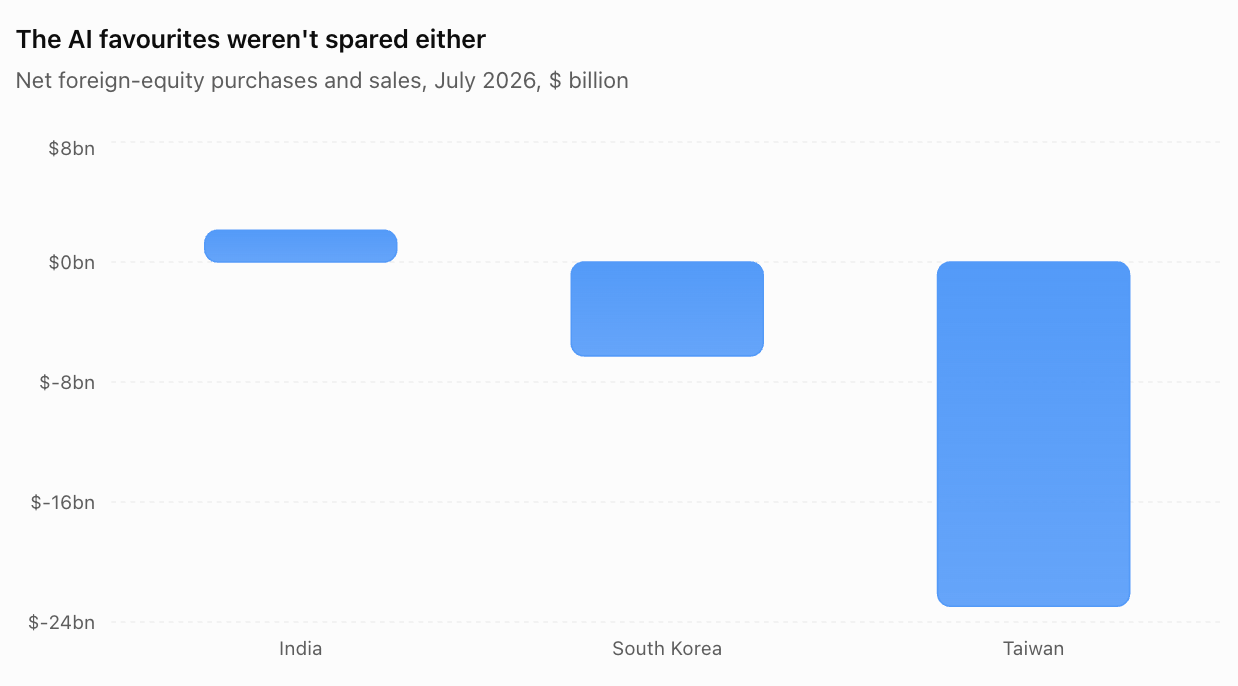
Source: LSEG data. Positive = net buying; negative = net selling.
In September, foreign investors sold a combined $23.49 billion across seven Asian stock markets. South Korea accounted for more than 70% of that selling, and India and Taiwan saw outflows too.
Quite a reversal for markets that had benefited so much from the AI excitement.
But it makes sense. Even when chipmakers are selling more and earning bigger profits, their shares can fall if investors think future growth won't justify the prices they have already paid. And when global investors get nervous, they sometimes reduce their exposure to Asian stocks altogether.
India also has problems of its own. Start with oil, the dollar and US bonds.
India imports most of the crude oil it uses, so higher prices squeeze the economy and put pressure on the rupee. A stronger dollar can make returns from Indian shares less attractive to someone investing in dollars.
Meanwhile, 10-year US government bonds are offering yields above 5%. These bonds are generally considered much safer than stocks. So if you can earn that kind of return from US government debt, investing in Indian shares needs to offer a convincing chance of earning more, despite the additional risks. Indian companies also need to deliver enough earnings growth to justify share prices that many investors consider expensive.
Still, foreign investors haven't given up on every Indian business.
According to JM Financial, they invested about $9.2 billion in new Indian share offerings over the 12 months to September 2026, even as they withdrew around $39 billion from already-listed shares.
In other words, foreign investors are still willing to back Indian companies. They're simply being more selective about where and at what price.
Indian investors have been stepping in as well. Equity mutual funds received ₹38,307 crore in net inflows in September, while monthly SIP contributions reached a record ₹32,490 crore. The SIP figure is part of mutual-fund activity, rather than an additional amount to add on top.
That domestic investment helps absorb foreign selling, although it cannot completely protect stock prices when overseas investors keep withdrawing money.
So, is the AI boom taking money away from Indian stocks?
To some extent, yes. AI has made Taiwan and South Korea more important destinations for global investors, and India's shrinking weight in emerging-market benchmarks shows how much the balance has changed.
But blaming the entire Indian sell-off on AI would be misleading. Expensive oil, high US interest rates, the stronger dollar and concerns about Indian stock valuations are also making investors cautious. And as the recent selling in Taiwan and South Korea shows, even AI's biggest beneficiaries aren't immune.
India still has a growing economy, a large consumer market and companies with strong long-term prospects. But global investors have more choices today, including semiconductor businesses already earning heavily from AI demand.
And that means India's companies have to give investors a good reason to keep choosing them. Economic growth alone won't do the convincing. Eventually, that growth has to show up in their profits too.
Sources
- Business Standard | Foreign investors withdraw ₹44,166 crore in October 2026.
- MSCI Emerging Markets Index | September 2026 country weights and semiconductor company allocations.
- The Economic Times | India's 19.9% MSCI Emerging Markets weight in 2024.
- Reuters via MarketScreener | Foreign-investor flows across India, Taiwan and South Korea in July 2026.
- Reuters via The Economic Times | Asian equity outflows and rising US Treasury yields in September 2026.
- TSMC | September 2026 revenue report.
- Tata Consultancy Services | Q2 FY27 financial results and AI revenue.
- Press Information Bureau | India's semiconductor manufacturing progress, September 2026.
- The Financial Express | JM Financial data on foreign investment in IPOs versus listed shares.
- NDTV Profit | September 2026 mutual fund inflows and SIP contributions.