

 Newsletter
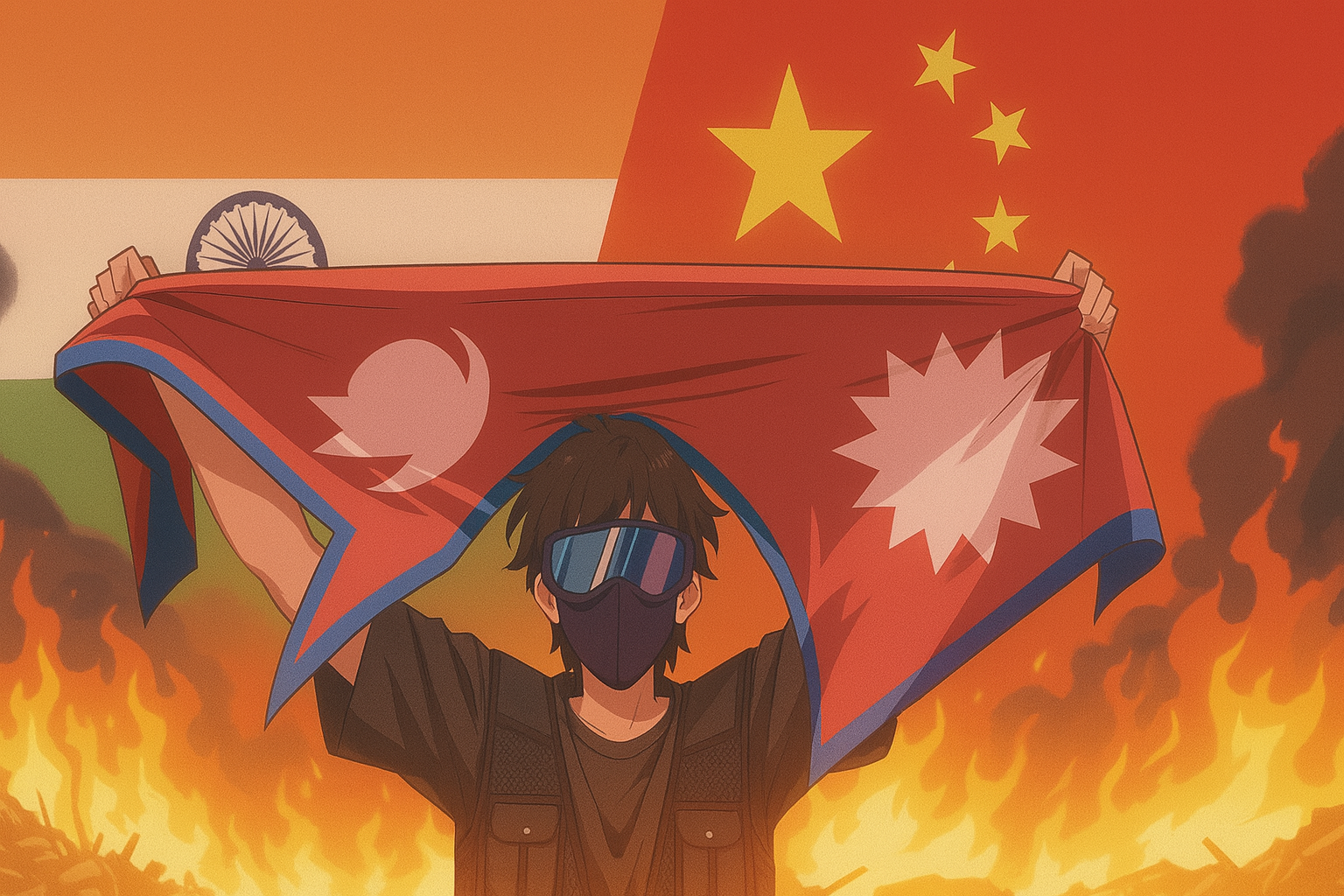
For years, Nepal has been described as a country “caught between two giants.” Landlocked between India and China, it has lived with the weight of geography, pulled one way or the other by its bigger neighbors. India has leaned on shared culture, open borders, and historic ties, while China has wooed Kathmandu with infrastructure projects and Belt and Road investments. But a new twist is unfolding — and this time, it’s not India or China calling the shots. It’s Nepal’s young generation.
The immediate trigger was dramatic.
Weeks of protests spiraled into violence after the government briefly banned social media. Government offices were ransacked, parliament buildings attacked, and the pressure forced Prime Minister KP Sharma Oli to resign. For the first time, Nepal swore in a female prime minister; a former Supreme Court Chief Justice Sushila Karki, as an interim leader. On paper, that looked like a fresh start. But beneath the symbolism lies a bigger story: a restless, frustrated Gen Z demanding jobs, accountability, and an end to the endless carousel of old political elites.
This generational shift is Nepal’s real disruption. Youth unemployment hovers around 20%, corruption rankings are consistently poor, and millions of young Nepalis leave to work in Gulf countries or Malaysia every year. That cycle has created a sense of betrayal at home — a belief that the system is stacked against them. They are less patient with political games, less forgiving of mismanagement, and far less deferential to the “special relationships” India or China like to highlight.
For India, this is both an opportunity and a headache. The India–Nepal connection is unique in South Asia. The two countries share an open border, visa-free movement, and deep cultural and family ties. Nearly all of Nepal’s petroleum and third-country trade flows through India. On paper, New Delhi holds the stronger hand. But proximity is not the same as popularity. Many young Nepalis still remember the 2015 blockade; when shortages of fuel and medicine hit the country hard. Regardless of the diplomatic back-and-forth on who was responsible, the memory has stuck. In their eyes, India’s leverage looked like bullying.
China, meanwhile, has been happy to fill the gaps. Over the past decade, Beijing has poured money into hydropower, roads, tunnels, and telecom projects in Nepal. It made Kathmandu a node in the Belt and Road Initiative. And because Tibet sits just across the border, Beijing sees Nepal not just as a development partner but as a security buffer. The strategy seemed to be paying off; until this recent wave of unrest showed that shiny projects don’t buy legitimacy with a generation demanding jobs and fairness. Even Oli, once India’s partner, leaned toward China in his later years, breaking tradition by visiting Beijing before New Delhi on his first foreign trip.
That tug-of-war is now running into a wall: Nepali youth don’t want to be treated as pawns in a geopolitical chess match. If India and China continue with the same playbook; backroom political deals, big-ticket projects, or heavy-handed diplomacy, then they risk alienating the very people who will shape Nepal’s politics for the next 30 years.
For New Delhi, the stakes are high. Nepal is a buffer state in the Himalayas, critical to India’s northern security. The open border is both an advantage and a vulnerability: it allows deep people-to-people links, but it also leaves room for drug smuggling, illegal trade, and potential infiltration. Almost all of Nepal’s trade passes through Indian routes and ports; a choke point that gives India leverage, but also responsibility. If India again mismanages supply lines or gets drawn into Nepal’s domestic politics, Beijing will use that space to cement influence.
For Beijing, Nepal fits into a bigger regional map. Roads and tunnels linking Tibet to Kathmandu strengthen its control over the Himalayas. Hydropower projects tie Nepal’s energy future closer to Chinese investors. And scholarships or training programs could create a generation of Nepali professionals more familiar with Beijing than Delhi. But China too faces pushback. Its projects are often criticized as exploitative, creating debt and limited local jobs.
What both giants need to recognize is that Nepal’s politics is no longer just about geography. It’s about demography. A young population with high unemployment and high expectations will not stay quiet. They want stability, yes, but they also want opportunities like jobs, training, apprenticeships, scholarships, and systems that feel less corrupt. That means India and China must shift their strategies.
For India, the smarter approach would be to double down on its natural advantages: uninterrupted fuel and food flows, more youth-focused programs like apprenticeships or IT training, and cultural exchanges that build goodwill directly with students and young workers. Quiet, consistent delivery will speak louder than grand promises. For China, smaller, job-rich projects could matter more than billion-dollar highways. Offering scholarships in fields Nepalis care about, like technology, medicine, and renewable energy, would ease concerns that its influence is purely extractive.
In the end, Nepal faces the toughest task of all. It has to channel this burst of political energy into stability rather than chaos. If protests give way to a cycle of instability, the very reforms young Nepalis want will remain out of reach. But if the political system adapts with leaders like Sushila Karki symbolizing renewal, Nepal could finally step out of the shadow of its neighbors and shape its own destiny.
For India and China, the temptation to interfere will be strong. But restraint, for once, might be the smartest move. Influence in Nepal won’t be won through threats or megaprojects. It will be built quietly, by addressing the frustrations of a young generation that has already made its voice heard on the streets.
FAQs
Why is Nepal considered caught between two giants?
Nepal is geographically landlocked between India and China. For decades, it has been influenced by both neighbours—India through cultural ties and open borders, and China through infrastructure investments and strategic projects.
What triggered the recent protests in Nepal?
The protests erupted after the government temporarily banned social media. This led to widespread unrest, attacks on parliament buildings, and the resignation of then Prime Minister KP Sharma Oli.
Who is Sushila Karki and why is her appointment significant?
Sushila Karki, a former Supreme Court Chief Justice, became Nepal’s first female prime minister as an interim leader. Her appointment symbolises a break from the old political order during a time of youth-led upheaval.
What are the main issues driving Nepal’s youth protests?
High youth unemployment around 20%, corruption, and lack of opportunities have fuelled frustration. Many young Nepalis migrate to Gulf nations or Malaysia for work, creating resentment towards the political system.
How do young Nepalis view India’s role in their country?
While India has deep cultural and economic ties, many youths see it as heavy-handed, especially recalling the 2015 blockade that caused severe shortages. This has made India’s influence appear like coercion to them.
What is China’s strategy in Nepal?
China has invested in hydropower, roads, tunnels, telecom, and made Nepal part of the Belt and Road Initiative. It sees Nepal as both a development partner and a security buffer near Tibet.
Why are China’s projects in Nepal facing criticism?
Many see China’s big projects as exploitative, creating debt and offering limited local jobs. The recent unrest showed that flashy infrastructure doesn’t satisfy a generation seeking employment and accountability.
What risks does India face in Nepal?
India risks losing influence if it interferes in Nepal’s domestic politics or disrupts trade flows. The open border gives it leverage but also exposes it to smuggling, illegal trade, and security threats.
What kind of support do young Nepalis want from India and China?
They want jobs, skills training, apprenticeships, scholarships, and less corruption. Youth prefer practical support over political deals or grand projects that don’t improve their everyday lives.
How can Nepal stabilise after this youth-led unrest?
Nepal needs to convert this political energy into real reforms, building systems that deliver jobs and transparency. If done well, it can break free of dependency and shape its own future.