

 Newsletter
Something interesting is happening in India’s battery story right now, and it’s not just about EVs or clean energy hype. It’s about what happens after the battery dies.
Earlier this month, a report highlighted that dry cell battery makers in India are struggling to meet new recycling rules. If you sell batteries, you are now responsible for collecting and recycling a chunk of them once they are used. But in reality, this is turning into a serious operational and financial headache for the industry.
To understand why, start with one basic fact.
India consumes between 2.5 billion and 3 billion dry cell batteries every year. These are the small cells that power TV remotes, toys, clocks, torches, and a hundred other everyday items. For decades, most of these batteries were either dumped in landfills or burned. Recycling was almost non-existent.
Now the government wants to change that. Under the Battery Waste Management Rules, producers have to start collecting used batteries in a structured way. The target for FY26 is to recover about 50% of the batteries they sold a few years earlier.
This number goes up to 60% in FY27 and keeps increasing gradually after that. On top of that, from FY28 onwards, companies also need to meet reuse and material recovery targets, starting at around 5% and rising over time.
If companies fail to meet these targets, they face environmental compensation penalties that can go as high as ₹2,400 per kg for certain metals and up to ₹555 per kg for others like manganese. These penalties are not small. In many cases, they are higher than the cost of producing a fresh battery using new raw materials. So the risk is real.
And this is where things get tricky.
Unlike lead-acid batteries used in cars, which already have a well-established collection system because they carry resale value, dry cell batteries are scattered everywhere. They are cheap, widely used, and thrown away without a second thought. There is no strong incentive for consumers or scrap dealers to collect them.
Reverse logistics becomes a nightmare. Imagine trying to collect millions of tiny batteries from homes across thousands of towns and villages. That is the scale of the problem.
Industry players are already pushing back. Some have suggested free battery exchange programs where consumers can return used batteries in exchange for new ones. Others are asking for a common industry-wide collection mechanism. At the same time, there is lobbying to either reduce targets or extend timelines because the current system is simply not ready.
This matters because the dry cell battery market itself is not small. It is valued at around ₹3,900 to ₹4,000 crore in India, with alkaline batteries alone contributing roughly ₹550 to ₹600 crore. Companies like Eveready dominate this space with massive distribution networks reaching over 4 million retail outlets. But even with that reach, collecting used batteries is not straightforward.
India’s battery market is expanding rapidly, driven by three forces. First, electric vehicles are picking up pace. Second, renewable energy needs large-scale storage solutions. Third, consumer electronics demand is exploding. This has pushed the government to actively support domestic manufacturing through schemes like the Production Linked Incentive for Advanced Chemistry Cells. In the latest Union Budget, allocations for auto and component-linked incentives were increased to ₹5,940 crore, and customs duty exemptions on lithium-ion manufacturing equipment were extended.
But there is a catch. India still depends heavily on imports for lithium-ion cells. Domestic manufacturing is just starting to scale. Companies like Amara Raja are setting up gigafactories with planned capacities of 16 GWh, and players like Exide and HBL are expanding into newer chemistries. Still, we are far from self-reliance.
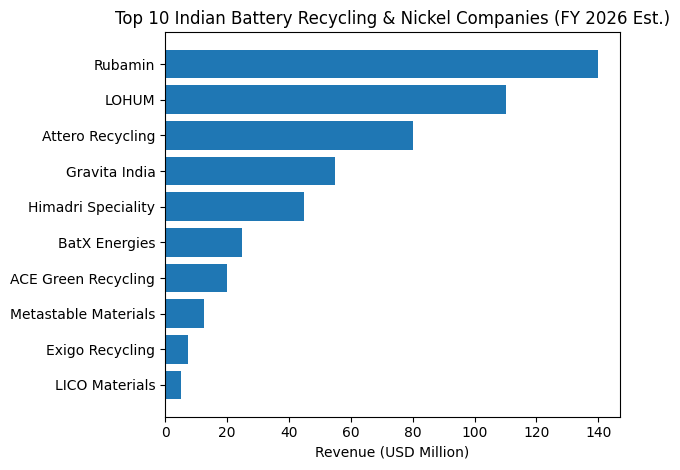
This is exactly why recycling is becoming so important. Batteries contain valuable materials like lithium, cobalt, nickel, and manganese. If India can recover these materials efficiently, it can reduce import dependence and build a circular supply chain. Globally, this is already a big deal. Countries are investing heavily in battery recycling to secure critical minerals.
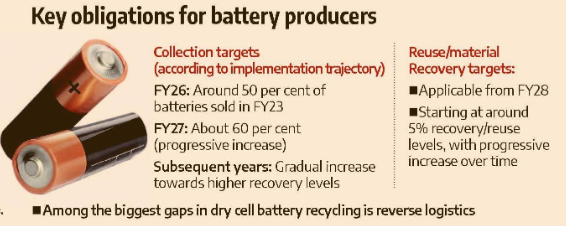
Image source: Business Standard
In India, the opportunity is massive. Estimates suggest that the battery recycling market could cross ₹30,000 crore by 2030. But right now, most of this ecosystem is underdeveloped. A large part of recycling still happens in the informal sector, which lacks proper environmental safeguards and efficiency.
Even in advanced markets like Switzerland and Belgium, it took 10-15 years to build systems that could achieve collection rates of around 70%. India is trying to hit 50% in just a few years, and that too in a far more complex environment. That explains why companies are calling the targets ambitious.
There is also a structural issue. Only a small portion of collected dry cell batteries is actually recyclable in an economically viable way. The value of recovered materials is often low compared to the cost of collection and processing. This makes the entire model financially challenging unless supported by strong policy or subsidies.
Meanwhile, new ideas are being explored. The government is working on traceability systems, sometimes referred to as battery passports, where each battery can be tracked through its lifecycle. There is also a push to build consumer awareness through collection centres and organised drives. Around 30-40 such initiatives are already underway across cities.
At the same time, the rules are not limited to dry cells. They apply across battery categories including EV batteries, industrial batteries, and portable lithium-ion units. For EV batteries, the economics are slightly better because the material value is higher. But even there, the ecosystem is still evolving.
So what we are seeing right now is a classic transition phase.
On one side, demand for batteries is exploding. On the other, the system to deal with battery waste is still catching up. The government is trying to fast-track this shift through strict rules. The industry is struggling to adjust because the ground reality is messy. And somewhere in between lies a huge economic opportunity that is yet to be fully unlocked.
For consumers, this change will eventually show up in small ways. You might start seeing more collection bins, buyback schemes, or awareness campaigns. For companies, this is a cost and compliance challenge today but could become a competitive advantage tomorrow if they figure out efficient recycling models early.
And for India as a whole, this is bigger than just waste management. It is about building a circular economy where the same battery materials keep coming back into the system instead of being lost forever.
Right now, the system is creaking under pressure. But if it works, it could quietly become one of the most important pieces in India’s clean energy puzzle.