

 Newsletter

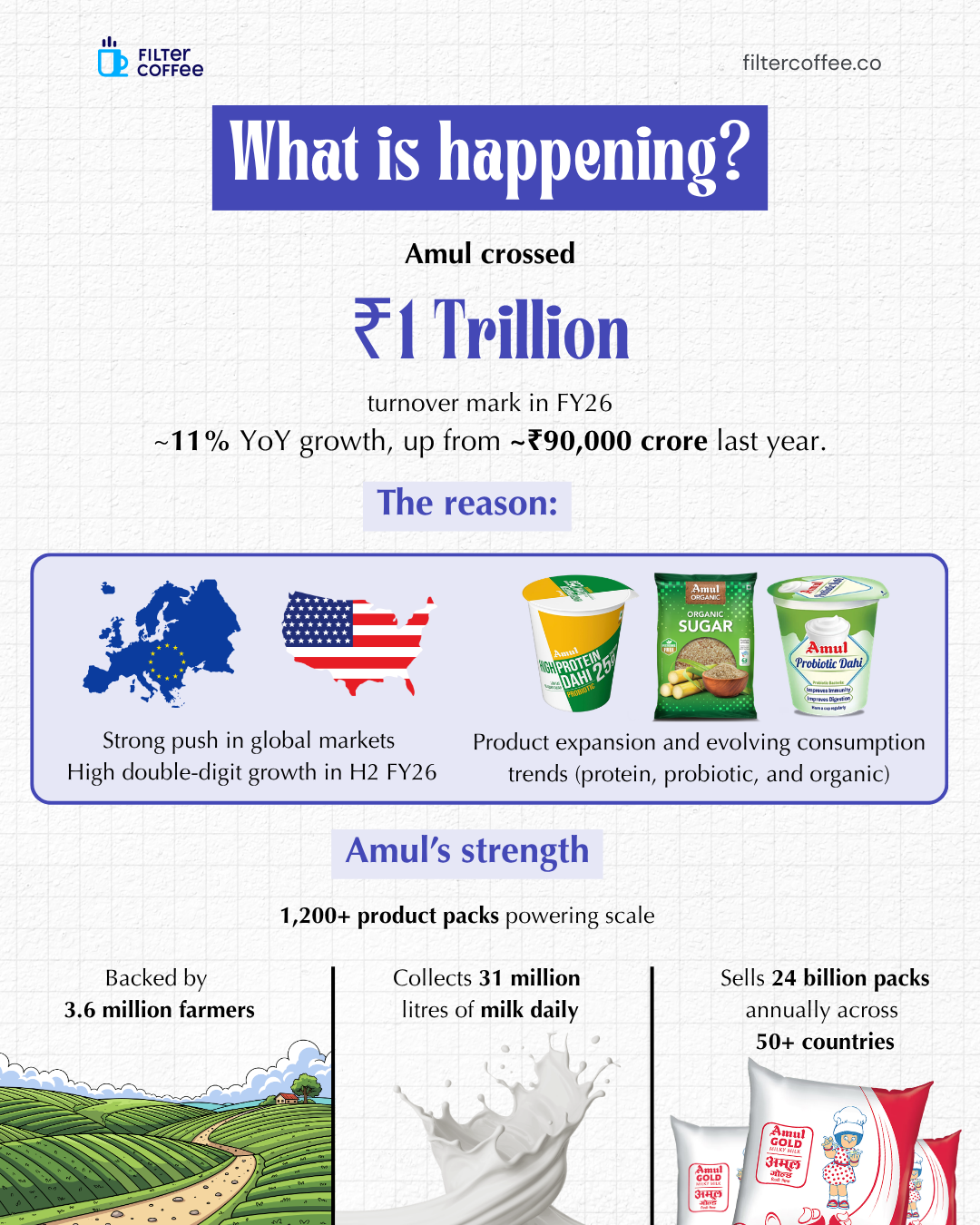
Amul just did something no Indian FMCG company has managed before. It crossed ₹1 lakh crore in turnover.
To put that in perspective, that’s bigger than Hindustan Unilever’s ₹60,000+ crore business and even ahead of AWL Agri’s ₹63,000+ crore scale. And unlike most of these companies, Amul isn’t a corporate giant backed by promoters or global investors. It’s a farmer-owned cooperative.
So naturally, the question is not just “how did Amul get here?” but “what exactly is changing in India’s consumer story?”
Because this isn’t just about milk anymore.
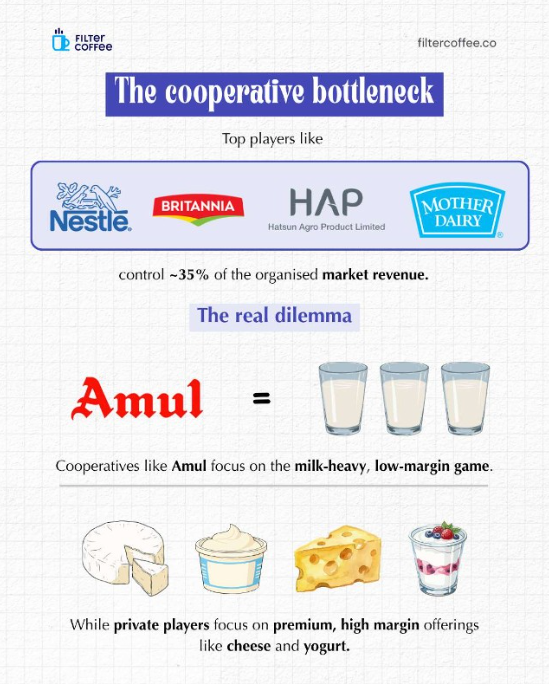
It might feel like this is just a story of selling more milk. India is the world’s largest milk producer, and demand keeps rising. But that explanation doesn’t fully hold up. Milk as a category is large, yes, but it’s also low-margin and highly regulated. You don’t build a ₹1 lakh crore consumer brand just by selling more litres.
The real shift is happening quietly in what Amul is selling, and where it is selling.
Over the last few years, Amul has been steadily moving beyond plain milk into higher-value categories like cheese, butter, paneer, probiotic drinks, protein products, organic variants. These are not just add-ons. They are where the margins sit, where branding matters, and where repeat consumption builds.
In fact, even within dairy, value-added products are growing faster than liquid milk. And that’s important, because it changes Amul’s identity from a milk supplier to a full-fledged FMCG player.
At the same time, Amul has been going deeper into India. Not metros. Not just Tier 1 cities. Towns with populations above 5,000.
This is the place where the next wave of consumption is coming from. As incomes rise and access improves, these markets start behaving like mini urban clusters. And Amul’s distribution has quietly reached there before most competitors could even build supply chains.
That distribution muscle is no joke. We’re talking about lakhs of retail touchpoints, a cold chain network that spans the country, and a system that can move perishable products daily without breaking.
And this is where Amul’s model becomes interesting.
Because unlike a typical FMCG company, Amul doesn’t “own” its entire revenue in the traditional sense. Its brand turnover crossed ₹1 lakh crore, but its federation, GCMMF, reported around ₹73,450 crore. The gap exists because multiple district unions sell under the Amul brand, and some revenues like cattle feed sit outside the federation’s books.
In simple terms, Amul is not one company. It’s a network of over 3.6 million farmers and 18 member unions. And a structure where producers are also stakeholders.
Which means growth here doesn’t just scale a business. It scales incomes across rural India.
And then there’s the global push.
For years, Indian dairy stayed local. Exporting milk was tricky. Regulations were tight. And global markets were dominated by players from Europe, New Zealand, and the US.
But that’s starting to change.
Amul has already entered the US through partnerships and launched fresh milk in select regions. It has moved into Europe, starting with Spain, and is actively expanding in Africa and Southeast Asia. The plan now is to add around 10 more international markets in the near term.
That’s a big shift.
Because India isn’t just consuming dairy anymore. It’s trying to export it.
And this is happening alongside policy support. The government has been pushing dairy infrastructure, increasing investments under the National Programme for Dairy Development, and expanding cooperative networks that now touch over 2 lakh villages and include more than 1.7 crore farmers.
So you have supply growing, distribution deepening, and demand shifting towards higher-value products.
But it’s not all smooth.
Milk prices have been rising. Amul itself increased prices by about ₹2 per litre in 2025 due to higher procurement and input costs. Feed, logistics, energy, everything is getting expensive. And since dairy is politically sensitive, pricing flexibility is limited.
Which means growth has to come from efficiency, product mix, and scale rather than just passing on costs. And that’s exactly what Amul seems to be doing.
It’s building a model where a cooperative can operate like an FMCG giant, compete with listed companies, expand globally, and still remain rooted in rural supply chains.
That’s rare.
Most Indian consumer stories follow a predictable path. Urban demand grows. Brands scale. Corporates dominate. This one flipped that script with a farmer-owned network scaled first. Built distribution before competition caught up. Moved into branded products later. And is now going global.
And maybe that’s the real takeaway here.
Amul crossing ₹1 lakh crore is not just a milestone. It’s proof that India’s next big consumer story might come from networks, from scale built slowly, and from understanding the most basic things really well.
In this case, something as simple as milk.