
 Newsletter

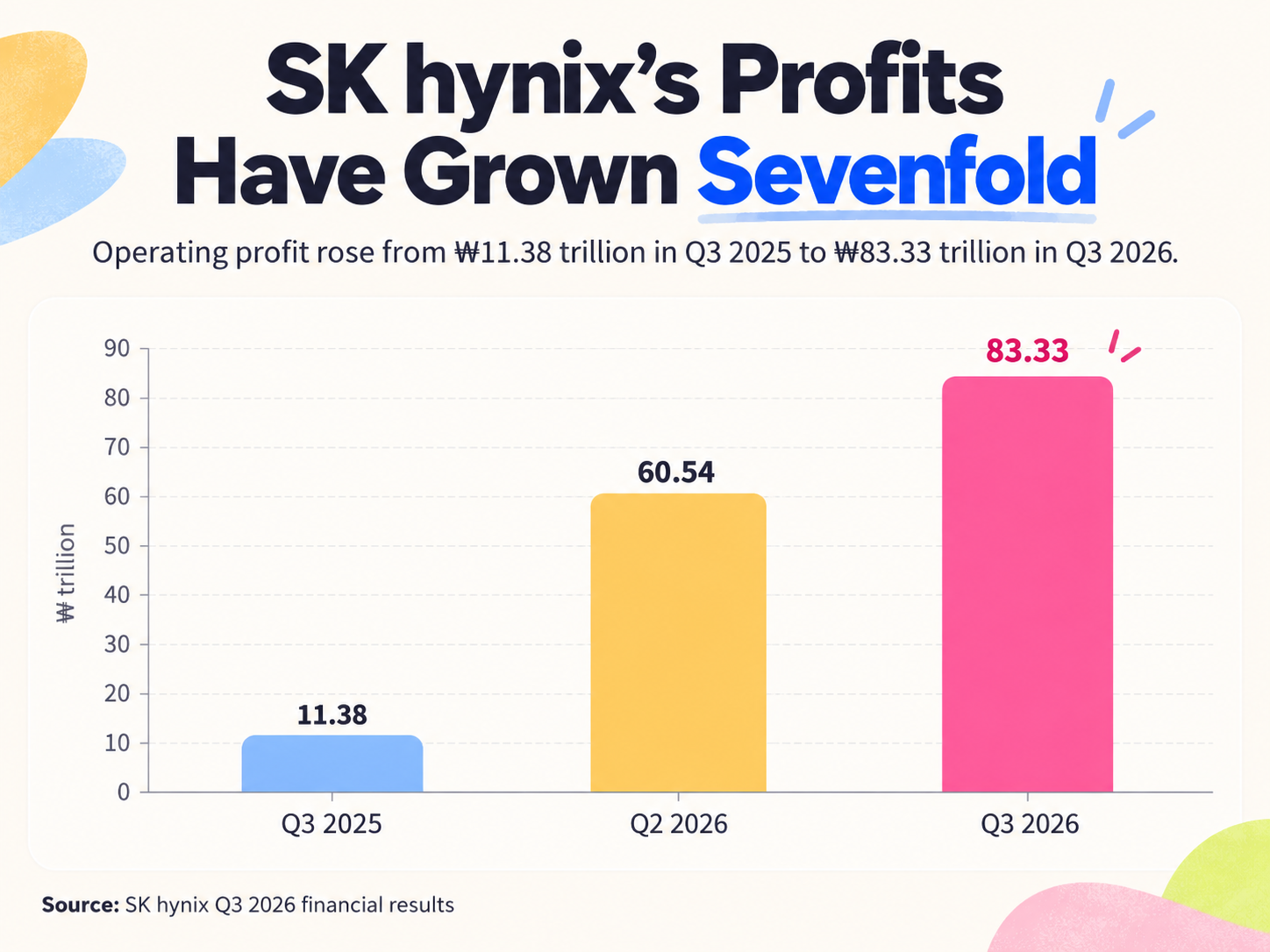
On Wednesday, South Korean chipmaker SK hynix reported an operating profit of ₩83.33 trillion, roughly $62.8 billion, for the July–September quarter. Its revenue reached ₩104.62 trillion, and its operating margin was nearly 80%. For every ₩100 the company earned from selling memory chips, around ₩80 remained as operating profit. A year ago, that margin was 47%.
The figures are hard to square with the company's recent history. In 2023, SK hynix lost ₩7.73 trillion at the operating level as memory-chip prices collapsed. It recovered to earn a record ₩47.21 trillion across all of 2025. Now, a single quarter has delivered considerably more profit than that entire year. Operating profit has grown 632% from the same quarter last year.
SK hynix makes memory chips, the components that allow computers and servers to store and access information. These have traditionally been a difficult business. Manufacturers spend billions on factories, then watch prices rise and fall as supply catches up with demand. A shortage can make them extremely profitable. Too many chips can wipe out those gains surprisingly quickly.
Artificial intelligence has tilted that balance heavily in favour of suppliers. AI processors, including the GPUs used to train and run large models, must move enormous quantities of information back and forth while performing calculations. Even an expensive processor becomes less useful if its memory cannot deliver data fast enough.
That has made high-bandwidth memory, or HBM, one of the most sought-after components in AI data centres. It is built by stacking memory chips vertically and connecting them so data can travel at very high speeds. SK hynix developed early HBM technology with AMD in 2014 and became an important supplier of advanced memory to the AI industry long before its latest earnings boom.
HBM also creates a manufacturing headache. According to semiconductor equipment maker Applied Materials, producing the same quantity of memory bits in HBM can require three to four times as many DRAM wafers as conventional memory. Wafers are the thin silicon discs from which chips are cut. When chipmakers devote more of their limited factory capacity to HBM, they have less room to produce ordinary memory for servers, computers and other devices.
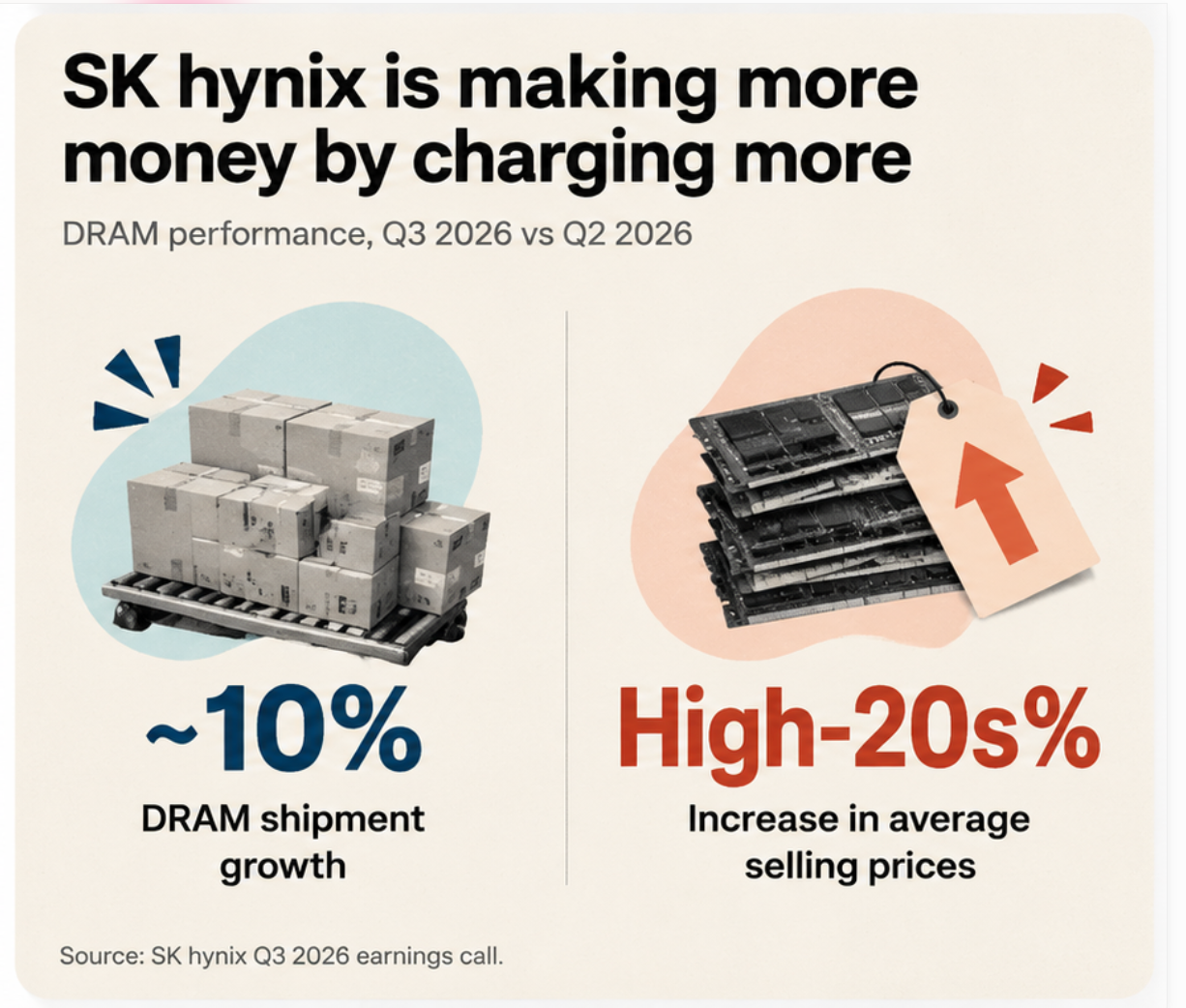
Alongside soaring demand for server memory and data-centre storage, that capacity squeeze has pushed prices across the memory market higher. SK hynix said its DRAM shipments rose by about 10% from the previous quarter, while average selling prices climbed by a high-20s percentage. NAND storage prices rose by a mid-20s percentage even though the company shipped slightly fewer bits. Much of the earnings surge, then, comes from charging more and selling a richer mix of products, rather than simply producing vastly more chips.
In fact, specialised AI memory is not always the most profitable product on a factory floor. TrendForce found that in the first quarter of 2026, a conventional server DDR5 memory module had become more profitable per wafer than HBM. Earlier HBM contracts adjusted more slowly to rising market prices, while the price of regular server memory was climbing quickly. AI's appetite for memory has made even the less celebrated parts of the business lucrative.
The effect is showing up beyond SK hynix. On Thursday, Samsung Electronics reported ₩107.4 trillion in quarterly operating profit, with its semiconductor division contributing ₩106.5 trillion. Its consumer-device division, which includes smartphones, recorded a ₩0.8 trillion operating loss. The divisions have different costs and business models, but their contrasting results show how profitable supplying the AI build-out has become.
Customers are also trying to secure supply before prices rise further. SK hynix says it has signed long-term agreements with 14 major customers, including large cloud companies, covering more than half its planned production capacity for both 2027 and 2028. The contracts, typically lasting five years, allow prices to move within agreed ranges.
A company that once had to worry about unsold chips can now plan part of its production years ahead. It also announced roughly ₩100 trillion in shareholder returns for financial year 2026 through dividends and share buybacks. That includes a ₩40 trillion buyback announced in August, rather than representing an entirely fresh cash payout. Some special dividends will draw on gains from its investment in Japanese chipmaker Kioxia.
After non-operating losses and taxes, SK hynix earned ₩39.78 trillion in net profit.
Outside the data centre, that pricing power has a cost. Counterpoint Research found that average smartphone prices in India rose 16% in the first half of 2026. Prices of handsets below ₹10,000 increased by around 32%, with memory inflation and a weaker rupee among the drivers. The same global supply squeeze enriching memory manufacturers is making affordable electronics more difficult to produce.
SK hynix is betting that the shortage will persist. It expects memory demand to exceed supply through 2030 and has committed around ₩31 trillion to its first Yongin semiconductor plant through 2030, with the first cleanroom scheduled to open in February 2027. Factories need years to build, equip and bring up to reliable production, so adding capacity cannot solve today's shortage immediately.
That investment also brings back an old risk. Rival manufacturers are expanding too, and Samsung is catching up in HBM. Counterpoint estimates SK hynix's share of HBM revenue fell from 64% in the second quarter of 2025 to 50% a year later, while Samsung's rose from 15% to 33%. Research firm Gartner expects DRAM prices to begin easing from late 2027 or early 2028, earlier than SK hynix's shortage forecast would imply.
Those forecasts are not necessarily contradictory. AI demand can keep growing even as new supply pushes prices down. The company's next test will come when all those expensive new factories begin producing chips. SK hynix has lived through what happens when memory is abundant. Its 80% operating margin depends on today's scarcity lasting long enough to justify the capacity being built to end it.