

 Newsletter

Indian tech startups raised $7.2 billion across 652 rounds in H1 2026, according to Tracxn. Of this, $3.8 billion went into late-stage companies. So money has not disappeared. It has simply become harder to find once companies get big.
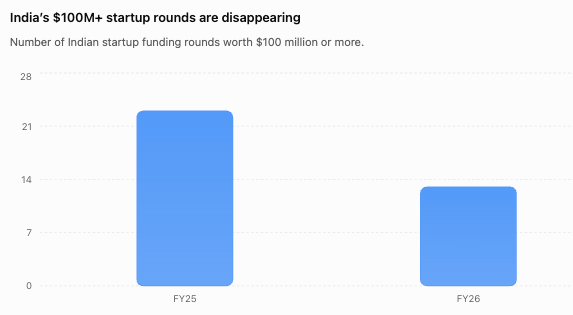
In FY2025–26, Indian tech startups raised $11.7 billion, down 18% from $14.3 billion a year earlier. Late-stage funding fell 38% to $5.6 billion, while the number of $100 million-plus rounds dropped from 23 to 13.
A founder looking for ₹5 crore or ₹10 crore can still knock on quite a few doors. When the company needs ₹500 crore or ₹1,000 crore, the list becomes much shorter. And India has been trying to solve some version of this problem for more than 50 years.
Rewind to 1972: The Bhatt Committee was studying an Indian economy with no unicorns, no Bengaluru startup ecosystem and definitely no funding announcements featuring founders staring thoughtfully out of office windows.
The Bhatt Committee, officially the Committee on Development of Small and Medium Entrepreneurs and led by R.S. Bhatt, was established in 1972 to examine the hurdles faced by new entrepreneurs and technologists trying to launch industrial ventures in India.
It had already identified the basic problem. Traditional lenders were not well designed to finance first-generation entrepreneurs trying to build new technologies and businesses. Banks preferred companies with assets, collateral and predictable cash flows. New businesses often had none of them.
India began experimenting with risk capital soon after. IFCI sponsored the Risk Capital Foundation in 1975, while IDBI introduced a seed-capital scheme in 1976. During the 1980s, institutions such as ICICI began experimenting with venture-style financing, and formal venture-capital guidelines arrived in 1988.
The challenge was similar to the one India faces today: new kinds of companies required new kinds of money.
Then liberalisation brought in the world. Through the 1990s and early 2000s, foreign private equity and venture investors began entering India. Warburg Pincus, Intel, Draper and SoftBank were among the international names exploring the market as India's IT industry expanded and the economy opened up.
India's venture-capital ecosystem grew quickly, but the domestic institutions supplying capital to those funds did not grow at the same speed. Over the following decade, foreign investors became central to financing India's private companies.
That created a model that would shape India's startup boom. Founders could build businesses primarily for Indian consumers while much of the risk capital financing them ultimately came from outside India.
For a long time, that worked very well. Smartphones arrived, mobile internet became cheaper and Indian consumer technology exploded. Flipkart, Ola, Paytm, Zomato and dozens of others were no longer trying to build small profitable businesses. They wanted to win markets with hundreds of millions of consumers.
And that costs money. A lot of it. In July 2014, Flipkart raised $1 billion in a single round. Around the same period, global investors including Tiger Global, SoftBank, Temasek, GIC, DST Global, Qatar Investment Authority, T. Rowe Price and BlackRock became increasingly prominent in large Indian startup financings.
That changed what an Indian founder could attempt. Companies could spend years building logistics networks, subsidising customer acquisition, expanding into dozens of cities and hiring thousands of people before turning profitable because somewhere in the global financial system were investors willing to finance that expansion.
Then came 2021, when things got slightly ridiculous.
Indian startups raised roughly $42 billion that year. There were 108 funding rounds worth at least $100 million, showing just how concentrated the boom had become at the top end. Industry reporting at the time put capital flowing through these mega-rounds at more than $30 billion.
For a brief period, raising $100 million started to feel almost routine.
It wasn't. Interest rates were low, global money was cheap and investors everywhere were hunting for growth. India had also become one of the world's biggest consumer internet opportunities. Venture funds raised enormous pools of money, startup valuations climbed quickly, and founders could assume another investor might arrive with an even bigger cheque a year later.
Then interest rates rose and that assumption stopped working. Indian startup funding fell sharply from its 2021 peak. Companies cut costs, valuations corrected and profitability returned to investor conversations after spending a few years sitting somewhere near the back.
More importantly, the correction exposed the weakness that cheap global money had been covering up.
India had built thousands of startups, angel networks, accelerators, seed funds and venture firms. But once a company became large enough to need another $100 million or $200 million, the number of investors capable of leading the round became much smaller.
That brings us back to 2026.
The weird part: India is not short of money.
India has enormous pools of domestic savings sitting across pension and provident funds, insurers, mutual funds, family offices and other financial institutions. Private equity has expanded too, while India's alternative investment fund industry has grown into a substantial pool of capital.

SEBI data shows commitments to Indian AIFs had reached roughly ₹16.94 lakh crore by March 2026. These funds had raised about ₹7.03 lakh crore and invested ₹6.76 lakh crore.
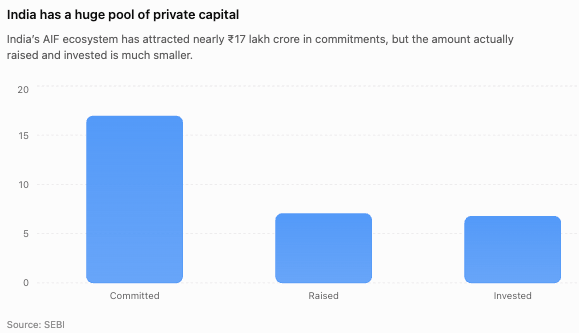
Category II AIFs, which include private equity, private credit and several other strategies, accounted for a large share of those commitments. But before you start dividing ₹16.94 lakh crore by the number of Indian startups, there is an important catch.
That money is not all venture capital. AIFs invest across real estate, infrastructure, private credit, financial services, technology and many other assets. Pension and insurance money also cannot simply be redirected towards startups because someone discovered an exciting SaaS company in Bengaluru.
Retirement money needs safeguards. Startup money requires an appetite for failure. That is India's actual capital problem. The country has built an enormous reservoir of domestic savings, but the pipes carrying those savings into risky, long-duration companies remain relatively narrow.
Pensions are a good example. Under the NPS Active Choice framework, alternative investments can account for up to 5% of an individual's allocation, and that category includes assets beyond venture capital, including REITs and InvITs.
There are good reasons for the restriction. Startups fail. Private investments can remain locked up for years, and their valuations are harder to establish than those of listed stocks. Pension funds ultimately have to return money to retirees, not explain why their portfolio company has fantastic engagement numbers but no revenue.
So the institutions holding some of India's largest pools of patient capital are also the institutions that have to be most cautious about deploying it.
And this debate is hardly new. A SEBI committee report published in 2000 examined how India could develop larger domestic pools of venture capital, including the role institutional investors could play.
Nearly two decades later, a parliamentary committee was again examining how participation by large domestic institutions in India's startup and alternative-investment ecosystem could be expanded. The difference today is that India's capital ecosystem is much bigger.
Family offices and wealthy Indians are increasingly participating in private-market funds as limited partners, or LPs, the investors who actually supply money to venture and private equity funds.
Fundraising among VC firms is also recovering. Bain and IVCA estimate Indian VC and growth funds raised about $5.4 billion in 2025, roughly twice the previous year's level. Peak XV then closed $1.3 billion across three funds in 2026.
But a big fund does not automatically mean big cheques.
Consider a hypothetical $500 million venture fund. If one of its companies wants $150 million, putting almost a third of the entire fund into that startup would create enormous concentration risk. The investor still has other companies to finance, money to reserve for follow-on rounds and LPs expecting diversification.

Once startups reach that stage, they need another layer of investors: growth equity funds, private equity firms, sovereign wealth funds, insurers, pension funds, strategic investors and eventually public-market investors. That part of India's financing ecosystem remains much shallower than its startup pipeline.
There is another constraint: exits.
An LP gives money to a venture fund, which invests in startups. When those companies are acquired or go public, the fund can return cash to its LPs. That money can then be recycled into larger funds and new investments.
India has historically taken longer to return capital from venture investments than mature markets. But the exit environment is improving.
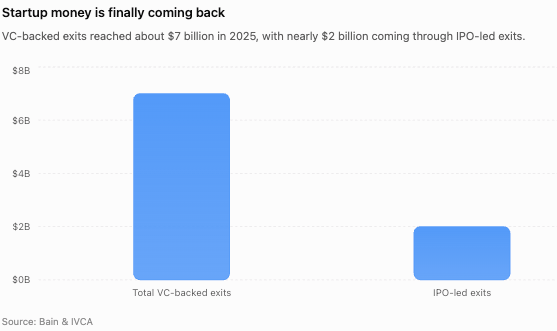
VC-backed exits reached roughly $7 billion in 2025. IPO-led exits generated nearly $2 billion, accounting for around 28% of total VC exit value. More exits mean more capital can flow back into the next generation of Indian startups.
The government is trying to widen the pool. In 2026, it approved another ₹10,000 crore for Startup India Fund of Funds 2.0. Under the official scheme, SIDBI routes the money through SEBI-registered AIFs, which then raise additional private capital and invest in startups.
By the end of FY2025–26, more than ₹7,000 crore had been disbursed to over 135 AIFs under the original Fund of Funds. Those funds had invested more than ₹26,900 crore across over 1,420 startups.
This time, the focus includes deeptech and technology-led manufacturing, where capital needs can be much higher. Semiconductors, space, defence, biotech, climate tech and advanced manufacturing can require years of R&D before meaningful revenue arrives.
India also introduced a separate recognition framework for deeptech startups in 2026, extending the eligibility age from the usual 10 years to 20 years to account for longer development cycles.
India wants to move from apps to atoms. That will need much deeper pools of patient capital.
Foreign capital also comes with geopolitical risk. In 2020, India moved investments from countries sharing a land border into the government approval route, affecting the flow of Chinese capital that had become prominent in India's startup ecosystem.
Then rising global interest rates made several large foreign investors more selective. Global capital can move quickly when regulations, interest rates or investment priorities change. For Indian startups that still depend heavily on overseas investors for large rounds, that makes a deeper domestic capital market increasingly important.
Zoom out: As of March 2026, India had recognised more than 2.23 lakh startups under DPIIT. Together, they had created more than 23.36 lakh direct jobs.
India has spent years building incubators, accelerators, startup policies, digital infrastructure and a culture where starting a company no longer automatically sounds like an elaborate way to worry your parents.
Now those companies are growing up.
A startup that needed ₹5 crore in its early years may eventually need ₹500 crore to build factories, acquire competitors, expand internationally or fund years of R&D. The ecosystem required to supply that second cheque looks very different from the one required to supply the first.
India's first startup decade was largely about creating founders and companies. The next challenge is building the domestic institutions capable of financing them as they grow.
Sources
- Tracxn, India Tech H1 2026 Report
- Bain & Company and IVCA, India Venture Capital Report 2026
- SEBI: Alternative Investment Funds Statistics;
- PRS Legislative Research, Financing the Startup Ecosystem; PFRDA, NPS Investment Guidelines
- Startup India Fund of Funds 2.0 Scheme
- PIB, Startup Recognition and Fund of Funds Data; PIB, Deeptech Startup Recognition Framework
- Inc42, Indian Startup Funding in 2021
- The Economic Times: FY26 Startup Funding Data; VC Exit Data


